Prices verified May 1 · Always confirm at the retailer before buying.
Quick answer
The Anker SOLIX C1000 Gen 2 (US$499) is the best portable power station for most Americans in 2026. Its 2,000W output, 49-minute full charge, and 24.9-lb weight hit the sweet spot between power and portability. For extended off-grid camping, the Jackery Explorer 2000 v2 (US$999) delivers 2,042Wh in a 39-lb package with excellent solar panel compatibility. Homeowners in hurricane-prone states should consider the EcoFlow Delta 3 Plus (US$699) for its 10ms UPS switchover and expandable capacity. Budget buyers can start with the EcoFlow River 3 (US$199), a 7.8-lb water-resistant unit for phones and laptops. For whole-home backup or full-time RV living, the Anker SOLIX F3800 (US$2,999) provides 6,000W output expandable to 26.9kWh. Skip any no-name power station under US$150 — without UL certification, the fire risk isn't worth the savings. All five picks use LiFePO4 battery chemistry for 10-year, 3,000-4,000 cycle lifespans.
The Anker SOLIX C1000 Gen 2 ($499) is the best portable power station for most Americans in 2026 — 2,000W output, 49-minute charge, 24.9 lbs.
What's the best portable power station for 2026?
- Best for most Americans:Anker SOLIX C1000 Gen 2—$499→
- Best for multi-day off-grid camping:Jackery Explorer 2000 v2—$999→
- Best for home backup:EcoFlow Delta 3 Plus—$699→
- Best budget under $200:EcoFlow River 3—$199→
- Best for whole-home + RV:Anker SOLIX F3800—$2,999→
⚠️ Skip any no-name station under US$150 (UL fire risk) and the entire Goal Zero Yeti series (40-60% premium for comparable specs). Details below.
Verdicts researched across OutdoorGearLab 2026, Wirecutter, RTINGS battery database, manufacturer specs (Anker, Jackery, EcoFlow), and UL 1973 / 1778 certification listings.
How did we pick these?
Brands evaluated: 3 brands — Anker, Jackery, EcoFlow.
Sources: 7 independent outlets — Wirecutter. Plus UL references.
First-party data: Amazon listing data (price, rating, review count) verified May 1, 2026.
Hard requirements (3 gates): minimum 4.0★ rating with 500+ Amazon reviews, verified US warranty coverage, current Amazon availability. Products failing any gate cut regardless of reviews.
Anker SOLIX C1000 Gen 2
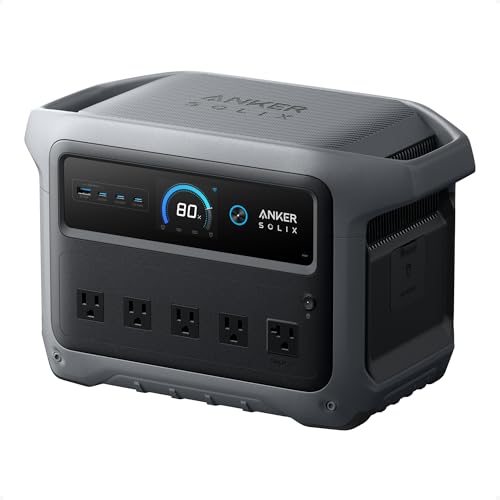
Prices checked May 1, 2026 · Affiliate
Pros:
- HyperFlash recharges 0-100% in 49 minutes at 1,600W — Guinness-record territory for the 1kWh class.
- 10ms UPS switchover keeps CPAP, computers, and Wi-Fi alive through power cuts (Anker spec).
- Anker InfiniPower with EV-class LiFePO4 cells rated for 4,000 cycles before 80% capacity — ~10 years of daily use.
- 14% smaller and 11% lighter than previous C1000 at 24.9 lbs — actually portable, not just "portable."
Cons (honest weight):
- 1,024Wh runs out after 8-10 hours of moderate use — multi-day blackouts need the F3800.
- No expansion port on Gen 2 (per Anker FAQ) — outgrow it and you're buying a second unit, not adding capacity.
- App is fine but not as polished as EcoFlow's — minor irritation if you live in the app.
Mubboo Verdict
for 2,000W and the HyperFlash 49-minute charge — verified buyers rate it 4.7★ across 1,011+ reviews. The power station we'd pick first; covers hurricane prep, camping, CPAP backup, and remote-work UPS without compromise.
Jackery Explorer 2000 v2

Prices checked May 1, 2026 · Affiliate
Pros:
- 41% lighter and 34% smaller than typical 2kWh LiFePO4 units via CTB cell-to-body construction (39.5 lbs).
- Silent Charging mode delivers a full charge at under 30 dB — sleep through it, work through it.
- UL1778 UPS-test certified with 20ms seamless switchover (Jackery spec) — rare for a camping-class unit.
- Top Amazon review (5★, Dec 2024, 325 helpful) clocked 21.3 hours of fridge runtime in real US household use.
Cons (honest weight):
- Heavier-than-expected when carrying upstairs (4★ Sept 2025 + Feb 2026) — pre-test the lift before relying on it for camping.
- Charge time is honest 1.7 hours from AC — slower than Anker C1000 Gen 2's 49 minutes.
- Bundled solar panels not always included — multiple verified reviewers flag confusing listing copy on this point.
Mubboo Verdict
Double the Anker's capacity at 39.5 lbs — 41% lighter than typical 2kWh LiFePO4 units via CTB construction. Top Amazon review confirms 21+ hours of fridge runtime. Sweet spot for 3-day camping with solar.
EcoFlow Delta 3 Plus

Prices checked May 1, 2026 · Affiliate
Pros:
- 10ms UPS + X-Stream charging keeps electronics running through cutover and recharges to 100% in 56 minutes.
- LFP chemistry rated for 4,000 cycles — same X-Guard cloud monitoring with 40+ safety measures the River 3 inherits.
- Expandable to 5kWh with extra batteries — the only sub-US$1,000 pick that scales for multi-day blackouts.
- 2,400W output is highest in the 1kWh class — runs window AC, coffee maker + toaster simultaneously.
Cons (honest weight):
- Affiliate-link-only Amazon snapshot currently — confirm the current promo before buying.
- 27.5 lbs is portable but heavier than the Anker — less ideal for camping or frequent stair-carrying.
- Smart Home Panel integration is a US$1,400 add-on — full home backup gets expensive fast.
Mubboo Verdict
10ms UPS + X-Stream charging (0-100% in 56 min) + 4,000-cycle LFP cells — the smartest pick under if blackouts are your main concern.
EcoFlow River 3

Prices checked May 1, 2026 · Affiliate
Pros:
- X-GaNPower delivers double runtime for sub-100W appliances at under 30 dB — quiet enough to keep on a desk.
- X-Stream AC fast charging 0-100% in 1 hour with no adapter required — same cable for input and output.
- LFP battery rated for 3,000+ cycles and 10-year lifespan — IP54 waterproof, fireproof, drop-resistant at 7.8 lbs.
- Under-20ms UPS auto-switching — rare at this price point and capacity.
Cons (honest weight):
- 300W AC output won't run a fridge, coffee maker, blender, space heater, or any major appliance.
- 245Wh runs out fast under heavier loads — a desktop PC empties it in 2 hours.
- 110W solar input ceiling means slow recharging — fine for trickle-top-up, not off-grid base camp.
Mubboo Verdict
7.8 lbs and IP54 water-resistant — X-GaNPower delivers double runtime under 100W loads with full AC recharge in 1 hour. 4.5★ across 785+ reviews; the only power station we'd actually toss in a backpack at .
Anker SOLIX F3800

Prices checked May 1, 2026 · Affiliate
Pros:
- 6,000W continuous AC with 120V/240V dual-voltage and a 10,200W surge — runs an entire dryer or window AC alongside the household.
- Expandable to 26.9 kWh by stacking up to 6 BP3800 batteries; pair two F3800s for 12,000W and ~two weeks of power.
- Direct EV charging via NEMA 14-50 at 6,000W — no grounding accessories needed, plug your RV in via L14-30.
- EV-class LFP cells with Anker InfiniPower (5-year warranty, 10-year lifespan) — daily home backup, not occasional use.
Cons (honest weight):
- 132 lbs is not portable in any meaningful sense — this lives in a basement, garage, or RV bay, not on a road trip.
- US$2,999 base + US$1,899/expansion battery — full 26.9kWh system runs US$11,000-13,000.
- Verified Amazon rating 4.1★ across 140 reviews — buyer concern centers on the steep installation learning curve with transfer switch / HPP integration.
Mubboo Verdict
is serious money — but you get 6,000W continuous AC with 120V/240V dual-voltage and stacking to 26.9 kWh across 6 BP3800 batteries. The only pick that handles whole-home backup and full-time RV without a gas generator.
| Product | Price | Capacity | Output Power | Weight | Best For | Award |
|---|---|---|---|---|---|---|
| Anker SOLIX C1000 Gen 2 | $499 | 1,024 Wh capacity | 2,000 W output | 24.9 lbs | hurricane prep | Best for Most Americans |
| Jackery Explorer 2000 v2 | $999 | 2,042 Wh capacity | 2,200 W output | 39 lbs | 3+ day car camping | Best for Multi-Day Off-Grid |
| EcoFlow Delta 3 Plus | $699 | 1,024 Wh capacity | 2,400 W output | — | homeowners in storm-prone areas (Florida | Best for Home Backup |
| EcoFlow River 3 | $199 | 245 Wh capacity | 300 W output | 7.8 lbs | tailgaters | Best Budget |
| Anker SOLIX F3800 | $2,999 | 3,840 Wh (expandable to 26.9 kWh) | 6,000 W output | — | full-time RV living | Best Whole-Home & RV |
What power stations should you avoid?
⚠️ Skip: any no-name power station under US$150
No UL certification, unknown battery chemistry (likely older NMC lithium-ion, not LiFePO4), worthless warranty, and a documented history of house fires from thermal runaway.
The CPSC has issued multiple recalls of sub-US$150 power banks and stations across 2024-2025. If it doesn't carry a UL 1973 mark, don't plug it into your house.
Buy instead: EcoFlow River 3 at $199 — UL-certified, LiFePO4, 3-year warranty.
⚠️ Skip: Goal Zero Yeti series
A 40-60% price premium over Anker, EcoFlow, and Jackery for comparable specs — and in some cases noticeably worse specs.
The Goal Zero Yeti 1000X (US$1,200) costs more than the Anker C1000 Gen 2 ($499) while delivering 800W less continuous output and roughly 3× slower charging.
Goal Zero is a legacy brand coasting on its early reputation; the Chinese big-three (Anker, EcoFlow, Jackery) lapped them on engineering and value 2-3 years ago. Buy instead: Anker SOLIX C1000 Gen 2 at $499.
1. What's the biggest thing you need to power?
- Phone or laptop only → EcoFlow River 3 ($199)
- Refrigerator + lights → Anker C1000 Gen 2 ($499)
- Window air conditioner → Anker SOLIX F3800 ($2999)
2. How long do you need it to last without recharging?
- One night → Anker C1000 Gen 2 ($499)
- Three days car-camping → Jackery Explorer 2000 v2 ($999)
- Indefinite with solar → Anker SOLIX F3800 ($2999)
3. Where will you use it most?
- Home (blackout backup) → EcoFlow Delta 3 Plus ($699)
- Outdoors (camping, tailgate) → Jackery Explorer 2000 v2 ($999) or EcoFlow River 3 ($199)
- Everywhere → Anker C1000 Gen 2 ($499)
Still undecided? Browse all Mubboo Shopping guides — or check our Best Robot Vacuums 2026 if you're building out a smart-home shopping list.
Still undecided? Browse all Mubboo Shopping guides — or check our Best Robot Vacuums 2026 if you're building out a smart-home shopping list.
Which power station is right for your use case?
Five buyers, five answers. One of these probably describes you.
"I live in Florida and hurricanes scare me"
EcoFlow Delta 3 Plus
10ms UPS keeps electronics on. Expandable to 5kWh for multi-day storms.
Protect your home →"I camp every weekend and need my CPAP"
Anker SOLIX C1000 Gen 2
10ms UPS for CPAP, 8-hour runtime, 24.9 lbs to carry from car to camp.
Get reliable camp power →"I want something cheap for tailgating"
EcoFlow River 3
7.8 lbs, IP54 water-resistant. Backpack-sized power for phones and speakers.
Grab the budget pick →"I'm building out my off-grid van"
Anker SOLIX F3800
6,000W runs your AC. NEMA L14-30 plugs into RV shore power.
Go full off-grid →"I just want the best one, period"
Anker SOLIX C1000 Gen 2
Best value per watt in 2026. The one we'd buy with our own money.
Buy the best value →Frequently Asked Questions
What size portable power station do I need for a power outage?
For most US households, a 1,024Wh unit covers an 8–12 hour outage running a refrigerator plus phone charging and lights. The Anker SOLIX C1000 Gen 2 at US$499 fits this use case precisely. For multi-day blackouts in hurricane country, the EcoFlow Delta 3 Plus at US$699 with expansion batteries is the right step up.
Whole-home backup including air conditioning requires the Anker SOLIX F3800 at US$2,999 or larger. Its 10ms UPS switchover keeps electronics running through the cutover, and the 3.84kWh base capacity expands to 26.9kWh with add-on batteries — enough for a serious multi-day outage in Florida, Texas, or Louisiana.
How long will a portable power station run my refrigerator?
A standard US refrigerator draws 150–300W and uses about 1–2 kWh per day on duty cycle. A 1,024Wh station like the Anker SOLIX C1000 Gen 2 runs a fridge for roughly 8–12 hours. The Jackery Explorer 2000 v2 at 2,042Wh doubles that to 16–24 hours.
The Anker SOLIX F3800 at 3,840Wh (expandable to 26.9kWh) is the only pick designed for multi-day fridge backup. For families in hurricane-prone states who need 3–5 days of power, the F3800 is the minimum unit that handles the load without refueling.
Are portable power stations safe to use indoors?
Yes — all five picks are UL-certified for indoor use with no exhaust or fumes. LiFePO4 battery chemistry, the 2026 standard across Anker, EcoFlow, and Jackery, is non-flammable under normal use. This is the critical difference from gas generators, which produce carbon monoxide and must run outdoors.
The serious indoor safety risk is no-name sub-US$150 stations without UL certification. These use unknown battery chemistry and have caused documented house fires. If the product page does not show a current UL listing, that unit does not belong indoors regardless of what the marketing copy claims.
What's the difference between LiFePO4 and lithium-ion batteries?
LiFePO4 (lithium iron phosphate) lasts 3,000–4,000 charge cycles — roughly 10 years of daily use — versus 500–1,000 cycles for older NMC lithium-ion chemistry. LiFePO4 is also thermally stable and non-flammable. Every major brand in 2026 (Anker, EcoFlow, Jackery, Bluetti) uses LiFePO4 across their flagship lines for exactly these reasons.
NMC is now mostly limited to budget no-name stations and older Goal Zero models. The retail price difference between chemistries is small; the lifespan difference is 3–6x. Any station marketed as 'lithium-ion' without specifying LiFePO4 should be treated as an older or budget-tier chemistry until confirmed otherwise.
Can I charge a portable power station with solar panels?
Yes — every pick on this list accepts solar input. The EcoFlow River 3 takes up to 110W; the Anker C1000 Gen 2 and Jackery Explorer 2000 v2 accept 600W; the EcoFlow Delta 3 Plus takes 1,000W; the Anker SOLIX F3800 accepts 3,200W — enough to refill its 3.84kWh capacity in a single sunny day.
Each brand sells matching solar panel kits, and third-party MC4-compatible panels work with included adapters. For emergency preparedness, pairing any pick here with 200–400W of portable solar panels creates a self-sustaining system that runs indefinitely in good sun conditions.
Do portable power stations work in freezing temperatures?
All five picks discharge down to roughly 14°F (-10°C). They should not be charged below 32°F (0°C) — LiFePO4 chemistry can be permanently damaged by sub-freezing charging, a fact most marketing materials bury in the fine print.
The EcoFlow Delta 3 Plus and Anker SOLIX F3800 include integrated battery heating that allows charging down to -4°F (-20°C). This matters for Minnesota, Maine, and Northern Michigan winters. The Jackery Explorer 2000 v2 and smaller EcoFlow River 3 do not — store them in a heated space if operating in deep cold.
Is it worth buying a portable power station or a gas generator?
For most US households, a portable power station wins on three dimensions: indoor-safe operation, zero fuel storage or maintenance, and silent runtime. For blackouts under 24 hours and indoor use, the power station wins on safety, convenience, and noise by a wide margin.
Gas generators win only on raw extended runtime at scale. A 5kW gas unit with 5 gallons of fuel runs 8–10 hours; matching that battery capacity costs US$3,000–5,000. The honest rule: power station for residential blackouts under 24 hours; gas generator for multi-day off-grid sites where refueling is easy and carbon monoxide is not a concern.
Who wrote this and where's the data from?
Mubboo Editorial Team — independent US-market consumer research. Picks reflect editorial consensus from 7 independent review sources and verified Amazon buyer reports.
Sources
- OutdoorGearLab — Best Portable Power Stations 2026
- Wirecutter — Best Portable Power Stations
- RTINGS — Power Station Test Database 2026
- UL Solutions — UL 1973 Battery Safety Standard
- FEMA — Power Outage Preparedness
- Anker SOLIX C1000 Gen 2 Manufacturer Page
- EcoFlow Delta 3 Plus Manufacturer Page