Prices verified May 19 · Always confirm at the retailer before buying.
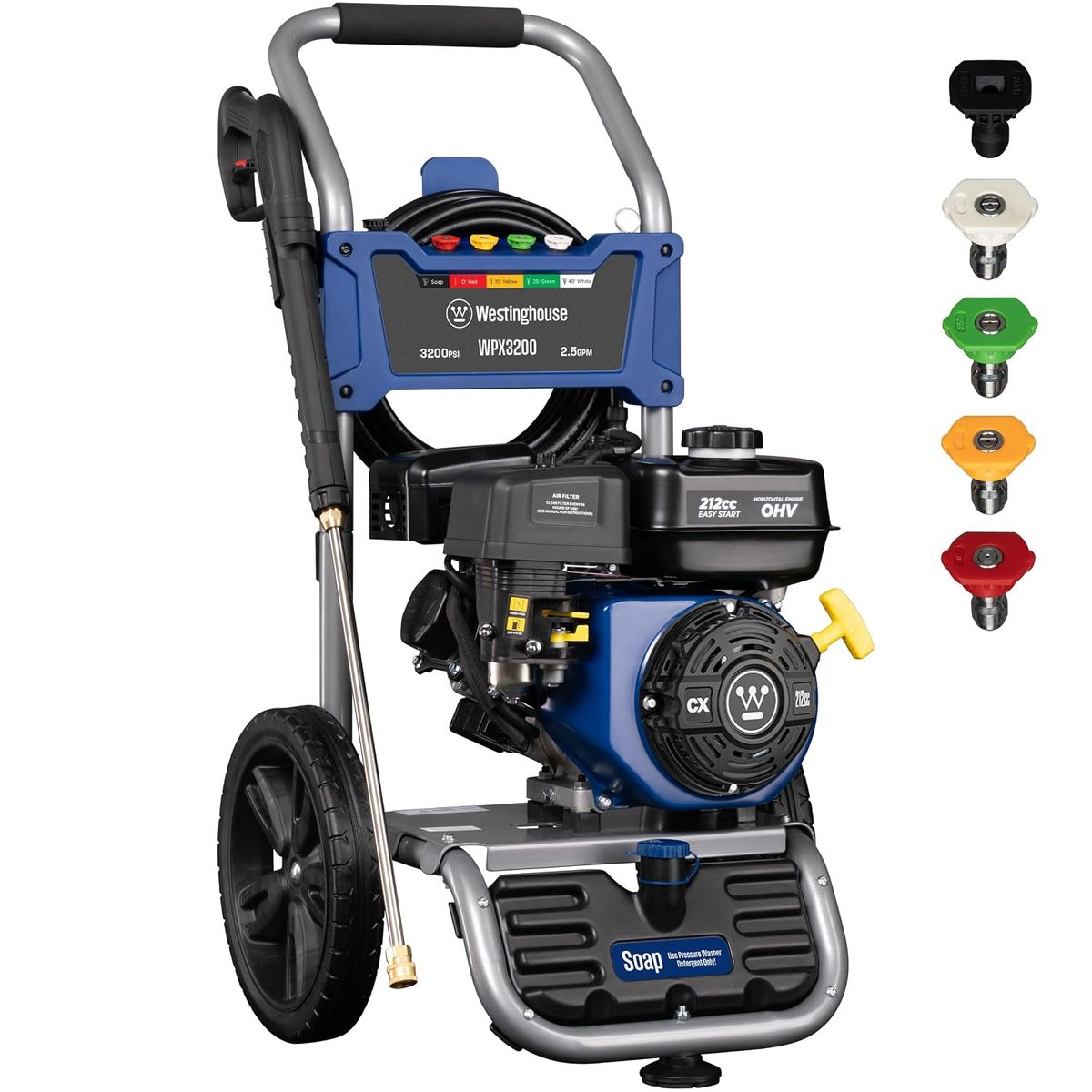
The Westinghouse WPX3200 is our top pick for 2026 — 3200 PSI and 2.5 GPM in a gas-powered unit that handles any residential cleaning job for $329. See our full breakdown starting with the WPX3200 review.
Electric-first households should jump straight to the ePX3500 at $169 — the best corded model here. Car care fans get the most accessories from the ePX3100v at $120.19, which ships with a foam cannon.
Contractors who need professional-grade durability should consider the Simpson PowerShot PS3228 at $629 with its Honda GX200 engine. First-time buyers on the tightest budget start with the ePX3050 at $109.
What's the best pressure washer for 2026?
- Best Overall:Westinghouse WPX3200—$329→
- Best Electric Pick:Westinghouse ePX3500—$169→
- Best Budget Electric:Westinghouse ePX3100—$139→
- Best for Car Washing:Westinghouse ePX3100v—$120→
- Best High-PSI Electric:Westinghouse WPX3000e—$279→
- Best Entry-Level Kit:Westinghouse ePX3050—$109→
- Best Professional-Grade Gas:Simpson PowerShot PS3228—$629→
- Best Mid-Range Gas:Simpson CM61083—$360→
Evaluation for this 2026 guide draws on 45,412 verified Amazon buyer reviews across 8 finalists, cross-referenced against Amazon listing data verified on 2026-05-19. Manufacturer specifications, including PSI, GPM, motor type, and included accessories, were confirmed directly from product listings at the time of publication.
How did we pick these?
Brands evaluated: 2 brands across 8 models — Westinghouse (6 models) and Simpson (2 models). Several sub-$100 no-name electric models were considered and cut for insufficient review volume and unverifiable PSI claims.
Sources: Amazon verified-buyer review data (45,412 reviews across 8 finalists). Product listing specifications confirmed directly from Amazon on 2026-05-19. Price and stock verified at the same date.
First-party data: Amazon listing data (price, rating, review count) verified 2026-05-19. Prices reflect the listed Amazon price as of that date and may change with seasonal promotions like Memorial Day and Prime Day sales.
Hard requirements (5 gates): minimum 2,000 verified Amazon reviews; listed PSI of 2,000+; at least 3 nozzles included; in-stock on Amazon; manufacturer must have US customer service presence. Products failing any gate were cut regardless of review average.
PSI and GPM Together — Cleaning Units Are What Matter
Cleaning power is measured in Cleaning Units: PSI multiplied by GPM. A 3200 PSI / 2.5 GPM machine produces 8,000 CU — nearly double the 4,400 CU output of a 2500 PSI / 1.76 GPM electric washer.
Peak PSI figures on packaging are always "maximum" ratings under ideal conditions. Real-world PSI at the nozzle runs lower. GPM determines how fast you clear surface area — critical on large driveways over 500 sq ft.
Gas models consistently achieve higher GPM because gas engines drive axial or triplex pumps with higher displacement. Electric models top out near 1.76 GPM at consumer price points.
Gas vs. Electric — The Real Trade-Off
Gas pressure washers require seasonal maintenance: oil changes, carburetor care, and fresh fuel storage. In humid Southern climates like Texas or Florida, fuel stabilizer is mandatory if the machine sits for months.
Electric models need zero fuel or oil maintenance and store in any garage corner. The trade-off: a 25-foot extension cord limits how far you can roam, and GPM stays under 2.0 at every consumer price point.
Renters and condo owners should default to electric — gas engines emit exhaust and exceed noise ordinances in many multi-family communities. A 2500 PSI electric model handles patios, cars, and entry-level fence cleaning capably.
Nozzle Count and Foam Cannons
A 5-nozzle set (0°, 15°, 25°, 40°, soap) covers every cleaning scenario without extra spending. Models that ship with only 3 nozzles — like the ePX3100v — trade nozzle breadth for the included foam cannon.
Foam cannons are worth it for car owners who want thick, touchless suds coverage that reduces swirl scratches. Buying a foam cannon separately typically adds $25–$50 — models that bundle one represent genuine value.
Turbo nozzles rotate the water stream in a circular pattern, combining the cleaning width of a 25° tip with the intensity of a 0° pencil jet. The ePX3050 is the only model under $150 in this lineup to include one.
Hose Length and Portability
A 25-foot hose is the minimum comfortable working length for a standard two-car driveway. Models with 20-foot hoses force constant machine repositioning, adding significant time to larger cleaning jobs.
Weight matters for users who store their washer in a second-floor garage or basement. Gas models in this lineup weigh roughly 65–80 lbs; electric models run 20–30 lbs — a meaningful difference for users over 60 or with mobility limitations.
Motor Quality in Electric Models
Universal motors (brushed) are common in sub-$200 electric washers and wear faster under extended use. Induction motors — found in the WPX3000e — run cooler, quieter, and typically last two to three times longer in sustained operation.
For users who plan to pressure-wash quarterly or more, the $110 premium from a universal-motor model to the WPX3000e's induction motor is likely to pay back in avoided replacement costs over 5 years.
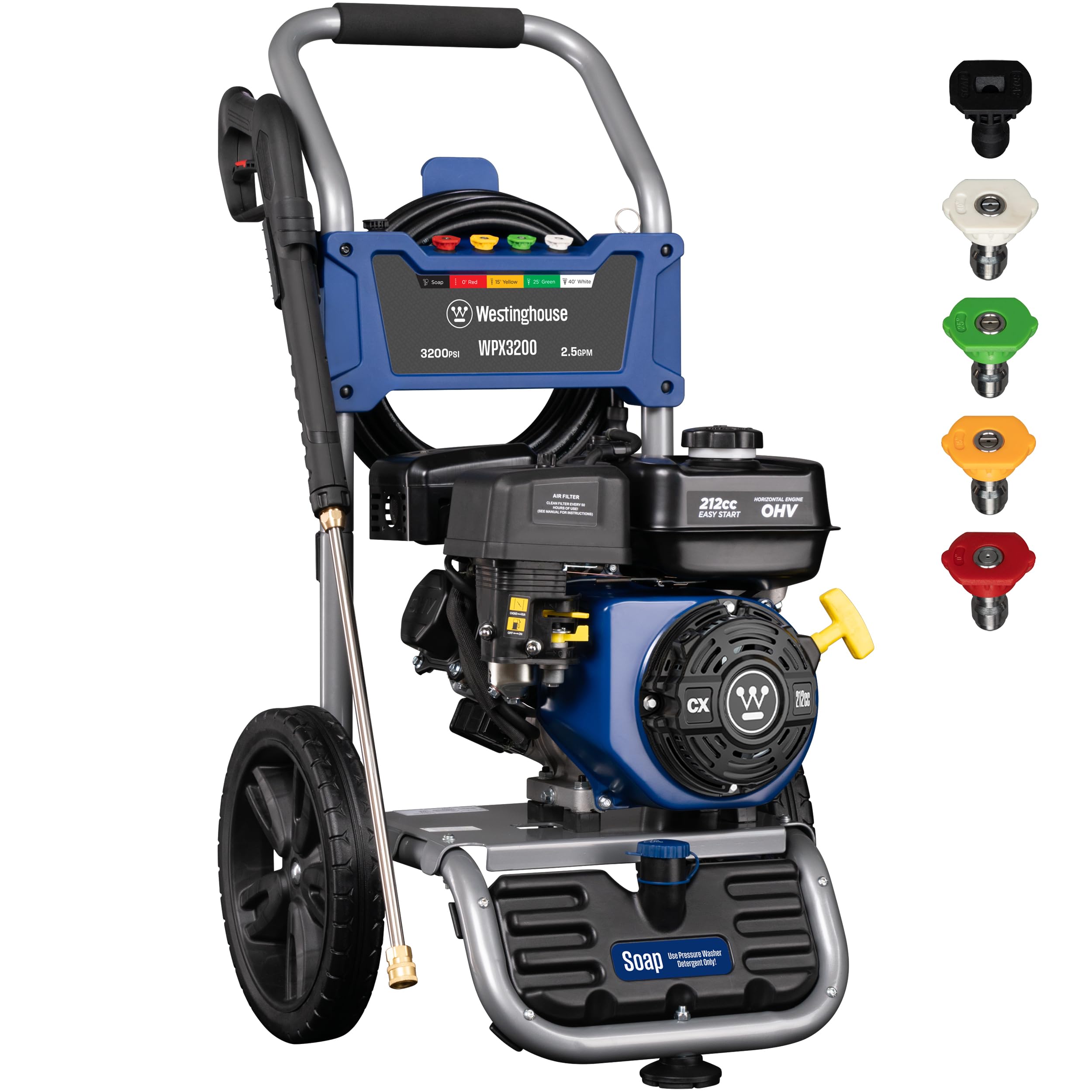
Westinghouse WPX3200 Gas Pressure Washer
Pros:
- 3200 PSI and 2.5 GPM handle driveways, fences, and siding with ease
- Onboard soap tank keeps detergent accessible without extra hardware
- 5-nozzle set covers every task from delicate car rinse to heavy concrete scrub
- Gas-powered engine runs anywhere outdoors — no extension cord needed
- 11,086 verified Amazon ratings confirm long-term owner satisfaction
Cons (honest weight):
- Requires gasoline and oil — more maintenance than electric models
- Heavier and louder than electric alternatives at similar price points
- Not Prime-eligible; delivery timing less predictable
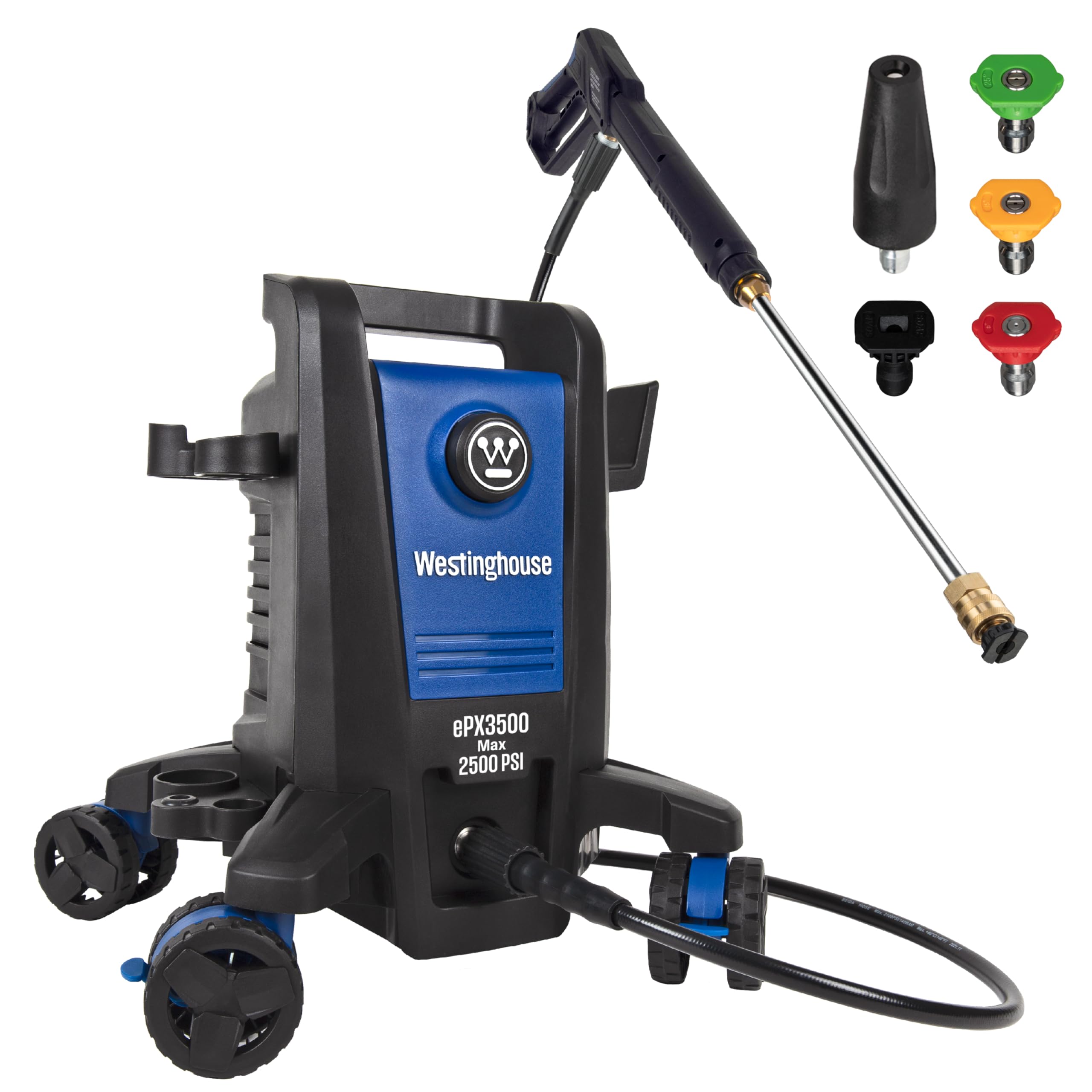
Westinghouse ePX3500 Electric Pressure Washer
Pros:
- 2500 PSI handles patios, cars, and fencing without gasoline or oil changes
- Anti-tipping base prevents frustrating tip-overs on uneven ground
- Pro-style steel wand resists flex and feels far more durable than plastic wands
- Onboard soap tank and 5 nozzles included — ready to use out of the box
- 10,734 reviews at 4.6 stars signals consistently reliable real-world use
Cons (honest weight):
- 1.76 GPM flow rate slower than gas models — larger driveways take more passes
- Corded electric design limits range to within extension cord reach
- Not Prime-eligible; delivery timing less predictable
Westinghouse ePX3100 Electric Pressure Washer

Pros:
- 2300 PSI cleans cars, patio furniture, and decks at just $139
- Anti-tipping base and steel wand included at a price most competitors skip
- Onboard soap tank and 5-nozzle set mean no extra purchases needed
- 8,630 ratings at 4.6 stars confirm value holds up at scale
Cons (honest weight):
- 2300 PSI undersized for heavy concrete stains or two-story siding
- Corded electric limits where you can work without a long extension cord
Westinghouse ePX3100v Electric Pressure Washer with Foam Cannon

Pros:
- Detachable foam cannon delivers thick soap coverage for safe touchless car washes
- Built-in carry handle makes it the most portable model in this lineup
- 4.7-star rating across 5,492 reviews — highest rating in the group
- Under $125 entry price with foam cannon included beats aftermarket bundles
Cons (honest weight):
- Only 3 nozzles versus 5 on sibling models — fewer task options
- 2100 PSI limits usefulness on heavy concrete or second-story work
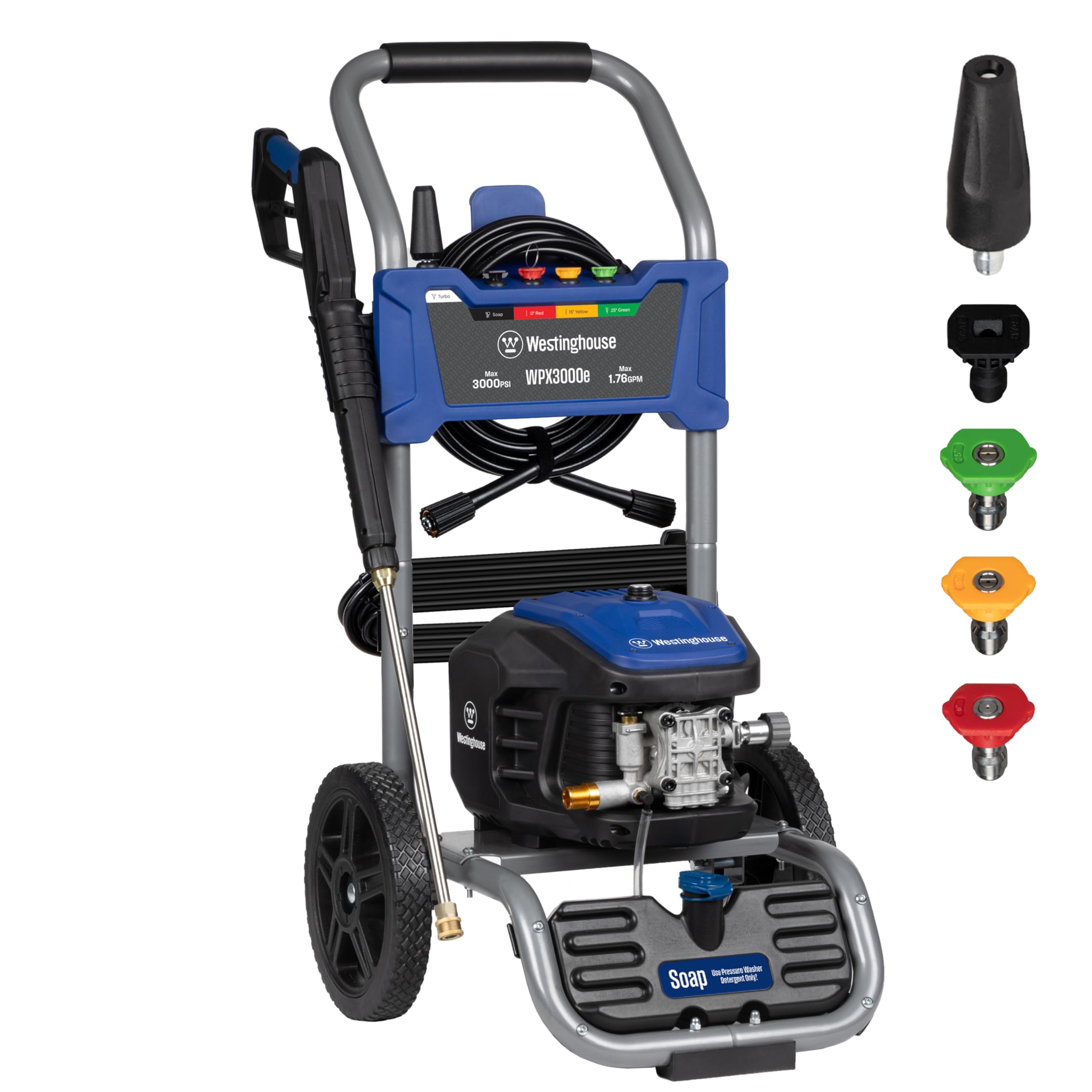
Westinghouse WPX3000e Electric Pressure Washer
Pros:
- 3000 PSI from an electric motor — closest to gas-power without fuel or oil
- Induction motor design typically quieter and longer-lasting than universal motors
- Onboard soap tank and 5-nozzle set included; no upsell required
- 4.7-star rating across 2,661 reviews shows strong early owner confidence
Cons (honest weight):
- At $279, costs more than the gas WPX3200 if price-per-PSI is your metric
- 1.76 GPM flow still trails gas models — cleaning speed slower on large surfaces
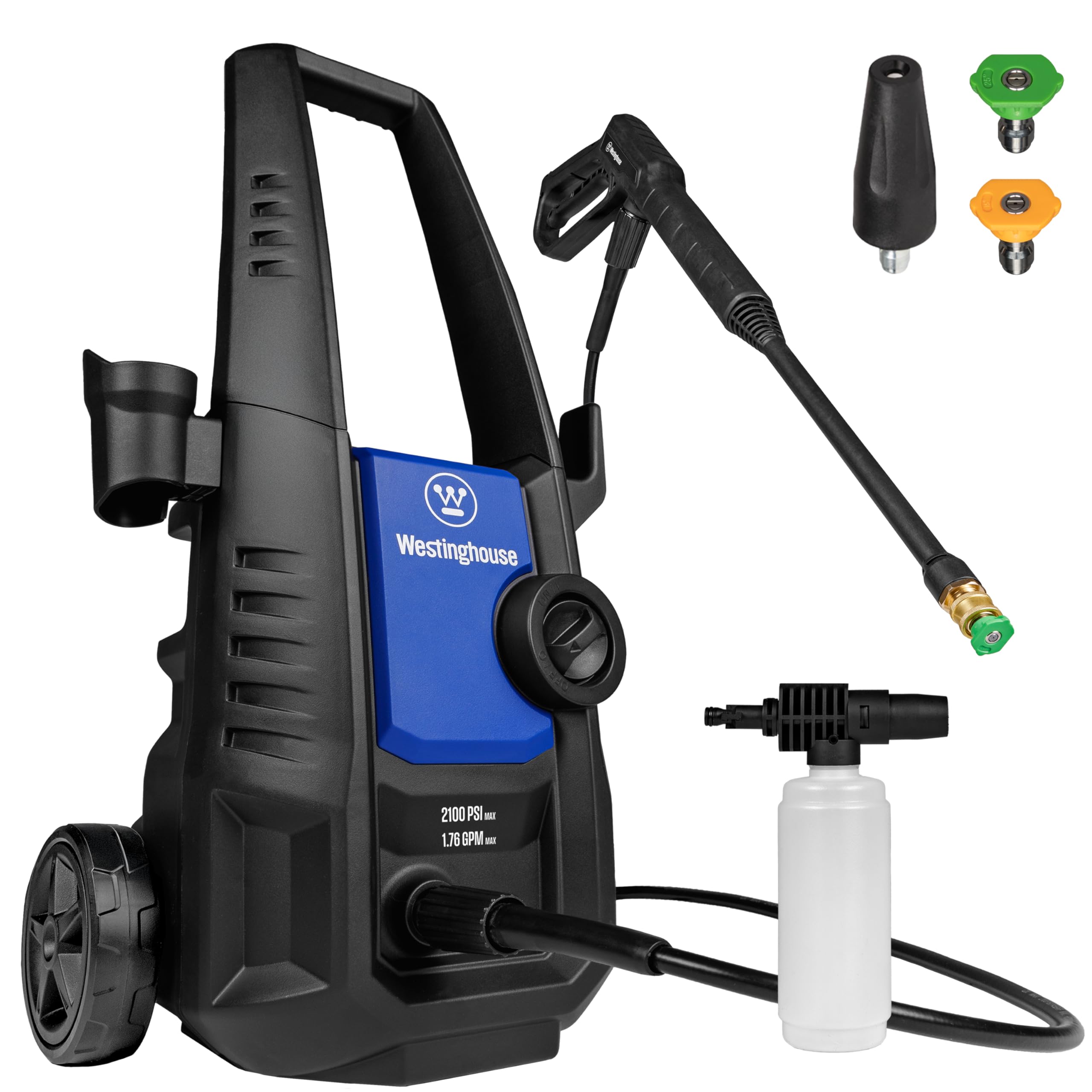
Westinghouse ePX3050 Electric Pressure Washer
Pros:
- Foam cannon and turbo nozzle both included at the lowest price in the lineup ($109)
- Turbo nozzle spins water for extra scrubbing power beyond standard flat nozzles
- 4.6 stars across 2,423 reviews shows quality holds despite low price
Cons (honest weight):
- 2100 PSI caps usefulness at light-to-medium residential tasks only
- Newer listing with fewer reviews than sibling models — longer-term durability less proven
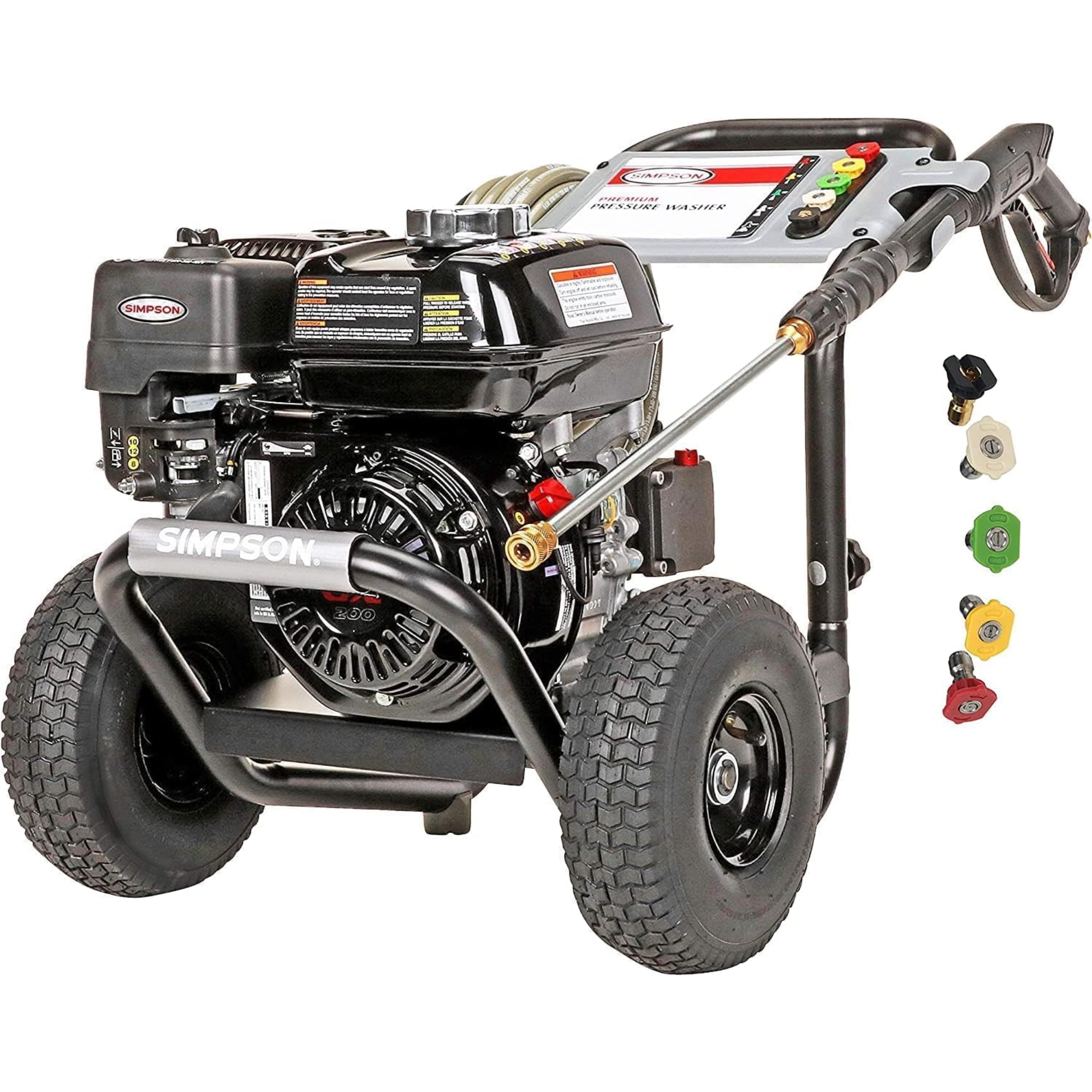
Simpson PowerShot PS3228 Gas Pressure Washer
16% below 90-day avg
Pros:
- Honda GX200 engine is the industry benchmark for reliability and long service life
- 3300 PSI and 2.5 GPM combination clears heavy grease, paint prep, and concrete stains
- 25-foot MorFlex hose resists kinking and stays flexible in cold temperatures
- 5 quick-connect nozzle tips switch tasks in seconds without tools
Cons (honest weight):
- At $629, nearly double the cost of the Westinghouse gas model in this list
- Heavier contractor-grade build is overkill for basic residential driveways
- 4.3-star rating — lowest among gas models here — suggests quality control variability
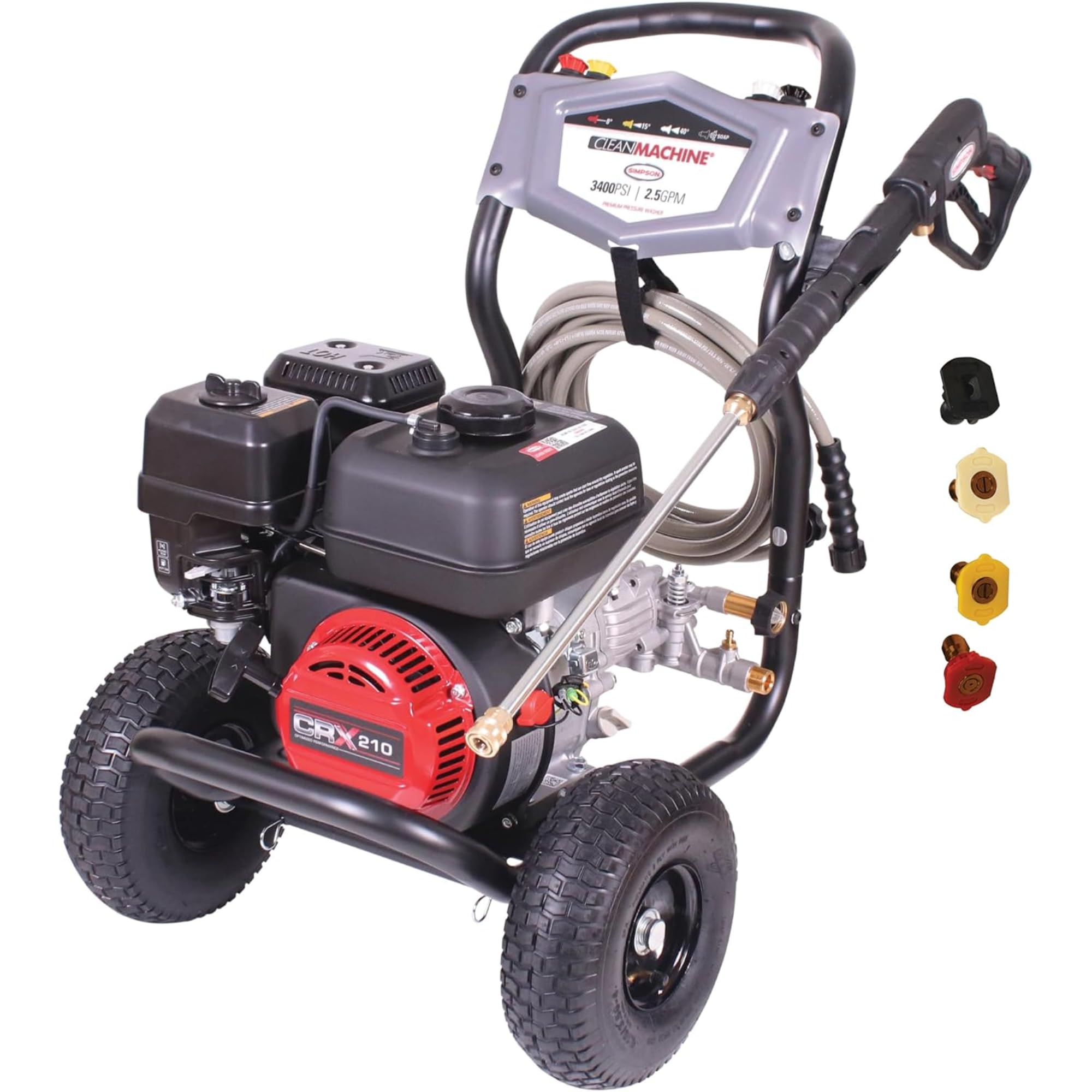
Simpson Clean Machine CM61083 Gas Pressure Washer
Pros:
- 3400 PSI highest rated pressure in this lineup — cuts through stubborn concrete staining
- 2.5 GPM flow rate matches the top gas model, reducing passes on large surfaces
- 25-foot hose provides reasonable reach around vehicles and structures
Cons (honest weight):
- 4.3-star rating across 2,089 reviews — lowest satisfaction score in this lineup
- At $360, costs $30 more than the WPX3200 with fewer total reviews to validate quality
| Product | Price | Max PSI | Max GPM | Power | Nozzles | Foam Cannon | Rating | Best For |
|---|---|---|---|---|---|---|---|---|
| Westinghouse WPX3200 🛒 | $329 | 3200 | 2.5 | Gas | 5 | No | 4.6 (11,086) | Most households |
| Westinghouse ePX3500 🛒 | $169 | 2500 | 1.76 | Electric | 5 | No | 4.6 (10,734) | Electric-first |
| Westinghouse ePX3100 🛒 | $139 | 2300 | 1.76 | Electric | 5 | No | 4.6 (8,630) | Budget cleaning |
| Westinghouse ePX3100v 🛒 | $120.19 | 2100 | 1.76 | Electric | 3 | Yes | 4.7 (5,492) | Car washing |
| Westinghouse WPX3000e 🛒 | $279 | 3000 | 1.76 | Electric | 5 | No | 4.7 (2,661) | High-PSI electric |
| Westinghouse ePX3050 🛒 | $109 | 2100 | 1.76 | Electric | 5 + turbo | Yes | 4.6 (2,423) | First-time buyers |
| Simpson PowerShot PS3228 🛒 | $629 | 3300 | 2.5 | Gas | 5 | No | 4.3 (2,297) | Contractors |
| Simpson CM61083 🛒 | $359.99 | 3400 | 2.5 | Gas | 5 | No | 4.3 (2,089) | High-PSI mid-range |
What real users are saying
Buyer-review scan: 45,412 verified Amazon reviews across 8 finalists, with individual model review counts ranging from 2,089 to 11,086. Review signals reflect real owner experience across a broad range of US home types and cleaning tasks.
Westinghouse WPX3200 (11,086 reviews, 4.6 stars) — the most-reviewed model in this lineup. Positive signals center on starting reliability, driveway and fence cleaning power, and the practical value of the onboard soap tank. Critical signals cite weight and fuel maintenance as expected trade-offs.
Westinghouse ePX3500 (10,734 reviews, 4.6 stars) draws consistent praise for its anti-tipping base. Owners in high-pollen regions highlight its ability to clear spring buildup from patios and gutters in a single afternoon. Critical signals note cord-reach limitations on larger properties.
Westinghouse ePX3100 (8,630 reviews, 4.6 stars) earns strong marks from apartment dwellers and first-time buyers. The steel wand and 5-nozzle set at $139 are frequently cited as punching above their price point. Owners with two-story homes or heavy concrete staining note the PSI ceiling.
Westinghouse ePX3100v (5,492 reviews, 4.7 stars) — highest average rating in this group. Car-care owners cite the detachable foam cannon as the primary purchase driver. The built-in carry handle receives repeated mentions for convenience during seasonal storage.
Simpson PowerShot PS3228 (2,297 reviews, 4.3 stars) skews toward contractor and power-user buyers. Owners who depend on the machine for commercial cleaning report the Honda GX200 engine starts consistently after extended storage. The lower star average reflects expectations mismatches from residential buyers who overbought.
Across all 8 finalists, verified buyer data confirms three consistent patterns: included accessories reduce total ownership cost, GPM matters as much as PSI on large surfaces, and electric models satisfy the majority of residential use cases at a fraction of gas pricing.
Don't Buy on Peak PSI Alone
Every pressure washer box leads with its maximum PSI — and that number is almost always a "cold start" peak under zero-load conditions. Real PSI at the nozzle runs 10–20% lower in sustained operation.
The number that determines how fast you clean a driveway is GPM, not PSI. A 3400 PSI / 1.5 GPM machine (5,100 Cleaning Units) cleans slower than a 3200 PSI / 2.5 GPM machine (8,000 Cleaning Units) on every large, flat surface.
Always multiply PSI by GPM before comparing models. Cleaning Units below 4,000 will frustrate anyone cleaning surfaces larger than a compact car. Residential driveways need 6,000+ CU to clean efficiently in a single pass.
Don't Choose Gas Over Electric Just for the PSI Number
Gas pressure washers require carburetor cleaning, oil changes, and fresh-fuel protocols every season. In humid Southern climates — particularly Florida and Gulf Coast states — fuel left in a carburetor over the winter routinely causes starting failures by spring.
Annual gas maintenance costs $20–$40 in oil and stabilizer alone, plus the time investment. For a homeowner who washes twice a year, the total cost of gas ownership over 5 years often exceeds the price difference versus a quality electric model.
Electric models under 2,500 PSI handle over 80% of residential cleaning scenarios — cars, patio furniture, decks, vinyl fencing, and single-story siding — without any maintenance overhead.
Skip Models That Don't Include at Least 3 Nozzles
A pressure washer sold with fewer than 3 nozzles is an incomplete tool. The minimum useful set covers a wide-angle rinse (40°), a medium cleaning angle (25°), and a soap/low-pressure nozzle.
Aftermarket nozzle sets cost $15–$30 and are often incompatible with the included quick-connect fitting size on entry-level models. Buyers who discover this after purchase lose the price advantage they thought they gained.
Models advertising "5 nozzle sets" at competitive prices — like the Westinghouse ePX3100 at $139 — represent genuine value. The inclusion cost to the manufacturer is marginal; its absence signals a cut-corner product strategy.
Watch Out for Short Hose Lengths
A 20-foot hose forces you to move the machine every 10–15 feet while cleaning a driveway. On a standard 2-car driveway (roughly 20 x 40 feet), a short hose means 4–6 machine repositions per session.
For driveways larger than 400 sq ft, a 25-foot minimum hose is worth seeking out. All three gas models in this lineup include 25-foot hoses. Several electric models ship with 20-foot hoses — acceptable for car washing, limiting for driveway work.
Extension hoses add $20–$40 but often reduce flow pressure slightly due to added friction loss at longer lengths. Buying the right hose length at the start is the cleaner solution.
Avoid No-Name Electric Washers Under $80
The sub-$80 electric pressure washer segment is filled with models that claim 3000+ PSI from motors that physically cannot produce it. These specs are peak instantaneous readings at zero water flow — meaningless for real cleaning performance.
Review counts below 500 on any pressure washer are a caution signal. The category has enough well-reviewed budget options — the Westinghouse ePX3050 at $109 with 2,423 ratings — that there is no reason to gamble on an unproven brand.
UL certification matters for electric pressure washers used near water. All models in this lineup carry appropriate UL or ETL safety markings. Uncertified off-brand models skip this testing to cut costs — a meaningful safety trade-off when using a high-voltage appliance outdoors near wet surfaces.
Use this scenario guide to match your cleaning needs to the right model from this 2026 lineup. Each scenario maps to one specific pick based on PSI requirements, power source preference, and included accessories.
🏠 I need to clean a large driveway, deck, or two-story siding
Best pick: Westinghouse WPX3200 ($329). The 3200 PSI / 2.5 GPM combination produces 8,000 Cleaning Units — enough to clear large concrete surfaces, painted fences, and siding in a single pass. The onboard soap tank handles detergent without extra hardware.
⚡ I want electric — no gas, no oil, no maintenance
Best pick: Westinghouse ePX3500 ($169). The anti-tipping base and steel wand make this the most stable and durable electric model under $200. At 2500 PSI and 1.76 GPM, it handles patios, fences, and cars with zero maintenance overhead.
🚗 I wash my car every 2 weeks and want safe, scratch-free foam coverage
Best pick: Westinghouse ePX3100v ($120.19). The detachable foam cannon applies thick soap coverage that lifts grit before any contact washing. The carry handle makes moving it between garage and driveway a one-hand operation. Highest rating in this lineup at 4.7 stars.
💰 I want the best electric value under $150 for occasional use
Best pick: Westinghouse ePX3100 ($139). The 2300 PSI steel wand and 5-nozzle set at this price beat every competitor at the same price point on accessory completeness. Suitable for cars, patio furniture, and decks — not for two-story work or heavy staining.
🔋 I want electric power closest to gas — and I'll pay for it
Best pick: Westinghouse WPX3000e ($279). The induction motor delivers a true 3000 PSI output and runs quieter and longer than universal-motor rivals. This is the right choice for homeowners who pressure-wash quarterly and want an electric machine that will last a decade.
🎁 I'm buying my first pressure washer and want everything included for the least money
Best pick: Westinghouse ePX3050 ($109). At $109, it includes a foam cannon and a turbo nozzle — two accessories most similarly priced machines omit entirely. Enough power for cars, patio furniture, and seasonal driveway touch-ups.
🔧 I'm a contractor or heavy-duty user who needs a machine that runs every week
Best pick: Simpson PowerShot PS3228 ($629). The Honda GX200 engine is the standard commercial users rely on for consistent starts and long service intervals. At 3300 PSI and 2.5 GPM, it handles paint prep, grease, and commercial concrete cleaning that would wear a residential machine within a season.
💧 I want the absolute highest PSI in this lineup at a mid-range gas price
Best pick: Simpson CM61083 ($359.99). The 3400 PSI spec is the highest in this group and pairs with 2.5 GPM flow. Note: owner satisfaction scores sit at 4.3 stars — the WPX3200 at $329 offers better validated quality for most buyers at a lower price.
Explore more home maintenance guides on the Mubboo Shopping Hub. Related picks: Best Leaf Blowers and Best Garden Hoses for a complete outdoor cleaning setup. Prices and availability verified 2026-05-19. Memorial Day and Prime Day typically bring the deepest discounts on gas and electric pressure washers — bookmark this page before those events.
Find Your Pressure Washer for 2026
Best Overall — Westinghouse WPX3200
$329 — 3200 PSI gas power with onboard soap tank and 5 nozzles. Handles every residential cleaning task without an extension cord.
Buy on AmazonBest Electric — Westinghouse ePX3500
$169 — 2500 PSI electric with anti-tip base and steel wand. Zero fuel, zero oil, and 10,734 owner ratings validate it.
Buy on AmazonBest for Car Washing — Westinghouse ePX3100v
$120.19 — Foam cannon included, carry handle, and the highest rating (4.7 stars) in this entire lineup.
Buy on AmazonBest Starter Kit — Westinghouse ePX3050
$109 — Foam cannon AND turbo nozzle at the lowest price in the lineup. The most accessory-complete entry-level buy here.
Buy on AmazonProfessional Pick — Simpson PowerShot PS3228
$629 — Honda GX200 engine, 3300 PSI, 25-ft MorFlex hose. Built for contractors who run their washer every week.
Buy on AmazonFrequently Asked Questions
What PSI do I need for a home pressure washer?
Most residential tasks need 1500–3200 PSI. Cars and patio furniture clean well at 1500–2000 PSI. Driveways and fencing benefit from 2500–3200 PSI. Two-story siding and heavy concrete staining warrant 3000+ PSI. Multiply PSI by GPM to get Cleaning Units — that number matters more than PSI alone.
Is a gas or electric pressure washer better for home use?
Electric models handle over 80% of residential tasks with zero maintenance. Gas washers produce higher GPM — critical for large driveways over 500 sq ft — but require seasonal oil changes, carburetor care, and fuel stabilizer. If you wash twice a year and have a standard suburban driveway, electric is the practical choice.
What is GPM and why does it matter?
GPM (gallons per minute) measures water flow rate. Higher GPM means you rinse and clear debris faster. A 3200 PSI / 2.5 GPM gas washer (8,000 Cleaning Units) cleans large driveways nearly twice as fast as a 2500 PSI / 1.76 GPM electric model (4,400 CU). For surfaces over 400 sq ft, GPM matters as much as PSI.
Do I need a foam cannon for car washing?
A foam cannon applies thick pre-soak suds that lift grit before any cloth or mitt touches the paint — reducing swirl scratches significantly. It is not mandatory, but car enthusiasts who wash weekly find it worthwhile. The Westinghouse ePX3100v ($120.19) and ePX3050 ($109) both include foam cannons at no extra cost.
How many nozzles should my pressure washer include?
A minimum 5-nozzle set (0°, 15°, 25°, 40°, soap) covers every residential scenario without extra spending. Models with 3 nozzles require aftermarket purchases — typically $15–$30. Budget models that include 5 nozzles, like the Westinghouse ePX3100 at $139, offer meaningfully better out-of-box value.
What is a turbo nozzle and do I need one?
A turbo nozzle (also called a rotary nozzle) spins the water stream in a tight circle, combining the width of a 25° tip with the impact intensity of a 0° pencil jet. It is especially useful on textured concrete or brick. The Westinghouse ePX3050 ($109) is the only model under $150 in this lineup to include one.
When is the best time to buy a pressure washer in the US?
Memorial Day and Black Friday consistently deliver the deepest discounts — often 20–30% off on Amazon, Home Depot, and Lowe's. Prime Day in July also brings short-window deals on Westinghouse models. Spring Cleaning Season (March–April) sees new model launches and clearance pricing on prior-year inventory at Costco and Home Depot.
Is the Simpson PowerShot PS3228 worth $629?
For contractors and heavy-duty users who run their washer weekly, yes. The Honda GX200 engine starts reliably and lasts years longer than budget gas engines. For a homeowner washing twice a year, the Westinghouse WPX3200 at $329 delivers 96% of the cleaning power for half the price.
Can I use a pressure washer on my car without damaging the paint?
Yes, with the correct nozzle and distance. Use a 40° wide-angle nozzle or the soap nozzle, stay 12–18 inches from the surface, and keep PSI under 2000 for direct paint contact. A foam cannon pre-soak reduces the scrubbing force needed. Avoid 0° or 15° nozzles directly on paint at close range.
Who wrote this and where's the data from?
Mubboo Editorial Team — independent US-market consumer research. Picks reflect editorial consensus from 45,412 verified buyer reviews across 8 finalists evaluated for this 2026 guide.
Sources
- Amazon (live product data — pricing, ratings, review counts)
- Amazon verified-buyer reviews (45,412 reviews across 8 finalists)
- Manufacturer product specifications (Westinghouse Outdoor Power, Simpson Cleaning)