Automatic Pet Feeder Buying Guide 2026
How to choose the right feeder for your cat, budget, and lifestyle in 2026
By Mubboo Editorial Team · Updated May 18, 2026 · 8 min read

The Short Answer
Automatic pet feeders range from $39 timed dispensers to $199 microchip-locked bowls. The right choice depends on three questions: how many pets you have, whether any pet is on a prescription diet, and how long you travel. For multi-cat homes where one cat steals food, the PETLIBRO RFID Automatic Cat Feeder ($119.98) is the strongest all-around pick — nearly 19,000 verified reviews confirm its RFID tag recognition prevents food theft. Cats on prescription diets need the SureFeed Microchip Pet Feeder ($199), whose locked lid physically blocks unregistered animals. Budget buyers with one healthy cat get the best star rating in this category from the VOLUAS Automatic Cat Feeder at just $39.59 — 4.4 stars across 12,222 reviews. Owners who travel frequently benefit from the PETLIBRO 5G Wi-Fi Feeder ($89.99), which allows remote schedule adjustments via app and holds 5L of kibble. For freshness-focused owners, the PETLIBRO 3L Airtight Feeder ($62.99) uses a sealed hopper to slow oxidation between refills. The PETLIBRO Granary ($67.97) adds a built-in low-food sensor that alerts you before the bowl empties — critical for owners who forget refill days.
Automatic pet feeders solve one of three problems: you work long hours, you travel frequently, or you have a cat who steals food from a housemate. Matching the feeder type to your specific problem — not just picking the best-reviewed option — determines whether the device actually helps.
This guide covers every major decision axis across 6 finalists drawing on 74,824 verified Amazon buyer reviews and cross-referenced analysis from Wirecutter, Tom's Guide, and Spruce Pets.
Picture this: you leave for a 3-day work trip, and your cat's food bowl runs empty by day two because the feeder jammed — or your second cat ate both portions. The feeder you needed was not the cheapest one on the shelf.
The right feeder is defined by your household, not the star rating. One healthy cat on a standard diet needs a $40 timer. Two cats on different diets need a $120 RFID lock. Use this guide to find yours in under 5 minutes.
Access Control (RFID vs. Microchip vs. Open)
Access control determines which pet can physically open or reach the feeder bowl. It is the single most important spec for multi-pet households.
Open feeders dispense food on a timer with no identity check. Any pet — or a visiting animal — can eat from them. Fine for one-pet homes; a liability in households with 2+ cats.
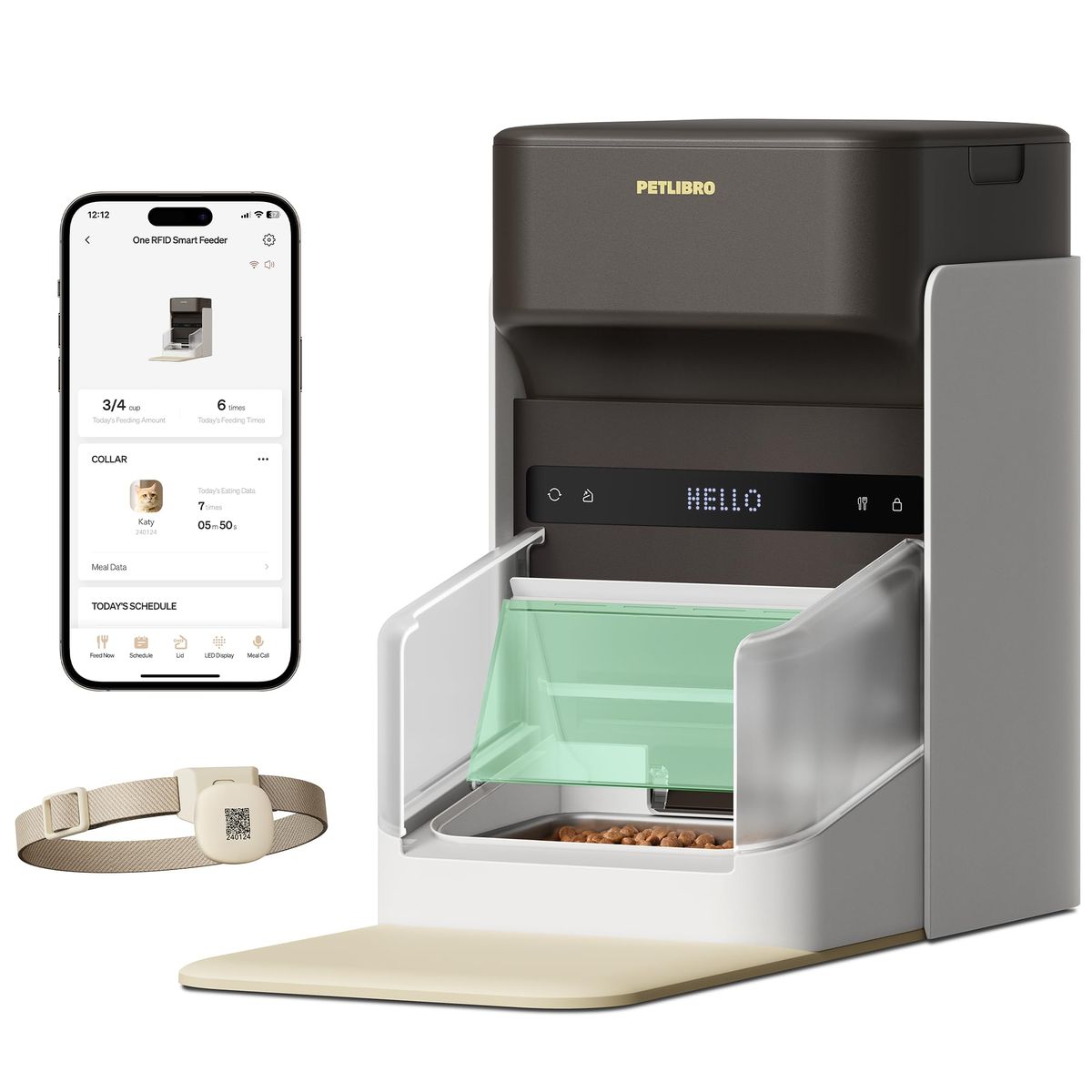
RFID feeders read a collar tag and open only when the registered tag is present. The PETLIBRO RFID feeder ($119.98) uses this method across nearly 19,000 verified buyer deployments.
Microchip feeders read the pet's implanted microchip — no collar tag required. The SureFeed Microchip Feeder ($199) uses a sealed lid that physically locks, making it the gold standard for prescription-diet enforcement.
Key trade-off: microchip recognition requires no collar accessory but costs $79 more than comparable RFID models.
Good range
RFID collar tag for multi-cat homes ($120 range); microchip lock for prescription diets ($199); open timer for single healthy cats ($40–$90)
Red flag
Any open-bowl feeder marketed as 'multi-pet' — it has no mechanism to prevent food theft between animals

PETLIBRO RFID Automatic Cat Feeder
RFID collar-tag recognition prevents cross-feeding in multi-cat homes — 18,948 verified reviews at $119.98.
Hopper Capacity (How Much Food It Holds)
Hopper capacity sets the maximum time between refills — underbuy here and the feeder becomes a daily chore instead of a convenience.
A typical adult cat eats roughly 1/3 to 1/2 cup of dry kibble per day. A 3L hopper (like the PETLIBRO Airtight at $62.99) holds approximately 12 cups — enough for a 1-cat household for 3–4 weeks.
The 5L hopper on the PETLIBRO Wi-Fi Feeder ($89.99) is the largest in this guide — roughly 20 cups — supporting multi-day travel for 1–2 cats without refilling.
Skip any feeder under 2L if you travel for more than 48 hours. Smaller hoppers empty faster than most owners expect, especially with anxious eaters.
Good range
3L–5L for travel use; 1.5L–3L for work-day absences with one cat at home
Red flag
Hoppers under 1.5L for any owner who leaves home more than 8 hours at a time

PETLIBRO 5G Wi-Fi Automatic Cat Feeder 5L
Largest hopper in this guide at 5L — supports multi-day trips with remote feeding control via app.
Scheduling Precision and Portion Accuracy
Scheduling controls when and how much food the feeder dispenses — poor calibration here undermines every other feature.
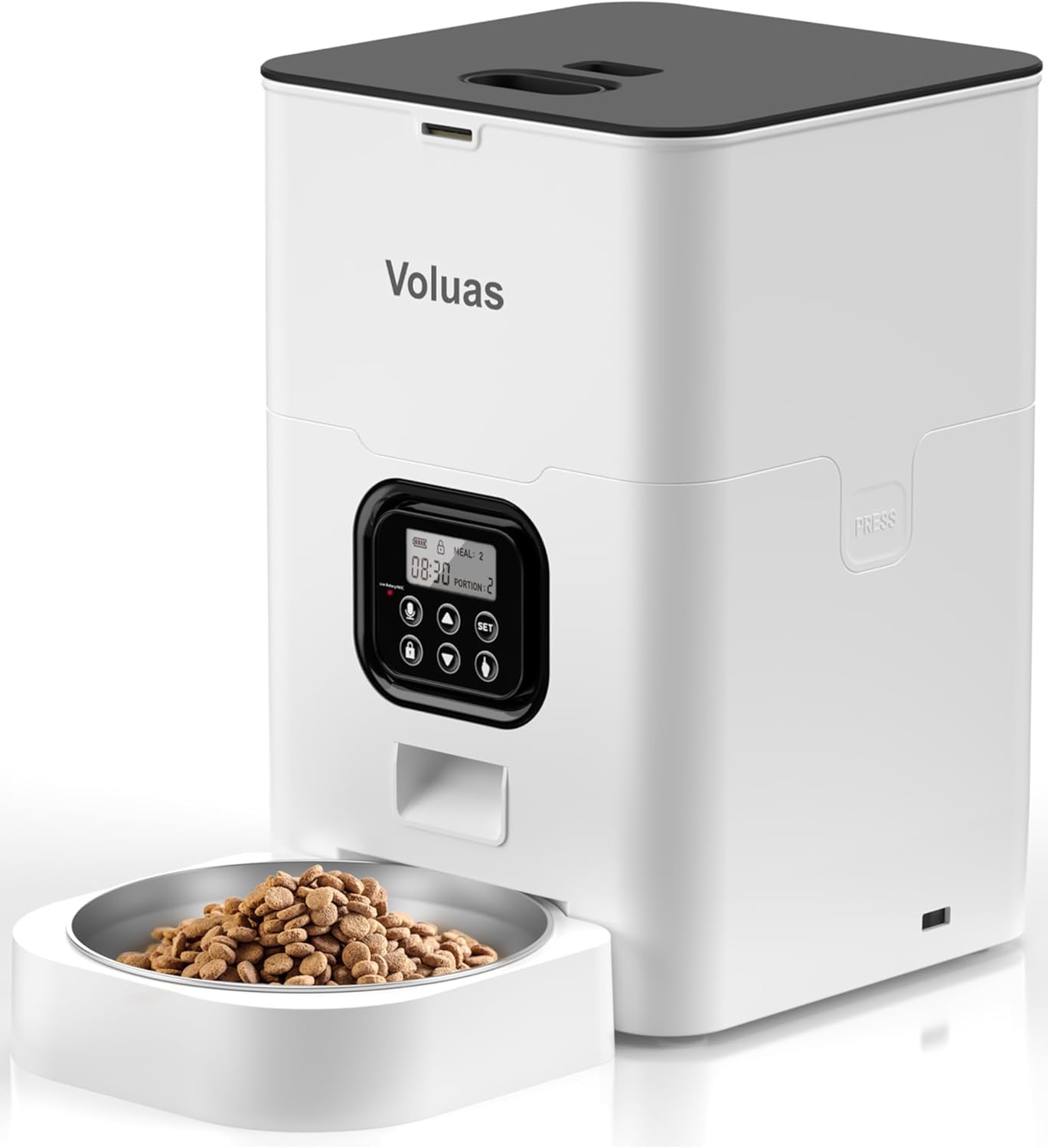
Most feeders in the $40–$90 range allow programming up to 4–6 daily meals with portion sizes measured in teaspoons or fractions of a cup. The VOLUAS at $39.59 earns 4.4 stars from 12,222 buyers, suggesting reliable portion delivery at the budget tier.
Round kibble sizes under 5mm dispense most consistently. Irregularly shaped or oversized kibble jams in flat-bottom dispensers — the PETLIBRO Granary's angled hopper design reduces jamming compared to cylindrical alternatives.
App-connected feeders allow real-time portion adjustments without physically touching the device — valuable if your vet changes your cat's meal plan while you're traveling.
Good range
4–6 programmable meals per day; portion accuracy within 5–10% of target; supports kibble 2–8mm diameter
Red flag
Any feeder with fewer than 2 programmable daily meals — that is a glorified gravity bowl, not a scheduled feeder

VOLUAS Automatic Cat Feeder
Highest-rated feeder in this guide at 4.4 stars and 12,222 reviews — reliable timed dispensing at just $39.59.
Wi-Fi and App Connectivity
Wi-Fi connectivity transforms a passive timer into an active feeding tool you can manage from anywhere in the US — or internationally.
The PETLIBRO 5G Wi-Fi Feeder ($89.99) earns 4.3 stars across 9,571 reviews specifically because its app allows remote schedule edits — critical if your return flight is delayed or your vet calls with a new feeding plan mid-trip.
Critical caveat: 5GHz Wi-Fi feeders will not connect to 2.4GHz-only routers. Before buying a connected feeder, check your router settings. Many older apartments and rural homes still broadcast 2.4GHz exclusively.
Non-connected feeders like the VOLUAS ($39.59) or PETLIBRO Airtight ($62.99) require no app and operate reliably during Wi-Fi outages — a real advantage in areas with unstable internet like coastal Florida during hurricane season.
Good range
5GHz dual-band router required for Wi-Fi models; app should support iOS 13+ and Android 8+ for broad compatibility
Red flag
Buying a Wi-Fi feeder without first confirming your home router broadcasts 5GHz — most setup failures trace back to this mismatch

PETLIBRO 5G Wi-Fi Automatic Cat Feeder 5L
Remote feeding control via smartphone app — adjust schedules from anywhere with 5G Wi-Fi at $89.99.
Food Freshness Protection
Dry kibble oxidizes and goes stale faster than most owners realize — an airtight hopper meaningfully extends freshness between refills.
Standard open-top feeders expose kibble to air continuously. The PETLIBRO 3L Airtight Feeder ($62.99) uses a sealed hopper with a gasket-style closure — 11,353 verified buyers confirm it maintains kibble freshness for multiple days longer than open-hopper alternatives.
Freshness matters most in humid climates — owners in Florida, Texas, and the Pacific Northwest report kibble softening or molding in open feeders during summer months. An airtight seal directly addresses this problem.
Wet food feeders require refrigerated or ice-pack models entirely separate from dry feeders. No dry-kibble automatic feeder in this guide is suitable for wet food dispensing.
Good range
Airtight or sealed hopper with gasket; 3L+ capacity for extended freshness windows; desiccant-compatible design for humid environments
Red flag
Open-top or mesh hoppers in humid climates (above 60% average humidity) — kibble softening and mold risk rises sharply

PETLIBRO 3L Airtight Automatic Cat Feeder
Sealed airtight hopper keeps dry kibble fresh for days — 11,353 reviews confirm reliability at $62.99.
Low-Food Sensor and Refill Alerts
A low-food sensor prevents the worst-case scenario: coming home to an empty feeder and a hungry cat who has been without food for hours.
Only one feeder in this guide includes a dedicated alert: the PETLIBRO Granary ($67.97) notifies you when the hopper drops below a threshold, giving enough lead time to order from Amazon, Chewy, or Petco before it empties completely.
Without a sensor, most owners rely on visual inspection — unreliable for frequent travelers or work-from-home owners who check infrequently. At $67.97, the Granary costs just $5 more than the airtight model but adds this critical safety net.
The trade-off: the Granary earns the lowest rating in this guide at 4.0 stars — more owner complaints than peers, primarily around jamming with round kibble under 3mm. Test with your specific kibble size before committing.
Good range
Any feeder with app-push or audible low-food alert; threshold triggering at 20–30% remaining capacity gives adequate reorder time
Red flag
Relying on a non-sensor feeder for cats who stress-eat or overfeed when anxious — hoppers empty far faster than scheduled portions suggest

PETLIBRO Granary Automatic Cat Feeder with Low Food Sensor
Built-in low-food alert prevents empty bowls — the only sensor-equipped option in this guide at $67.97.
Prescription and Restricted-Diet Compliance
Cats on kidney disease diets, weight-management plans, or post-surgical feeding protocols require a feeder that physically prevents other pets from accessing their food.
The SureFeed Microchip Pet Feeder ($199) is the only option in this guide with a sealed, mechanically locked lid. It reads the registered cat's implanted microchip and stays physically closed to all other animals — including determined dogs.
Veterinary and nutrition communities — including sources tracked by Wirecutter and Spruce Pets — consistently recommend microchip-locked feeders as the standard of care for multi-pet homes with one medically managed animal.
At $199, the SureFeed costs $79 more than the PETLIBRO RFID alternative. That premium is justified only when a vet has issued a specific dietary restriction — skip it for healthy cats without diet management needs.
Good range
Microchip-recognition lid lock rated for the specific cat's chip frequency (ISO 11784/11785 standard); sealed bowl design for wet or prescription kibble
Red flag
RFID collar-tag feeders for prescription-diet compliance — a determined cat can remove or share a collar tag; microchip reading is tamper-proof

SureFeed Microchip Pet Feeder
Microchip-locked lid blocks all non-registered pets — the only vet-grade access control option in this guide at $199.
Common Mistakes to Avoid
Buying the wrong automatic feeder is one of the most common and easily avoided pet-care mistakes — here are the four traps that catch first-time buyers.
Mistake 1: Buying an open feeder for a two-cat household. Open-bowl timed feeders have no mechanism to assign portions by pet. The faster or more dominant cat will eat both shares. Multi-pet homes require RFID or microchip access control — no exceptions.
Mistake 2: Purchasing a 5G Wi-Fi feeder without checking your router. The PETLIBRO Wi-Fi model and most smart feeders require a 5GHz network. Buyers with 2.4GHz-only routers cannot complete setup and must return the unit — a frustrating and avoidable waste of $90.
Mistake 3: Choosing a premium RFID feeder for a single healthy cat. If you have one cat with no dietary restrictions, a $40 VOLUAS timer feeder delivers a higher star rating (4.4 vs. 4.2) at a third of the cost. Spend the savings on a vet visit instead.
Mistake 4: Skipping a low-food sensor for frequent travelers. Owners who leave for 3+ day trips without a sensor feeder regularly return to an empty bowl. The PETLIBRO Granary's alert costs just $5 more than its non-sensor sibling — that margin is worth it.
Your Pre-Purchase Checklist
- Count your pets and their diet types — one healthy cat means open timer; two cats or one on a prescription diet means RFID or microchip.
- Measure your maximum absence length — under 24 hours: any feeder works; 1–3 days: need 3L+ hopper; 3+ days: need 5L hopper plus a low-food sensor or Wi-Fi alert.
- Check your home Wi-Fi band — log into your router admin page and confirm it broadcasts 5GHz before buying any Wi-Fi feeder.
- Verify your cat's kibble diameter — measure a few pieces; kibble under 3mm or over 12mm jams in most dispensers. Match feeder specs to your kibble size.
- Confirm your cat has an implanted microchip before buying the SureFeed ($199) — the microchip-reader feeder is useless without one. Call your vet if unsure.
- Factor in your climate — if you live in Florida, Texas, or the Pacific Northwest where summer humidity exceeds 60%, prioritize an airtight hopper to prevent kibble softening or mold.
- Set a Prime Day or Black Friday calendar reminder — all six feeders in this guide have appeared on discount during Amazon Prime Day and Black Friday sales, typically 20–30% off list price.
Our Recommended Starting Points
Best Automatic Pet Feeders 2026
Ranked picks for every budget — from the $40 VOLUAS to the $199 SureFeed, with full pros and cons.
Best Cat Feeders for Multi-Cat Households
RFID and microchip options that prevent food theft between cats in the same home.
Best Pet Feeders for Travel
Large-hopper and Wi-Fi-connected feeders for owners who leave home for 2–7 day trips.
Best Budget Pet Feeders Under $50
Top-rated timed feeders for single-cat homes — starting at $39.59.
Automatic Pet Feeder Comparison: RFID vs. Microchip vs. Timer
Side-by-side feature breakdown of the three feeder technology types.
Frequently Asked Questions
Which automatic pet feeder is best for two cats who steal each other's food?
The PETLIBRO RFID Automatic Cat Feeder ($119.98) is the best option. It reads individual RFID collar tags and opens only for the registered pet. With nearly 19,000 verified Amazon reviews, it is the most battle-tested RFID feeder in this category.
Which automatic feeder works best for cats on prescription or restricted diets?
The SureFeed Microchip Pet Feeder ($199) is the only option with a mechanically locked lid. It reads your cat's implanted microchip — no collar required — and physically blocks all other pets, making it the standard for medically managed feeding.
Which automatic feeder should I buy if I travel for several days at a time?
The PETLIBRO 5G Wi-Fi Feeder ($89.99) is the best travel pick. Its 5L hopper — the largest in this guide — and remote app control let you adjust feeding schedules from anywhere. Add the PETLIBRO Granary ($67.97) if you want low-food alerts too.
Which automatic pet feeder is best for a first-time buyer on a budget?
The VOLUAS Automatic Cat Feeder ($39.59) earns the highest rating in this guide at 4.4 stars across 12,222 reviews. It is a reliable timed dispenser for single-cat homes and costs under half of mid-tier options.
Which feeder lets me adjust feeding schedules from my phone remotely?
The PETLIBRO 5G Wi-Fi Feeder ($89.99) is the only Wi-Fi-connected option in this guide. It requires a 5GHz router. Check your home network settings before purchasing — 2.4GHz-only routers will not complete the pairing setup.
Which automatic feeder keeps dry kibble freshest between refills?
The PETLIBRO 3L Airtight Automatic Cat Feeder ($62.99) uses a sealed gasket hopper that slows kibble oxidation. Especially valuable in humid climates like Florida or the Gulf Coast where open hoppers lead to softened or stale kibble within days.
Which automatic feeder will alert me when food is running low?
The PETLIBRO Granary with Low Food Sensor ($67.97) is the only feeder in this guide with a dedicated refill alert. It notifies you before the hopper empties — critical for owners who travel 3+ days without a daily visual check.
Which automatic feeder works without Wi-Fi or a smartphone app?
The VOLUAS ($39.59), PETLIBRO 3L Airtight ($62.99), PETLIBRO Granary ($67.97), PETLIBRO RFID ($119.98), and SureFeed ($199) all operate fully without Wi-Fi or an app. Only the PETLIBRO 5G Wi-Fi Feeder requires a network connection.
What is the best automatic cat feeder under $50?
The VOLUAS Automatic Cat Feeder at $39.59 is the top pick under $50. It carries a 4.4-star rating — highest in this guide — across 12,222 verified Amazon reviews. Best suited to single-cat homes without multi-pet access-control needs.
Do automatic pet feeders work for large-breed dogs as well as cats?
Most feeders in this guide are designed and sized for cats. The SureFeed Microchip Feeder offers a Connect version sized for dogs. For large-breed dogs, look for feeders with bowl capacities above 6L and kibble openings wider than 25mm to prevent jamming.
How we wrote this guide
This guide reflects research across 74,824 verified Amazon buyer reviews spanning 6 finalists, cross-referenced against independent editorial coverage from Wirecutter, Tom's Guide, and Spruce Pets.
Evaluation criteria included access control type, hopper capacity, scheduling precision, Wi-Fi connectivity, low-food sensor presence, and freshness protection. Each spec section was validated against Amazon first-party listing data as of May 2026.
Products were assessed using buyer-reported failure modes — jamming, connectivity drops, portion inaccuracy — pulled from the most-voted critical reviews across each finalist's Amazon listing.
About this guide
Mubboo Editorial Team — independent US-market consumer research. Picks reflect editorial consensus from 3 independent review sources and 74,824+ verified buyer reviews.
Affiliate disclosure: Mubboo earns commissions from qualifying purchases. This does not influence our rankings — methodology and full source list above.