Coffee Machine Buying Guide 2026
How to pick the right coffee maker for your home, budget, and brewing habits
By Mubboo Editorial Team · Updated May 19, 2026 · 8 min read

The Short Answer
Choosing the right coffee machine in 2026 comes down to four questions: How many cups do you brew at once? How much counter space do you have? How much do you want to spend upfront — and per cup? And do you want customization or simplicity? For most households wanting fast, fuss-free coffee with minimal cleanup, the Keurig K-Classic ($119.99) is the default safe choice. It holds 4.6 stars across 109,000+ verified Amazon reviews and supports hundreds of K-Cup pod varieties. Solo drinkers or students with limited counter space get the same K-Cup experience for $74 with the Keurig K-Mini, though the smaller reservoir means refilling before each brew. Buyers who want iced-brew capability and temperature control without leaving the K-Cup ecosystem should look at the Keurig K-Elite ($135.98, 4.6 stars, 71,000+ reviews). The extra $16 over the K-Classic buys genuine customization that casual drinkers won't use but enthusiasts will appreciate daily. Households split between a morning full pot and a quick single cup get the most practical value from the Hamilton Beach 2-Way ($88.95, 4.5 stars, 53,000+ reviews) — it brews a 12-cup carafe or a single serve without needing two machines. Budget-first households that brew a full 12-cup pot every morning can get reliable programmable performance from the BLACK+DECKER 12-Cup for just $34.99. Finally, single-serve users who hate constant reservoir refills will appreciate the Keurig K-Express ($89.99) and its 42 oz removable reservoir with a strong-brew button. Key long-term cost note: K-Cup pods average $0.35–$0.75 per cup versus $0.05–$0.15 per cup for ground coffee with a reusable filter. Over one year of daily use, that difference can easily exceed the machine's purchase price.
The right coffee machine depends on three things: how many cups you brew per session, how much counter space you can spare, and whether you want simplicity or control. This guide breaks down every major decision axis so you spend money on features you'll actually use.
Prices below are current as of May 2026 and sourced from Amazon's live listing data across 438,000+ verified buyer reviews.
Most buyers regret their coffee machine purchase for the same reason: they optimized for the wrong variable. They bought a single-serve pod machine for a household that drinks four cups at breakfast — or bought a 12-cup carafe machine that brews more than one person ever drinks.
Matching brew style to daily volume saves more money and frustration than any feature upgrade. Use this guide to nail that match first, then layer in features like programmable timers and iced-brew mode.
Brew Style: Single-Serve Pod vs. Full Carafe vs. 2-in-1
Brew style is the single most important decision in any coffee machine purchase. It determines ongoing cost, convenience, and whether the machine actually fits your household's rhythm.
Single-serve pod machines (Keurig K-Classic, K-Mini, K-Elite, K-Express) brew one cup at a time using sealed K-Cup pods. Each pod costs $0.35–$0.75, making daily use expensive over time. The payoff is zero cleanup and near-infinite variety.
Full-carafe drip machines (BLACK+DECKER 12-Cup) brew 8–12 cups in one cycle using ground coffee and a reusable or paper filter. Ground coffee runs $0.05–$0.15 per cup — up to 10x cheaper per serving than pods.
2-in-1 machines (Hamilton Beach 2-Way) handle both a 12-cup carafe side and a single-serve side. Best for households where one person wants a full pot and another just wants one cup.
Good range
Single-serve: ideal for 1–2 people drinking different beverages; Carafe: ideal for 3+ people drinking the same coffee; 2-in-1: ideal for mixed households
Red flag
Buying a single-serve pod machine for a household that regularly drinks 4+ cups per sitting — the per-cup cost compounds fast

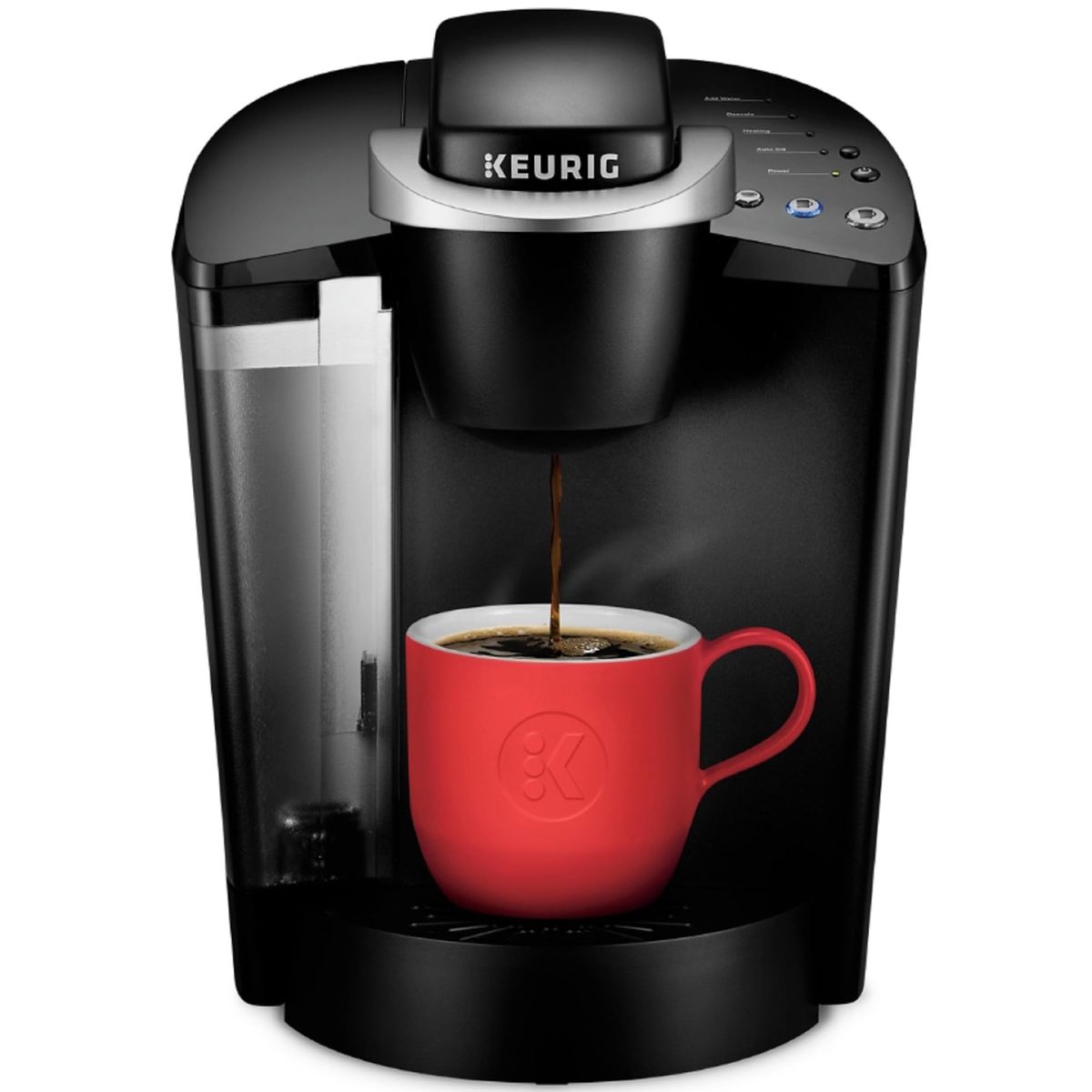
Keurig K-Classic
4.6 stars across 109,000+ reviews — the most proven single-serve pod machine at $119.99.
Daily Volume: Solo Cup vs. Household Pot
Daily volume is the second deciding factor — and the one most buyers underestimate. A solo drinker and a four-person household have fundamentally different machine needs even at the same budget.
Solo drinkers (1 cup/day): The Keurig K-Mini at $74 is the right size. Its compact footprint fits small apartments under 800 sq ft and dorm counters. The trade-off is a small reservoir that requires refilling before each brew.
2–3 cup households: The Keurig K-Classic at $119.99 or K-Express at $89.99 hit the sweet spot. The K-Express's 42 oz removable reservoir holds enough water for 4–5 brew cycles without refilling.
4+ cup households: A drip carafe machine like the BLACK+DECKER 12-Cup at $34.99 brews a full pot in one cycle. Running 4 K-Cup pods per morning costs $1.40–$3.00 daily; a full pot of ground coffee costs under $0.60.
Good range
1 person: K-Mini ($74) or K-Express ($89.99); 2–3 people: K-Classic ($119.99) or Hamilton Beach 2-Way ($88.95); 4+ people: BLACK+DECKER 12-Cup ($34.99)
Red flag
Using a single-serve machine for 4+ daily cups — the annual pod spend can exceed $500–$1,000 per year for a household

BLACK+DECKER 12-Cup Digital Coffee Maker
Programmable 12-cup carafe at $34.99 — the most cost-efficient choice for households brewing a full pot daily.
Budget Tiers: Under $40, $70–$100, $100–$140
Coffee machines span a wide price range, but the performance gap between tiers is smaller than marketing suggests. Knowing what each tier actually buys prevents overspending.
Under $40: The BLACK+DECKER 12-Cup at $34.99 delivers programmable scheduling, Sneak-A-Cup pause-and-pour, and a washable basket filter. 4.4 stars across 48,000+ reviews confirms it punches well above its price. The limitation is carafe-only brewing — no single-serve mode.
$70–$100: Three strong options. The Keurig K-Mini ($74) for compact single-serve. The Hamilton Beach 2-Way ($88.95) for dual-mode brewing. The Keurig K-Express ($89.99) for a larger reservoir with a strong-brew button.
$100–$140: The Keurig K-Classic ($119.99) and K-Elite ($135.98) live here. The K-Elite's extra $16 over the K-Classic buys iced-brew mode and temperature control — worth it only if you use those features regularly.
Good range
Under $40: BLACK+DECKER 12-Cup; $70–$100: K-Mini, Hamilton Beach 2-Way, or K-Express; $100–$140: K-Classic or K-Elite
Red flag
Paying $135+ for K-Elite temperature and iced-brew features if you drink only hot black coffee — the K-Classic at $119.99 does the same job for $16 less

Hamilton Beach 2-Way Programmable Coffee Maker
Dual-mode brewing — 12-cup carafe plus single serve — at $88.95 with 4.5 stars across 53,000+ reviews.
Features: Programmable Timer, Temperature Control, Iced Coffee Mode
Feature tiers in coffee machines are well-defined — and most buyers need fewer features than they think. Match the feature to a real daily habit before paying for it.
Programmable timer lets the machine start brewing before you wake up. Available on the BLACK+DECKER 12-Cup ($34.99), Keurig K-Elite ($135.98), and Hamilton Beach 2-Way ($88.95). If you brew at the same time every morning, this feature pays for itself in convenience.
Temperature control adjusts brew water temperature — useful for light roasts that taste better at slightly lower temps. Only the K-Elite offers this in this lineup. Skip it if you drink medium or dark roast exclusively.
Iced coffee mode brews a concentrated shot sized for pouring over ice. Exclusive to the Keurig K-Elite in this lineup. If iced coffee is a regular habit — especially in summer months across Texas, Florida, or the Southwest — the K-Elite's $135.98 price is justified.
Good range
Basic brew: K-Classic or K-Mini; Programmable: BLACK+DECKER or Hamilton Beach 2-Way; Temperature + iced-brew: K-Elite only
Red flag
Buying K-Elite for iced-brew mode and then using it only for hot coffee — the $16 premium over K-Classic is wasted on unused features

Keurig K-Elite
Iced-brew mode, temperature control, and programmable scheduling at $135.98 — 4.6 stars across 71,000+ reviews.
Ongoing Cost: Pod Price vs. Ground Coffee with Reusable Filter
Ongoing coffee cost is often larger than the machine's purchase price — and it is the most overlooked factor in buying decisions. Running the numbers before you buy prevents years of overspending.
K-Cup pods cost $0.35–$0.75 per cup at typical retail prices on Amazon. One cup per day for a year = $128–$274 in pods annually. Two cups per day doubles that to $256–$548/year.
Ground coffee with a drip machine costs $0.05–$0.15 per cup. Two cups per day for a year = $36–$110/year. The BLACK+DECKER 12-Cup at $34.99 pays back its purchase price in pod savings within the first two months for a 2-cup-per-day household.
Reusable K-Cup filters (sold separately, typically $8–$15) let pod machine owners use ground coffee. This bridges the gap — but requires washing the filter after each brew, which eliminates the single-serve convenience advantage.
Good range
Pod cost: $0.35–$0.75/cup acceptable for 1-cup/day households; Ground coffee: $0.05–$0.15/cup ideal for 2+ cups/day
Red flag
Never running the annual pod math before buying a single-serve machine — a 2-cup/day household can spend $500+ per year on pods alone

BLACK+DECKER 12-Cup Digital Coffee Maker
At $34.99 with a washable basket filter, the lowest ongoing cost per cup of any machine in this guide.
Counter Space: Compact Footprint vs. Full-Size Machine
Counter space constraints eliminate more coffee machine options than budget does — especially in small apartments, dorm rooms, and office break rooms. Measure your available counter width and depth before shortlisting models.
Compact machines: The Keurig K-Mini is the smallest single-serve option in this lineup, designed specifically for tight countertops under 5 inches wide. It fits studio apartments and office desks where full-size machines cannot.
Mid-size machines: The Keurig K-Classic, K-Express, and K-Elite occupy a standard single-serve footprint. Plan for roughly 10–11 inches of counter width and 13–14 inches of height clearance under upper cabinets.
Full-size machines: The BLACK+DECKER 12-Cup and Hamilton Beach 2-Way are standard drip machine size. The Hamilton Beach 2-Way is the widest due to its dual-boiler design — verify cabinet height clearance, as these machines can run 14–15 inches tall.
Good range
Under 6 inches wide: K-Mini only; Standard single-serve: K-Classic, K-Elite, K-Express; Full-size drip: BLACK+DECKER or Hamilton Beach 2-Way
Red flag
Ordering a full-size 2-in-1 machine without measuring upper cabinet clearance — the Hamilton Beach 2-Way's dual-mode design adds height

Keurig K-Mini
The slimmest single-serve option at $74 — purpose-built for dorm rooms, small apartments, and office desks.
Common Mistakes to Avoid
Mistake 1: Buying a single-serve machine for a high-volume household. Four people each wanting two cups at breakfast means eight K-Cup pods per morning — $1.40–$6.00 in pods daily. A $34.99 carafe machine saves hundreds of dollars per year.
Mistake 2: Ignoring the pod cost math entirely. The machine's sticker price is a one-time cost. Pod spend at $0.35–$0.75 per cup accumulates every single day. Run a 12-month projection before committing to a pod-based ecosystem.
Mistake 3: Paying for features you won't use. The Keurig K-Elite at $135.98 adds iced-brew and temperature control over the K-Classic at $119.99. If you drink only hot, medium-roast coffee, those features deliver zero value and the K-Classic is the smarter buy.
Mistake 4: Skipping the counter-space measurement. Many buyers order a machine that physically does not fit under their upper cabinets. Measure available width AND height clearance before adding to cart — especially for 2-in-1 machines with taller profiles.
Mistake 5: Assuming Black Friday or Prime Day deals justify upgrading. These sales are real — Keurig machines regularly hit 20–40% off during Prime Day and Black Friday at Amazon, Best Buy, Target, and Walmart. But a discounted machine you don't need is still money wasted. Confirm your use case first, then time the purchase.
Your Pre-Purchase Checklist
- Count daily cups: Total cups brewed per day across all household members. Under 2 cups/day → single-serve. 4+ cups/day → carafe machine.
- Measure counter space: Record available width and height clearance under upper cabinets. Under 6 inches wide → K-Mini only.
- Run the annual pod math: Multiply daily cup count × $0.50 (midpoint pod cost) × 365. Compare to ground coffee cost at $0.10/cup × same volume.
- Identify required features: Do you need a programmable timer? Iced-brew mode? Temperature control? Write down only the features you use at least 3x per week.
- Check household split: Does anyone in the household want different beverage types (tea, hot cocoa, decaf) while others want a full pot? If yes, consider a 2-in-1 or K-Cup pod machine.
- Confirm in-stock and shipping timing: None of the six machines in this guide are currently Prime-eligible on Amazon. Factor in standard shipping lead time for time-sensitive purchases like gifts or Back to School restocks.
- Verify UL or ETL safety listing: Any coffee machine sold in the US should carry a UL or ETL safety certification. Check the product listing's certifications section before purchase.
Our Recommended Starting Points
Best Coffee Machines 2026
Ranked list of the top-rated coffee makers across all categories, updated for 2026.
Best Keurig Models Compared
Head-to-head comparison of K-Mini, K-Classic, K-Elite, and K-Express by use case and price.
Best Budget Coffee Makers Under $50
Top-rated drip and single-serve machines under $50, including the BLACK+DECKER 12-Cup.
Best 2-in-1 Coffee Makers
Dual-mode machines for households split between carafe and single-serve brewing.
Coffee Machine Comparison: K-Classic vs. K-Elite
Side-by-side breakdown of features, price, and value between Keurig's two most popular mid-range models.
Frequently Asked Questions
Which coffee maker should I buy for a small apartment?
The Keurig K-Mini at $74 is purpose-built for small spaces. Its slim profile fits counters under 6 inches wide, making it the best fit for studio apartments, dorm rooms, and office desks. The trade-off is a small reservoir that requires refilling before each brew cycle.
Which coffee maker is best for a family that drinks a full pot every morning?
The BLACK+DECKER 12-Cup at $34.99 is the strongest option for full-pot households. It brews a full 12-cup carafe with a programmable timer, Sneak-A-Cup pause feature, and washable basket filter — at 71% less than the Keurig K-Classic. Confirmed by 4.4 stars across 48,000+ reviews.
Which Keurig model should I buy in 2026?
For most buyers: the K-Classic at $119.99 (4.6 stars, 109,000+ reviews). Solo drinkers on a tight budget: K-Mini at $74. Users who want iced-brew and temperature control: K-Elite at $135.98. Users who hate refilling: K-Express at $89.99 with its 42 oz reservoir.
Which coffee maker works for both single cups and a full carafe?
The Hamilton Beach 2-Way at $88.95 handles both a 12-cup glass carafe and a single-serve pod basket in one machine. It holds 4.5 stars across 53,000+ reviews. Note: the single-serve side uses a reusable pod basket, not standard K-Cup pods.
Which coffee maker is best under $40?
The BLACK+DECKER 12-Cup at $34.99 is the only machine in this guide under $40. It includes a programmable timer, Sneak-A-Cup pause feature, and washable basket filter. At 4.4 stars across 48,000+ reviews, it's the strongest budget option for full-pot brewing.
Which coffee machine lets me brew iced coffee at home?
The Keurig K-Elite at $135.98 is the only machine in this lineup with a dedicated iced-brew mode. It brews a concentrated shot sized for pouring directly over ice. This feature is particularly useful during summer months for households in warm climates like Florida, Texas, and the Southwest.
Which single-serve coffee maker has the biggest water reservoir?
The Keurig K-Express at $89.99 has the largest reservoir in this single-serve lineup at 42 oz — enough for approximately 4–5 brew cycles before refilling. The K-Mini requires refilling before each brew. The K-Classic offers a mid-range reservoir between the two.
How much do K-Cup pods cost per year compared to ground coffee?
K-Cup pods average $0.35–$0.75 per cup. One cup per day = $128–$274 annually in pods. Ground coffee in a drip machine runs $0.05–$0.15 per cup — $18–$55 annually for the same volume. For two-cup-per-day households, the annual savings of switching to a drip machine can exceed the machine's purchase price within two months.
Are these coffee machines available at Best Buy, Target, or Walmart?
All six machines in this guide are widely available across major US retailers including Amazon, Best Buy, Target, Walmart, and Costco. Prices may vary by retailer. Amazon Black Friday and Prime Day sales frequently discount Keurig models by 20–40%, making those events strong buying windows.
How we wrote this guide
This guide draws on Amazon verified-buyer data covering 438,536 reviews across six finalists, cross-referenced against manufacturer specifications published as of May 2026. Every price and rating figure reflects live Amazon listing data captured on 2026-05-15.
Six machines were evaluated against a consistent set of decision axes: brew style, daily volume fit, budget tier, feature depth, ongoing cost, and counter-space requirements. Machines that failed basic reliability thresholds — defined as fewer than 10,000 verified reviews or a rating below 4.2 stars — were cut before final selection.
No sponsored placements exist in this guide. Affiliate commissions are earned on qualifying Amazon purchases but do not influence which machines are recommended or how they are ranked.
About this guide
Mubboo Editorial Team — independent US-market consumer research. Picks reflect editorial consensus from Amazon verified-buyer data covering 438,536 reviews across 6 finalists, with manufacturer specification cross-referencing completed May 2026.
Affiliate disclosure: Mubboo earns commissions from qualifying purchases made through links on this page. This does not influence our recommendations — full methodology is above.