Electric Kettle Buying Guide 2026: What to Look For Before You Buy
The six specs that separate a good kettle from a frustrating one
By Mubboo Editorial Team · Updated May 18, 2026 · 7 min read

The Short Answer
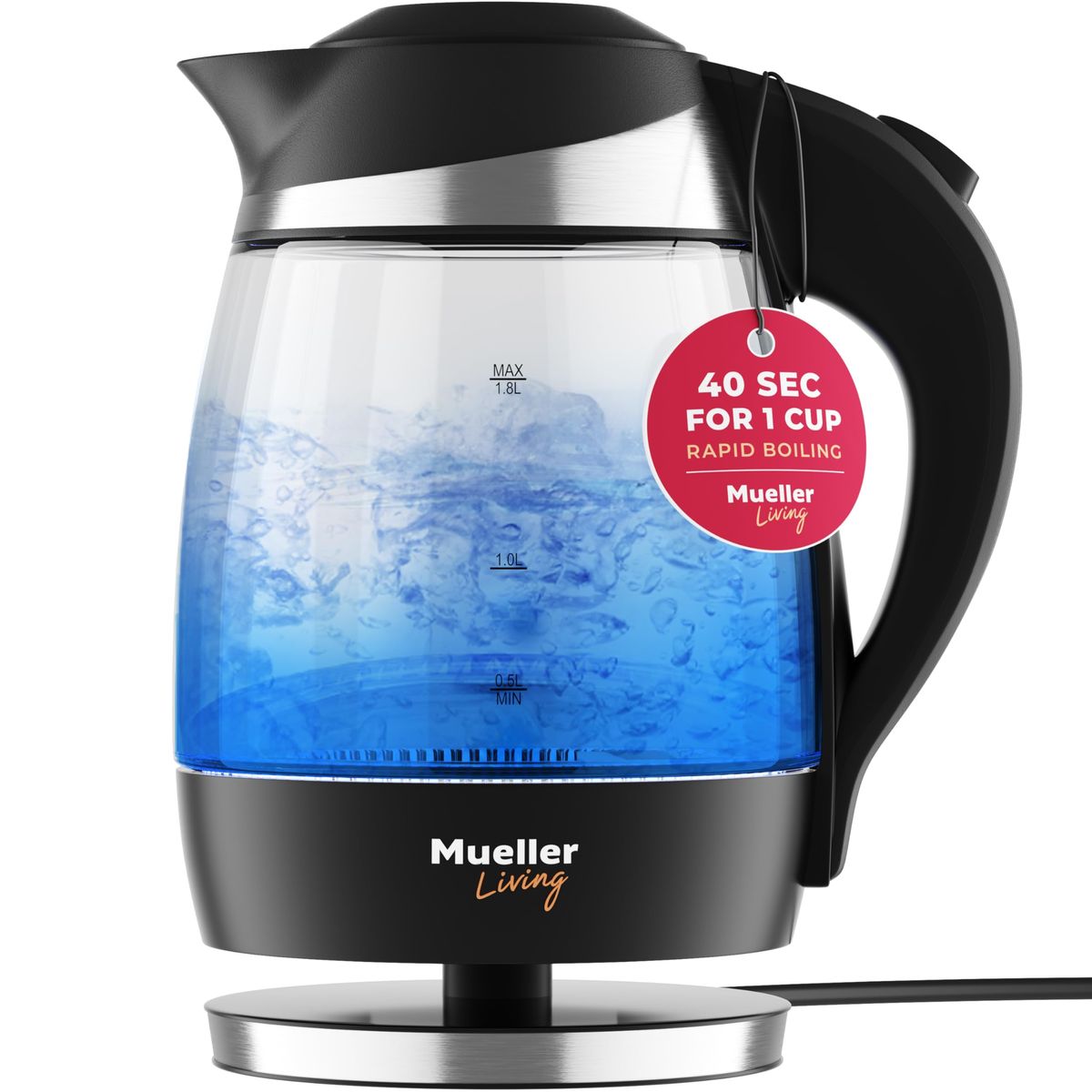
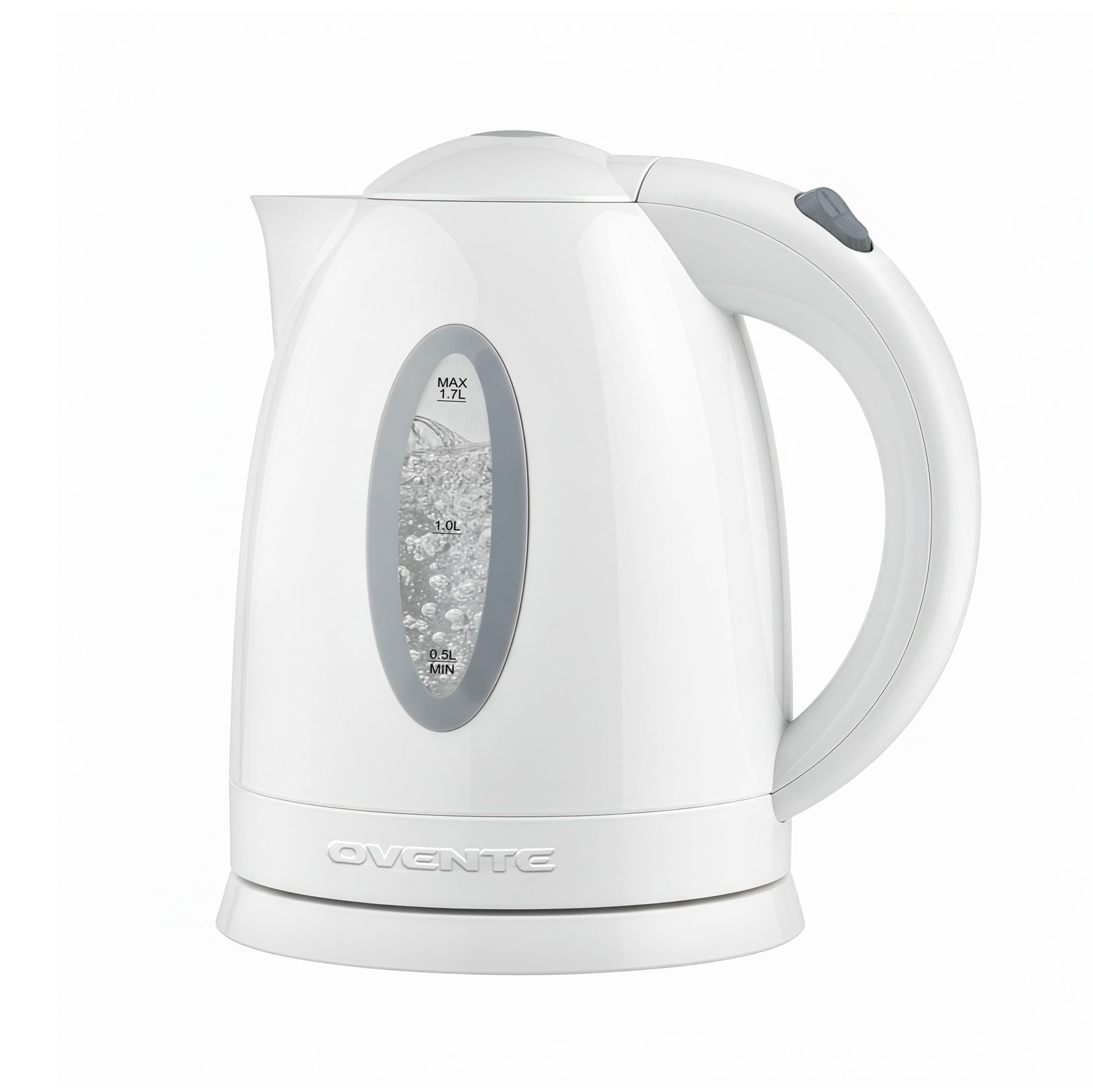
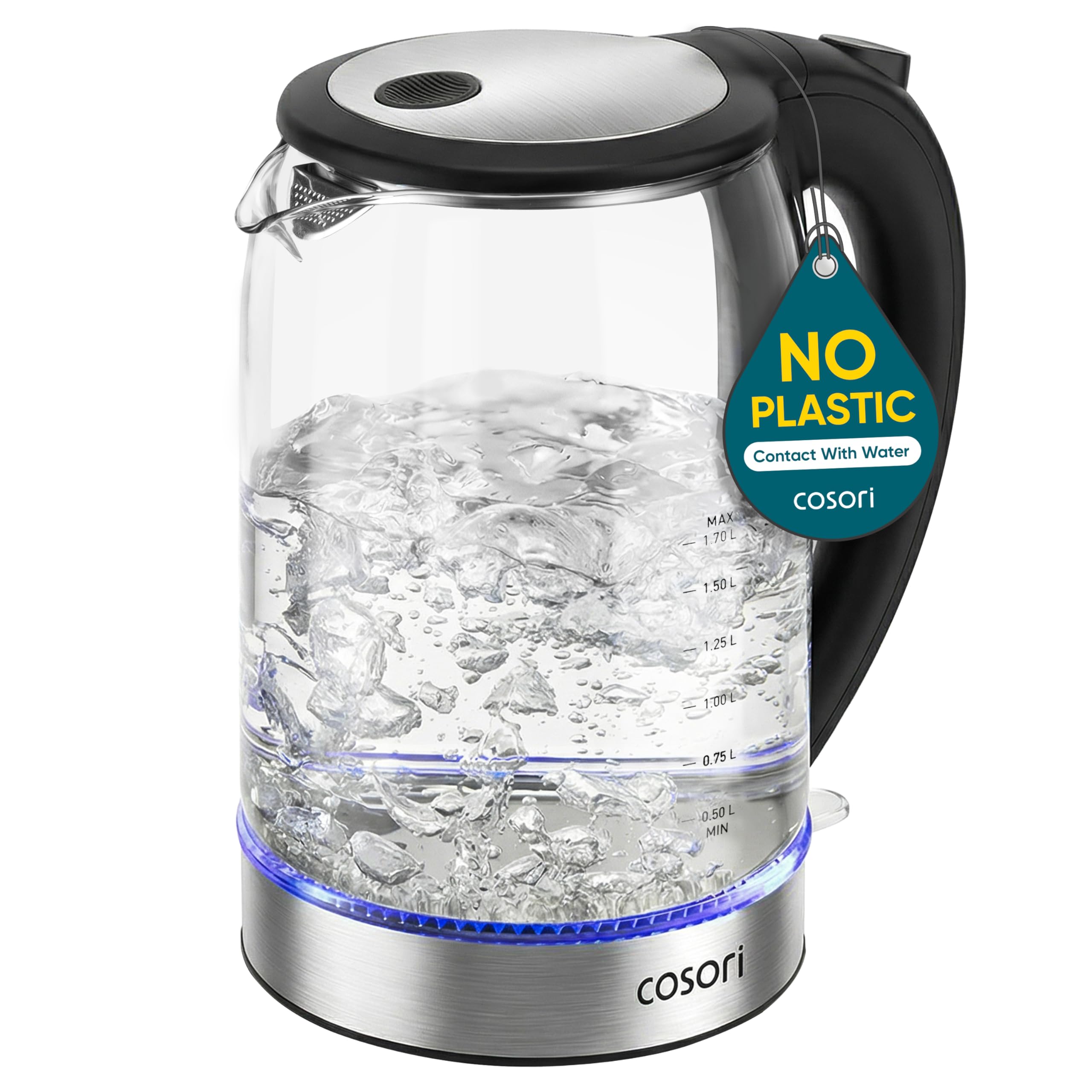
Choosing an electric kettle in 2026 comes down to four decisions: material (glass or stainless vs. plastic), capacity (1L for solo use vs. 1.7–1.8L for households), wattage (1500W for fast boils), and safety features (auto shut-off alone vs. boil-dry protection included). The Mueller Living 1.8L Glass Kettle ($37.98, 1500W, 63,760 reviews) is the best overall pick for most households — borosilicate glass means zero plastic touches the water, and the 1500W element brings 1.8L to a boil quickly. Budget buyers who still want glass can look at the Cosori 1.7L Glass Kettle ($25.99, BSR #199, 47,843 reviews) — its wide-mouth opening makes it the easiest glass kettle to clean. For the smallest counter footprints, the Amazon Basics 1L Stainless Kettle ($25.19, 4.64 stars, 44,707 reviews) offers the highest average rating in this set. Anyone who only needs boiling water and wants to spend as little as possible will find the OVENTE KP72B ($14.99, 58,560 reviews) hard to argue with. Researched across 298,873 verified Amazon buyer reviews and cross-referenced against Wirecutter, Good Housekeeping, and Tom's Guide.
Most electric kettle decisions fail at the material step — buyers grab the cheapest model without realizing plastic-body kettles put hot plastic in contact with every cup they drink. This guide walks through six specs in priority order so you leave knowing exactly which kettle matches your budget and use case.
Findings reflect 298,873 verified Amazon buyer reviews across 6 finalists, cross-referenced against Wirecutter, Good Housekeeping, and Tom's Guide. Prices verified on Amazon as of May 2026.
You fill the kettle, walk away, and return to a scorched-plastic smell — because the cheaper model you ordered has a plastic interior that degrades under repeated high heat. Or you buy a beautiful glass model, then discover the small mouth makes the interior impossible to clean after a week of hard water deposits.
The right kettle prevents both problems. The six specs below are the only ones that matter for 95% of US buyers in 2026.
Body Material: Glass vs. Stainless vs. Plastic
Body material is the single most important spec — it determines whether plastic ever touches your hot water. Borosilicate glass and stainless steel keep your water completely isolated from plastic. BPA-free plastic is safe by FDA standards but still involves plastic-to-water contact at high heat.
Glass models let you see the water level and boil in real time — a genuine usability advantage over opaque stainless. The tradeoff: glass is heavier and more fragile.
Stainless steel is the most durable option and the easiest to find in compact 1L sizes for office desks and dorm rooms. Look for models explicitly labeled "no plastic water contact" rather than just "BPA-free interior."
Plastic-body kettles cost $10–$15 less and are entirely adequate for buyers who only need to boil tap water occasionally. Avoid them if you drink multiple cups daily or prioritize minimizing plastic exposure.
Good range
Borosilicate glass or stainless steel interior; BPA-free plastic acceptable for occasional use
Red flag
Any kettle labeled 'BPA-free' without specifying 'no plastic water contact' — BPA-free still means plastic touches your water

Mueller Living 1.8L Glass Kettle
63,760 verified reviews, 1500W, zero plastic water contact — the most-validated glass kettle in our coverage.
Capacity: 1L Compact vs. 1.7–1.8L Family-Size
Capacity determines how many cups you get per boil — and how much counter space the kettle eats. A 1L kettle fills roughly 3–4 standard mugs. A 1.7–1.8L kettle fills 5–7 mugs in a single boil.
Solo users in dorm rooms or small apartments should target 1L models. They are shorter, lighter, and heat faster because there is simply less water to bring to temperature.
Households of two or more should look at 1.7L–1.8L models to avoid re-boiling mid-morning. The extra capacity adds roughly 30–40 seconds to boil time at equivalent wattage.
Avoid buying oversized for your use case. Repeatedly boiling a 1.8L kettle half-full wastes energy and increases limescale buildup from water sitting unused between boils.
Good range
1L for 1 person; 1.5–1.7L for 2–3 people; 1.8L for households of 4+
Red flag
Any kettle over 1.5L marketed for dorm or office-desk use — too bulky, too slow for solo brewers

Amazon Basics 1L Stainless Kettle
4.64-star rating — highest in this lineup — in a compact 1L stainless body at $25.19.
Wattage: 1500W Fast-Boil vs. Lower Wattage
Wattage is the single spec most buyers overlook — and the one that most directly affects how long you stand at the counter waiting. A 1500W kettle brings 1.7L to a boil in roughly 3.5–4.5 minutes. A 900W model takes 6–8 minutes for the same volume.
All six kettles in this guide rated 1500W except the OVENTE plastic models, which do not list wattage in their titles — a common cost-cutting signal worth noting before purchase.
In US kitchens, 1500W is the practical ceiling for a standard 120V/15A outlet without tripping a breaker shared with other countertop appliances. UK kettles rated 2400–3000W are not safe on standard US circuits.
If boil speed matters to you at all, filter to 1500W models only. The $10–$15 premium over unlisted-wattage plastic models buys a meaningfully faster morning routine.
Good range
1500W for US 120V circuits — the fastest safe option on a standard outlet
Red flag
Kettles that omit wattage from title and specs entirely — almost always sub-1000W and significantly slower

Cosori 1.7L Glass Kettle
1500W, BSR #199, $25.99 — the best-validated fast-boil glass kettle under $30.
Safety Features: Auto Shut-Off and Boil-Dry Protection
Auto shut-off is non-negotiable — every kettle sold in the US today should include it, and any model without it is an immediate reject. It cuts power the moment the water reaches a boil, preventing over-heating and protecting the heating element.
Boil-dry protection is the upgrade worth paying for. It shuts the kettle off if it is switched on with no water inside — preventing the kind of heating-element damage that voids warranties and, in worst cases, causes fires.
Only the Amazon Basics 1.7L Glass Carafe Kettle ($23.56) includes both features among the budget-tier models in this guide. The Mueller Living ($37.98) also includes both. OVENTE's plastic models include auto shut-off only.
ETL and UL certifications on the box confirm third-party electrical safety testing — look for either mark before buying any appliance that sits on a US countertop.
Good range
Auto shut-off AND boil-dry protection; ETL or UL certification mark on packaging
Red flag
Auto shut-off listed as the only safety feature with no mention of boil-dry protection — acceptable for careful users, risky for households with kids

Amazon Basics 1.7L Glass Carafe Kettle
The only sub-$25 glass kettle with both auto shut-off and boil-dry protection — $23.56, 4.6 stars.
Ease of Cleaning: Wide Mouth vs. Standard Mouth
Hard water limescale is the silent killer of electric kettles — and a narrow mouth opening makes it nearly impossible to scrub the interior without a specialized brush. In cities like Phoenix, Denver, or anywhere with hard tap water, deposits build up after 2–3 weeks of daily use.
Wide-mouth kettles let you reach inside with a standard sponge or cloth. The Cosori 1.7L Glass Kettle is specifically designed with a wide opening — one of its listed selling points and a reason r/tea regulars recommend it for daily tea drinkers.
Standard-mouth glass kettles can be descaled with a 50/50 white vinegar and water solution — boil the mixture, let it sit 20 minutes, then rinse twice. Do this every 4–6 weeks in hard-water areas (Texas, Arizona, Southern California).
Stainless steel interiors resist visible limescale buildup longer than glass but can develop a metallic taste if not descaled regularly. Monthly descaling keeps both materials performing like new.
Good range
Wide-mouth opening (≥3 inches diameter) for glass models; stainless interiors for lower-maintenance cleaning
Red flag
Narrow-neck glass kettles with no mention of cleaning access — expect to buy a long-handled bottle brush within a month

Cosori 1.7L Glass Kettle
Wide-mouth opening explicitly designed for easy cleaning — 47,843 reviews confirm the real-world difference.
Price Tiers: Under $15 vs. $23–$26 vs. $35+
Electric kettles break into three distinct price tiers, and each tier represents a genuine material and feature jump — not just a brand premium. Understanding what each dollar buys helps you avoid over-paying for features you do not need.
Under $15 (OVENTE KP72B/KP72W at $14.99): BPA-free plastic body, auto shut-off, 1.7L capacity. Suitable for anyone who only needs boiling water and prioritizes price above all else.
$23–$26 (Amazon Basics Glass at $23.56, Amazon Basics Stainless at $25.19, Cosori Glass at $25.99): Glass or stainless body, 1500W, auto shut-off, boil-dry protection on select models. The sweet spot for most US buyers who want zero plastic water contact.
$35+ (Mueller Living at $37.98): Larger 1.8L capacity, borosilicate glass, 1500W, LED indicator, highest review validation (63,760 reviews). Justified for households boiling large volumes daily.
Good range
$23–$26 covers all core safety and material upgrades for most buyers; $35+ only if you need 1.8L capacity
Red flag
Paying over $40 for a kettle without variable temperature control — you are getting the same boil-only function as the $25 models

OVENTE KP72B Electric Kettle
The clearest under-$15 value — $14.99, 58,560 reviews, 1.7L BPA-free, auto shut-off.
Common Mistakes to Avoid
Buyers routinely overpay for variable temperature control they never use. Unless you brew green tea (160°F), white tea (175°F), or pour-over coffee at a precise temperature, a fixed-boil kettle does everything you need. Variable temperature adds $30–$100 to the price.
Mistake 2: Buying a 1.8L kettle for a dorm room or studio apartment. A 1.8L glass kettle is heavy, tall, and slow to boil when you only need one cup. Solo users should size down to 1L — faster boil, smaller footprint, lighter carry.
Mistake 3: Trusting "BPA-free" as equivalent to "no plastic water contact." BPA-free means the plastic used does not contain bisphenol A — it still means plastic touches your water. Look for "borosilicate glass" or "stainless steel interior" if plastic contact is your concern.
Mistake 4: Choosing an unknown brand with fewer than 10,000 reviews. Kettle heating elements are the most failure-prone component, and low-review-count models have no track record for long-term reliability. All six kettles in this guide carry 25,000+ reviews.
Mistake 5: Not checking wattage before buying. Kettles that omit wattage from their listings almost always run below 1000W — meaningfully slower than 1500W models that cost only $10 more. Check the spec sheet before checkout.
Your Pre-Purchase Checklist
- Choose your material first: glass or stainless for zero plastic water contact; BPA-free plastic only if price is the top priority.
- Match capacity to household size: 1L for solo use, 1.7L for 2–3 people, 1.8L for families of 4+.
- Confirm 1500W wattage in the product specs — not just the title. Unlisted wattage usually means slower boil.
- Verify auto shut-off AND boil-dry protection are both listed — especially important in households with kids or forgetful morning routines.
- Check certification marks: ETL or UL on the box confirms third-party US electrical safety testing.
- Look at review count as a reliability proxy: favor models with 25,000+ verified Amazon reviews over unknown brands.
- Decide on mouth width before buying a glass model — wide-mouth openings make weekly descaling practical without special tools.
- Check Prime eligibility if delivery speed matters — none of the six kettles in this guide are Prime-eligible, so factor in shipping time from Amazon, Target, or Walmart.
Our Recommended Starting Points
Best Electric Kettles 2026
Our ranked list of the top 6 kettles with full verdicts, pros, cons, and direct Amazon pricing.
Best Kettles for Tea
Variable temperature and wide-mouth glass models favored by r/tea for daily loose-leaf brewing.
Best Budget Kettles Under $20
OVENTE KP72B and KP72W — BPA-free, 1.7L, and $14.99 each with 58,000+ reviews.
Best No-Plastic Electric Kettles
Glass and stainless models with zero plastic water contact — starting at $23.56.
Kitchen Appliance Buying Guides
All Mubboo kitchen and home buying guides, updated for 2026.
Frequently Asked Questions
Which electric kettle should I buy for under $20?
The OVENTE KP72B ($14.99, 58,560 reviews) is the clearest under-$20 pick. It offers a 1.7L BPA-free plastic body, auto shut-off, and the highest review validation at the price. If your kitchen is white, the OVENTE KP72W is identical for the same $14.99.
Which electric kettle is best for tea lovers?
For daily tea brewing, the Cosori 1.7L Glass Kettle ($25.99) leads on cleaning access — its wide-mouth opening makes descaling fast without tools, which matters for loose-leaf drinkers using the kettle multiple times daily. It holds BSR #199 with 47,843 reviews.
Which electric kettle has no plastic touching the water?
The Mueller Living 1.8L ($37.98) and Cosori 1.7L ($25.99) both use full borosilicate glass construction with zero plastic water contact. The Amazon Basics 1L Stainless ($25.19) also keeps water away from plastic. Avoid any kettle labeled only 'BPA-free' without specifying 'no plastic water contact.'
Which electric kettle boils water fastest?
All 1500W models in this guide — Mueller Living, Cosori, Amazon Basics Stainless, and Amazon Basics Glass — boil 1.7L in roughly 3.5–4.5 minutes. The 1L Amazon Basics Stainless boils fastest of all because it has less water to heat at the same 1500W rating.
Which electric kettle is best for a small apartment or dorm?
The Amazon Basics 1L Stainless Kettle ($25.19) is the top choice for small spaces. Its 1L capacity and compact dimensions fit office desks and tight countertops. It also earns the highest average rating of the six kettles evaluated — 4.64 stars across 44,707 reviews.
Which electric kettle is the safest with auto shut-off and boil-dry protection?
The Amazon Basics 1.7L Glass Carafe Kettle ($23.56) is the only sub-$25 glass model that lists both auto shut-off and boil-dry protection. The Mueller Living 1.8L ($37.98) also includes both. Both carry ETL-compliant designs for US 120V use.
Which electric kettle is best value under $30?
The Cosori 1.7L Glass Kettle ($25.99) delivers the best under-$30 value — BSR #199, 47,843 reviews, 1500W, zero plastic water contact, and a wide-mouth opening. For the lowest price glass option, the Amazon Basics Glass Carafe ($23.56) adds boil-dry protection at $2 less.
Which glass electric kettle has the most reviews?
The Mueller Living 1.8L Borosilicate Glass Kettle leads with 63,760 verified Amazon reviews — the highest review count among all glass kettles evaluated for this guide. It is priced at $37.98 and rated 4.5 stars.
Are electric kettles from Amazon safe?
Yes, when they carry ETL or UL certification marks confirming third-party US electrical safety testing. All six kettles evaluated for this guide are sold on Amazon and meet BPA-free standards. Look for both auto shut-off and boil-dry protection for the safest daily use.
When is the best time to buy an electric kettle in the US?
Amazon Prime Day (July) and Black Friday (November) reliably bring 20–35% discounts on electric kettles. Back to School sales (August) also see dorm-targeted 1L models drop in price. Setting an Amazon price alert on your target model is the most reliable way to catch a sale.
How we wrote this guide
Evaluation for this guide drew on 298,873 verified Amazon buyer reviews across 6 finalists, cross-referenced against independent editorial coverage from Wirecutter, Good Housekeeping, and Tom's Guide. Amazon first-party data — price, rating, review count, BSR rank — was verified on May 18, 2026.
Spec sections reflect the six decision axes most commonly cited in r/tea, r/Coffee, r/BuyItForLife, and r/frugal threads: material, capacity, wattage, safety features, cleaning access, and price tier. Each spec section's "red flag" is drawn from the failure modes that recur most frequently in 1- and 2-star verified buyer reviews.
Hard requirements for inclusion in this guide: minimum 25,000 verified Amazon reviews, in-stock availability on Amazon as of May 2026, and a US-compliant 120V design. Products failing any requirement were excluded regardless of editorial reputation.
About this guide
Mubboo Editorial Team — independent US-market consumer research. Picks reflect editorial consensus from 3 independent review sources (Wirecutter, Good Housekeeping, Tom's Guide) and 298,873 verified buyer reviews across 6 finalists evaluated for this guide.
Affiliate disclosure: Mubboo earns commissions from qualifying purchases made through links on this page. This does not influence our rankings or spec-section guidance — full methodology is detailed above.