Prices verified Aug 12 · Always confirm at the retailer before buying.
Quick answer
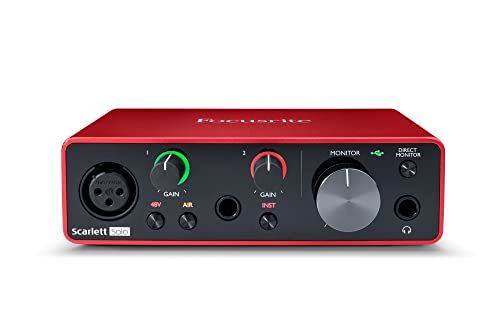
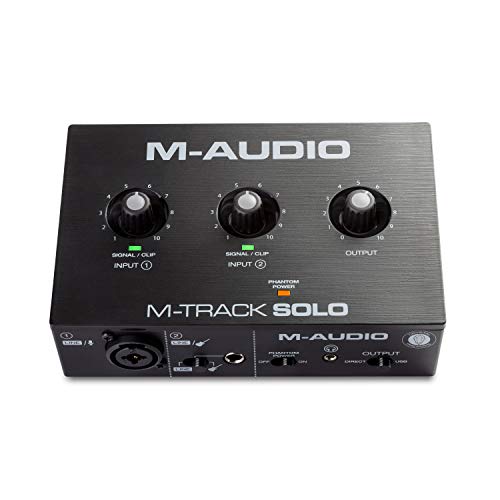
The Focusrite Scarlett Solo 3rd Gen is the higher-priced option at the August 10, 2026 Aurora check: $119.99 versus $55.51 for the M-Audio M-Track Solo. Focusrite documents a 2-in/2-out USB interface with one microphone preamp, a switchable line/instrument input, balanced outputs, Air mode, direct monitoring, USB-C, and 24-bit/192 kHz converters. M-Audio documents a 2-channel USB interface with one combo input, 48V phantom power, a dedicated instrument input, stereo line input, RCA and headphone outputs, and a USB/Direct monitoring switch. Choose Scarlett Solo when its documented feature set, USB-C connection, Air mode, and included software ecosystem fit your setup. Choose M-Track Solo when the lower current price, 48V input support, RCA outputs, and included MPC Beats bundle cover your needs. This is a specification and price comparison, not a recording, latency, driver, or sound-quality test.
Scarlett Solo is the feature-led option; M-Track Solo is the lower-price option. Compare the documented inputs, outputs, connection, monitoring, and software requirements before treating the $64.48 price gap as meaningful.
Mubboo Verdict
Best for most people
Focusrite Scarlett Solo 3rd Gen
Choose it when the documented USB-C, Air mode, balanced outputs, and software bundle match your setup.
Pick the M-Audio M-Track Solo USB Audio Interface instead if
- You want the lower current price
- You need documented 48V phantom power and RCA outputs
- M-Audio’s included software fits your workflow
Focusrite Scarlett Solo 3rd Gen USB Audio Interface vs M-Audio M-Track Solo USB Audio Interface, side by side
Focusrite Scarlett Solo 3rd Gen USB Audio Interface

Pros:
- Focusrite documents a 2-in/2-out layout
- USB-C, Air mode, Direct Monitor, and 24-bit/192 kHz are listed by Focusrite
- Balanced outputs and a switchable line/instrument input are documented
Cons (honest weight):
- Higher current price than M-Track Solo
- No Mubboo hands-on recording, latency, driver, or sound test
- Check current software and operating-system compatibility
M-Audio M-Track Solo USB Audio Interface
Pros:
- Lower current Aurora price
- M-Audio documents 48V phantom power, instrument input, RCA outputs, and USB/Direct monitoring
- MPC Beats and AIR software are listed by M-Audio
Cons (honest weight):
- USB-B-to-USB-A cable and Windows driver steps are documented in the manual
- No Mubboo hands-on recording, latency, driver, or sound test
- Confirm your computer and output connector requirements
Where each one wins
7 dimensions scored head-to-head. Focusrite Scarlett takes 2; M-Audio M-Track takes 1.
| Dimension | Focusrite Scarlett Solo 3rd Gen USB Audio Interface | M-Audio M-Track Solo USB Audio Interface | Winner |
|---|---|---|---|
| Current priceM-Track Solo is $64.48 lower. | $119.99 | $55.51 | M-Audio M-Track |
| Inputs and outputsBoth document two-channel workflows with different connector layouts. | 2-in/2-out; balanced outputs | Combo, instrument, stereo line; RCA/headphone outputs | M-Audio M-Track |
| MonitoringBoth manufacturers document direct monitoring features. | Direct Monitor | USB/Direct switch | M-Audio M-Track |
| ConnectionFocusrite lists USB-C. | USB-C | USB-B-to-USB-A cable | Focusrite Scarlett |
| Feature focusAir mode, Gain Halos, and 24-bit/192 kHz are documented. | Air mode; Gain Halos | 48V phantom; RCA outputs | Focusrite Scarlett |
| SoftwareBoth list included software; compare the named bundle. | Ableton/Pro Tools/Hitmaker named | MPC Beats/AIR/ReValver named | M-Audio M-Track |
| Evidence boundaryNeither received a Mubboo recording test. | No sound/latency test | No sound/latency test | M-Audio M-Track |
| Overall | 2 wins | 1 win | Focusrite Scarlett |
Current price
Aurora listed Scarlett Solo at $119.99 and M-Track Solo at $55.51 on August 10, 2026. The $64.48 gap is useful for budgeting, but it is not a test result and should not be treated as a proxy for sound quality or reliability.
Inputs and outputs
Focusrite documents two inputs and two outputs: one 3rd Generation mic pre, one switchable line/instrument input, and balanced outputs. M-Audio documents a combo input, dedicated instrument input, stereo line input, RCA outputs, and a headphone output. Match the connectors to your microphone, instrument, keyboard, monitors, or headphones before buying.
Monitoring
Focusrite lists Direct Monitor. M-Audio lists a USB/Direct switch and describes direct-monitoring monitoring. These are manufacturer-documented functions; Mubboo did not measure latency or monitor-path behavior.
Connection and platform notes
Focusrite lists USB-C and MacOS, Windows, and iPadOS compatibility. The M-Audio manual documents a USB-B-to-USB-A cable and separate Windows driver instructions, while describing class-compliant macOS operation. Check current operating-system support before ordering.
Feature and software differences
Focusrite lists Air mode, Gain Halos, 24-bit/192 kHz converters, and a software bundle including Ableton Live Lite, Pro Tools Intro+, and Hitmaker Expansion. M-Audio lists 48V phantom power, MPC Beats, AIR instruments and effects, ReValver, and an 80-plugin bundle. These are included-feature descriptions, not independent quality judgments.
What to skip
Do not treat a manufacturer phrase such as “marketing language,” a specification number, a rating, or a software bundle as proof of better recordings. This page does not claim measured noise, latency, driver stability, conversion quality, sound quality, or long-term reliability.
Which should you buy?
| Your situation | Pick | Why |
|---|---|---|
| Vocal and guitar setup | Focusrite Scarlett Solo 3rd Gen USB Audio Interface | Focusrite documents a mic pre, line/instrument input, Air mode, and balanced outputs. |
| Entry budget constraint | M-Audio M-Track Solo USB Audio Interface | M-Track Solo is the lower-priced current option. |
| USB-C or tablet setup | Focusrite Scarlett Solo 3rd Gen USB Audio Interface | Focusrite lists USB-C and iPadOS compatibility. |
| Keyboard or RCA monitoring | M-Audio M-Track Solo USB Audio Interface | M-Audio documents stereo line input and RCA outputs. |
| Front-panel control priorities | Focusrite Scarlett Solo 3rd Gen USB Audio Interface | Focusrite lists Direct Monitor and Gain Halos. |
| M-Audio software bundle | M-Audio M-Track Solo USB Audio Interface | M-Audio lists MPC Beats, AIR instruments/effects, and ReValver. |
Focusrite documents a mic pre, line/instrument input, Air mode, and balanced outputs.
M-Track Solo is the lower-priced current option.
Focusrite lists USB-C and iPadOS compatibility.
M-Audio documents stereo line input and RCA outputs.
Focusrite lists Direct Monitor and Gain Halos.
M-Audio lists MPC Beats, AIR instruments/effects, and ReValver.
Frequently Asked Questions
Which audio interface is cheaper, Scarlett Solo or M-Track Solo?
M-Track Solo is cheaper in the current Aurora record: $55.51 versus $119.99 for Scarlett Solo. The $64.48 difference is a price fact only; it does not prove a difference in audio results, reliability, or driver experience.
How many inputs and outputs does Scarlett Solo 3rd Gen have?
Focusrite describes it as a 2-in/2-out USB interface, with one microphone preamp, one switchable line/instrument input, and balanced outputs. Consult the official manual for connector and electrical details.
What inputs does M-Track Solo provide?
M-Audio lists one combo input with a Crystal preamp, a dedicated instrument input, and a stereo line input. Its official page also lists 48V phantom power, RCA stereo outputs, and a headphone output.
Which interface supports direct monitoring?
Both manufacturers document monitoring features. Focusrite lists Direct Monitor; M-Audio lists a USB/Direct switch and describes direct-monitoring monitoring. Mubboo did not measure monitoring latency in a test setup.
Does Scarlett Solo use USB-C?
Focusrite lists USB-C connectivity and compatibility with MacOS, Windows, and iPadOS. Confirm the cable and adapter arrangement for your specific computer or tablet before ordering.
Which one should a beginner buy?
Choose based on the connection and input/output requirements you can verify, not a generic quality ranking. Scarlett Solo suits a buyer who wants Focusrite-documented Air mode, USB-C, balanced outputs, and its software bundle. M-Track Solo suits a buyer who wants the lower price, RCA outputs, 48V phantom power, and the M-Audio bundle.
Primary sources: Current US price, rating, review count, stock, and product images use the exact registry records for Amazon US product listing (B07QR6Z1JB) and Amazon US product listing (B08Q1NJSBQ). Listing language supports the stated input and workflow positioning; it does not establish tested preamp quality, noise, latency, driver stability, monitoring, or recording performance.
Additional source links. Manufacturer context: Manufacturer product page; Manufacturer product page; Manufacturer product page; Manufacturer product page.
Who wrote this and where's the data from?
Mubboo Editorial Team — independent US-market consumer research. This comparison uses Aurora registry facts, exact retailer listings, and official Focusrite and M-Audio product documentation. Mubboo did not run recording or latency tests.