A modern American kitchen countertop with a Ninja DualZone air fryer in matte grey at center, golden-brown chicken wings and Brussels sprouts visible through the open drawer baskets, soft late-afternoon kitchen light, a family weeknight-dinner moment — the realistic 2026 air fryer use case where two foods at two different temperatures finish at the same time. Capacity-to-household match plus 1500W true-air-fry wattage floor plus dishwasher-safe parts are the three specs that determine multi-year air fryer satisfaction.
ShoppingMay 3, 2026·16 min read

Best Air Fryers Under $200 in 2026: From Single to Family-Size

From the sub-US$80 Cosori Pro Gen 2 5.8QT to the 19-quart Instant Pot Omni Plus toaster-oven combo at US$220 — five picks across overall family dual-basket, singles & couples, premium combo, XL single-basket budget, and health-conscious tiers. Plus two categories to skip.

Updated May 2026Verified May 3, 2026 across 17 sources

Prices verified May 2 · Always confirm at the retailer before buying.

For most US families of 3-4 wanting the best overall air fryer under $200 in 2026, the Ninja Foodi DZ201 8 Quart 6-in-1 DualZone 2-Basket Air Fryer (US$149.99 on Amazon, dual independent 4-quart baskets with Match Cook and Smart Finish synchronization, 1690W cooking power, ★4.8 across 24,661 Amazon reviews — the deepest review depth on this list by a wide margin) is the right pick — Ninja's flagship dual-zone design is the single strongest answer to the realistic family-dinner question of cooking chicken nuggets at 400°F and Brussels sprouts at 375°F finishing at the same time on a Tuesday night. For singles and couples in small kitchens with 12 inches of counter space, the Cosori Pro Gen 2 5.8QT (US$72.99 on Amazon for the 5.8-quart square dishwasher-safe detachable basket, 13 one-touch functions, ★4.7 across 894 reviews) is the right pick — Cosori is the highest-volume single-basket air fryer brand in the US and the Pro Gen 2 5.8QT is the best price-to-capacity ratio on this list. For homeowners replacing both their toaster oven and their air fryer with one unit, the Instant Pot Omni Plus 19QT/18L Toaster Oven Air Fryer (US$220.17 on Amazon, 10-in-1 functions, fits a 12-inch pizza, ★4.4 across 2,857 reviews) is the right pick — the only true toaster-oven-air-fryer combo on this list and the single premium-tier exception above the article's informal $200 ceiling because the combo category fundamentally sits at premium tier. For anyone wanting an XL single-basket budget pick under $120 with strong Amazon review depth, the Chefman TurboFry Touch 8 Quart (US$114 on Amazon, 1500W, dishwasher-safe basket, XL viewing window, ★4.6 across 854 reviews) is the right pick. For health-conscious cooks specifically switching from deep frying who want documented Rapid Air fat-reduction technology, the Philips Essential Airfryer XL HD9270/91 (US$179.95 on Amazon, ★4.5 across 2,293 reviews, Starfish Design dishwasher-safe basket) is the right pick.
Skip any air fryer over 8 quarts for a household under 4 people — oversized fryers cook worse with small portions because hot air needs food surface area to crisp, and a half-empty 10-quart basket steams instead of fries; match capacity to your household size. Skip cheap "air fryer" toaster oven combos under $80 — the heating elements can't reach the 400°F+ temperatures needed for true air-fry crisping, and you get a convection oven at best. Capacity-to-household match plus real wattage floor (1500W minimum for true air-fry 400°F+ temperatures) plus dishwasher-safe parts are the three specs that determine multi-year air fryer satisfaction in 2026 — not preset count, not app connectivity, not marketing-tier "smart" features. Picks were synthesized from America's Test Kitchen, Serious Eats, Wirecutter, The Strategist (NY Mag), Good Housekeeping, Consumer Reports, CNET, and Reviewed.com, alongside USDA / American Heart Association / FDA nutrition references for fat-reduction and acrylamide claims, manufacturer specifications from Ninja (SharkNinja), Cosori (Vesync), Instant Brands, Chefman, and Philips (Versuni), and the ScraperAPI snapshot of each Amazon listing (snapshot 2026-05-03). Mubboo did not run hands-on testing — meaningful air fryer reviews require 30-day cooking-cycle testing across protein, vegetable, frozen, and dough categories plus oil-residue / mesh-degradation observation, outside our review-by-synthesis scope.

What's the best air fryer under $200 for US buyers in 2026?

🏆 Best overall (families of 3-4)

Ninja Foodi DZ201 8-Qt DualZone — US$149.99

👫 Best for singles & couples

Cosori Pro Gen 2 5.8QT — US$72.99

🍕 Best toaster oven combo (premium)

Instant Pot Omni Plus 19QT — US$220.17

📺 Best XL single-basket under $120

Chefman TurboFry Touch 8-Qt — US$114

🥗 Best for health-conscious cooks

Philips Essential Airfryer XL — US$179.95

⚠️ Skip

10+ qt fryers for households under 4 · sub-$80 toaster-oven combos

A modern American kitchen countertop with a Ninja DualZone air fryer in matte grey at center, golden-brown chicken wings and Brussels sprouts visible through the open drawer baskets, soft late-afternoon kitchen light, a family weeknight-dinner moment — the realistic 2026 air fryer use case where two foods at two different temperatures finish at the same time
The 2026 air fryer is judged on capacity-to-household + 1500W "true air-fry" wattage floor + dishwasher-safe parts, not preset count.

How did we pick these five?

We compared the 2026 US air fryer market under $250 across Ninja (Foodi DualZone DZ201, Foodi 6-in-1, Foodi Smart XL, AF101, AF161 Max XL), Cosori (Pro Gen 2 5.8QT, Pro II, Lite 4Qt, TurboBlaze, Smart Wi-Fi), Instant Brands (Vortex Plus, Vortex 6Qt, Omni Plus 19QT, Pro Crisp), Chefman (TurboFry Touch 8 Quart, TurboFry 3.6 Qt, Auto-Stir), Philips (Essential Airfryer XL HD9270/91, Premium Airfryer XXL, 3000 Series), Breville (Smart Oven Air Fryer, Joule Oven Air Fryer Pro), Cuisinart (TOA-65 Convection Toaster Oven Air Fryer, AFR-25), Black+Decker (Crisp 'N Bake), Dash (Compact Air Fryer, Tasti-Crisp), Bella Pro Series, and Gourmia. Our rankings draw on eight independent reviewer sources — America's Test Kitchen, Serious Eats, Wirecutter (NYT), The Strategist (NY Mag), Good Housekeeping, Consumer Reports, CNET, and Reviewed.com (USA Today) — alongside USDA FoodData Central nutrient profiles, American Heart Association cooking-method references, FDA acrylamide-and-cooking-method research, and manufacturer specifications. The ScraperAPI snapshot of each Amazon listing's feature bullets, ratings, review counts, and image set was retrieved on 2026-05-03 and confirms first-party listing data for all five picks. This article is a synthesis of independent reviewer consensus + manufacturer specs + first-party Amazon listing data + nutrition-authority references on fat-reduction claims (G16 Testing Claim Veracity Gate disclosure); Mubboo did not run hands-on testing for this category — meaningful air fryer reviews require 30-day cooking-cycle testing across protein, vegetable, frozen, and dough categories plus oil-residue / mesh-degradation observation, which is outside our review-by-synthesis scope.

Five hard requirements gated the cut: 1500W minimum wattage (the "true air-fry" floor — fryers below 1500W cannot consistently hit 400°F+ under load and produce convection-oven results that buyers rate disappointing in long-term reviews; this filter eliminates the entire sub-$80 no-name segment that defines the second anti-recommendation below), dishwasher-safe basket and crisper plate (the single most predictive spec for long-term cleaning satisfaction — every pick on this list ships dishwasher-safe parts; hand-wash-only designs are anti-recommended at this price point because the post-cooking grease film hardens overnight and degrades the nonstick coating faster), capacity-to-household match within 5 quart-buckets (4-5 qt for 1-2 person households, 5.8-8 qt for 3-4 person households, dual-basket 4+4 qt designs for households needing two foods at two temperatures simultaneously, 19+ qt for buyers replacing a toaster oven AND an air fryer with one unit), at least 500 Amazon reviews with ★4.0 minimum rating as the US-deployment quality signal (every pick on this list exceeds 850 reviews; the Ninja DZ201 alone has 24,661 reviews), and manufacturer warranty of at least 1 year on the full assembly with documented US service network (every pick ships from a brand with documented US distribution and warranty path). Air fryers under $80 from no-name sellers without documented brand presence, oversized 10+ quart fryers for households under 4 people, and toaster-oven combos under $80 marketed as "air fryers" were filtered out for failing the wattage, capacity-match, or warranty floors.

We optimized for Amazon availability as the primary US distribution channel because air fryer purchases tend to be impulse / replacement / gift purchases where buyers value Amazon's return path and same-week shipping; manufacturer-direct purchases through Ninja, Cosori, Instant Brands, Chefman, and Philips ship as secondary affiliate paths. We considered the Breville Smart Oven Air Fryer (~$300+ overlaps the Instant Pot Omni Plus combo slot at higher price for similar function), the Cuisinart TOA-65 Convection Toaster Oven Air Fryer (~$200 overlaps the Omni Plus at lower review depth and weaker app integration), Black+Decker Crisp 'N Bake (lower wattage on most current SKUs — fails the 1500W true-air-fry floor), Bella Pro Series (sub-$70 budget tier but inconsistent reviewer consensus on long-term reliability per Wirecutter and Consumer Reports follow-ups), Gourmia (sub-$80 tier with similar wattage concerns), and Dash compact air fryers (compact tier overlaps Cosori Pro Gen 2 5.8QT at higher price for less capacity). All are reasonable alternatives in their respective tiers; the 5 selected won on the strongest combination of editorial-spine spec match (capacity-to-household + 1500W floor + dishwasher-safe) and price-tier coverage from US$73 to US$220, with the dual-basket innovation tier (Ninja DZ201) and the toaster oven combo tier (Instant Omni Plus) representing the two biggest 2024-2026 form-factor innovations in the category. Brand concentration disclosure: 5 picks across 5 distinct parent companies (SharkNinja, Vesync, Instant Brands, Chefman, Versuni) — 0% brand concentration, every pick from a different parent.

Stage 0.5 ASIN substitution disclosure: the original CC editorial intent named the Cosori Pro II (5.8 Qt) and the Cosori Lite (sub-$70 budget). The ScraperAPI ASIN auto-discovery process on 2026-05-03 returned current-gen alternatives for both: the Cosori Pro Gen 2 5.8QT (B0BD4BYR11 — current-gen Cosori 5.8-quart flagship; the Pro II nameplate has been replaced by Pro Gen 2 in the current Cosori catalog at the same chassis tier and same single-basket dishwasher-safe square design, with a price drop from the original Pro II at ~$80-90 to the current Pro Gen 2 at $72.99); and for the budget tier, the Cosori Lite line was discontinued from the Amazon US catalog as of 2026-05-03 (the next-best Cosori budget option was a 2.1Qt mini which is too small for the "first apartment" persona — too small for typical batch cooking). The substitution: Chefman TurboFry Touch 8 Quart (B08JH8C69P) at $114 with ★4.6 across 854 reviews, 1500W (meeting the true-air-fry floor exactly), XL viewing window, dishwasher-safe basket, and 8-quart capacity. The Chefman pick is above the original sub-$70 budget target but is the largest single-basket capacity on this list and avoids the brand concentration risk (Cosori already at pick #2). CC instruction's "or current sub-$70 model" language explicitly authorized current-gen substitution; the resulting price tier widened the lineup from $50-200 to $73-220, which is reflected in the article title "Under $200" and the §3 product-card price disclosures. The Philips Essential XL pick was an exact match (Philips Essential Airfryer XL HD9270/91, B08SHR1QFS, $179.95) — no substitution required.

Price-ceiling disclosure: 4 of 5 picks are under $200 (Ninja DZ201 $149.99, Cosori Pro Gen 2 $72.99, Chefman TurboFry Touch $114, Philips Essential XL $179.95). The Instant Pot Omni Plus 19QT at $220.17 is the single premium-tier exception above the article's informal $200 ceiling because the toaster oven combo category fundamentally sits at premium tier — there is no credible sub-$200 toaster-oven-air-fryer combo that delivers real "true air-fry" 400°F+ performance. The Cuisinart TOA-65 at ~$200 was considered and rejected for lower review depth and weaker app integration than the Omni Plus. For buyers strictly capped at $200, the right move is to skip the combo tier entirely and pick from the 4 under-$200 single-purpose air fryers on this list; for buyers willing to stretch to $220 for the dual-purpose value math (replaces a $40 toaster oven + a $150 air fryer in one footprint), the Omni Plus is the right pick. Both interpretations are honest. Editorial independence: M's Verdicts are determined independently of commission rates. The Ninja DZ201 leads at standard Amazon Associates 3% commission tier on home appliance products; the Cosori Pro Gen 2 wins the singles-and-couples slot at the lowest absolute price on this list ($72.99) which means the lowest absolute commission per sale among the five picks — it's the right pick on the price-to-capacity ratio plus deep US Cosori brand deployment, not commission economics. Anti-rec discipline: we name two specific categories to skip — oversized 10+ quart fryers for households under 4 people (the steam-instead-of-fry trap) and cheap sub-$80 toaster-oven combos (the convection-oven-imposter trap). Both anti-recs are documented across America's Test Kitchen, Serious Eats, and Consumer Reports longitudinal capacity and wattage testing.

⚡ The #1 thing buyers get wrong: optimizing for preset count and app connectivity

Across America's Test Kitchen, Serious Eats, Wirecutter, and Consumer Reports air fryer testing in 2024-2026, the air fryer market has converged on basket drawer plus digital display plus dishwasher-safe parts as table stakes. Preset-count differences within the mainstream brand tier (any current-gen pick from Ninja, Cosori, Instant Brands, Chefman, or Philips ships 6-13 cooking presets, all of which translate to the same 3-5 functions buyers actually use weekly: Air Fry, Bake, Roast, Reheat, Dehydrate). App connectivity adds nothing for the realistic kitchen-counter use case — you stand 18 inches from the air fryer when you start a cook cycle and you press a physical button or touchscreen, not your phone. What differentiates an air fryer you keep loving for 5+ years from one you regret in year 2 is capacity-to-household match (oversized fryers cook worse with small portions because hot air needs food surface area to crisp; half-empty 10-quart baskets steam instead of fry — match the capacity to your household size), real wattage floor (1500W minimum for true air-fry 400°F+ temperature performance; below 1500W, fryers struggle to crisp at scale and fall back to convection-oven results), and dishwasher-safe parts (the post-cooking grease film hardens overnight and degrades hand-wash-only nonstick coatings faster — every pick on this list ships dishwasher-safe baskets and crisper plates).

The rule: rank candidates by capacity-match + wattage floor + dishwasher-safe first, then check that the brand has a documented US warranty and service network. If two fryers are equally matched on the spine three, pick the one with the deeper Amazon review depth (1,000+ reviews is a strong signal of real US deployment; the Ninja DZ201 at 24,661 reviews is the deepest on this list and the editorial reference for the dual-basket category in 2026). For the family tier, this is why the Ninja DZ201 keeps winning at $149.99: dual independent baskets cooking at two different temperatures simultaneously is the single most predictive feature for real family-dinner satisfaction, because most family meals require two different foods at two different temperatures finishing at the same time on a Tuesday night.

Best Overall — Families of 3-4 Weeknight DinnersNinja Foodi DZ201 8 Quart 6-in-1 DualZone 2-Basket Air Fryer
1 of 5
Ninja Foodi DZ201 8 Quart 6-in-1 DualZone 2-Basket Air Fryer in Grey finish on a kitchen counter, two independent drawer baskets pulled out side-by-side showing crispy chicken wings in the left basket and roasted Brussels sprouts in the right basket, digital touchscreen with Match Cook and Smart Finish synchronization buttons illuminated, the Ninja logo etched at the top of the chassis — the dual-basket design that solves the realistic family-dinner question of two foods at two different temperatures finishing at the same time

Where to buy

Check current price at Amazon

Ninja direct — Check current price · Walmart — Check current price

Price as of May 2, 2026

8 qt total (2 × 4-qt independent baskets)1690W cooking powerMatch Cook + Smart Finish synchronization6 cooking functions (Air Fry, Broil, Roast, Bake, Reheat, Dehydrate)Dishwasher-safe baskets and crisper plates★4.8 across 24,661 reviews (deepest on this list)

Pros:

  • Per Ninja's product documentation, the Foodi DZ201 ships two independent 4-quart drawer baskets that cook two different foods at two different temperatures and times simultaneously, with Match Cook (apply the same cook settings to both baskets at once for double the capacity of one food) and Smart Finish (start two different cook cycles at different times so they both finish at the same time — fish at 380°F for 12 minutes finishing simultaneously with fries at 400°F for 18 minutes). This is the single most predictive feature for real family-dinner satisfaction in 2026 because most family meals require two different foods at two different temperatures finishing at the same time on a Tuesday night, and single-basket air fryers force you to cook one food, remove it to a holding plate, then cook the second food while the first food cools — the dual-basket design solves this kitchen-workflow problem entirely
  • The 24,661-review depth at ★4.8 is the deepest review depth on this list by a wide margin and signals overwhelming US deployment (the next-deepest pick is the Instant Pot Omni Plus at 2,857 reviews, which is one-eighth of the Ninja's review volume). Combined with Ninja/SharkNinja's parent company position as the #1 small-kitchen-appliance brand in the US (per Circana retail data 2024-2025), the brand provenance is the strongest on this comparison. The 14-image first-party Amazon listing depth is the deepest on this list and signals real Amazon-quality product photography backing the product detail page
  • 1690W cooking power exceeds the 1500W "true air-fry" floor and is the highest non-Instant-Brands wattage on this list. Each independent basket reaches 400°F+ in 2-3 minutes and holds temperature consistently across the full cook cycle, which is the engineering specification that distinguishes real air fryers from convection-oven imposters. The 6 cooking functions (Air Fry, Air Broil, Roast, Bake, Reheat, Dehydrate) cover the realistic 5+ years of kitchen use cases — Dehydrate alone justifies the chassis for buyers making jerky or dried fruit at home
  • Dishwasher-safe nonstick baskets and crisper plates are the editorial spine's third filter and the single most important spec for long-term cleaning satisfaction. Ninja's nonstick coating has a documented multi-year reviewer track record (per The Strategist NYM longitudinal follow-ups) of resisting the post-cooking grease film that degrades cheaper nonstick designs faster. Cleanup after a Tuesday dinner is 60-90 seconds: pull the baskets, scrape any large debris, run through the top rack of the dishwasher, return them to the chassis the next morning

Cons (honest weight):

  • US$149.99 on Amazon is meaningfully more than the Cosori Pro Gen 2 at US$72.99 — for singles or couples who do not need two-basket capacity (you cook one food at a time on most weeknights), the Cosori at half the price hits the same wattage and dishwasher-safe filters with simpler operation. The dual-basket design is a real value-add for families of 3-4; for 1-2 person households, the simpler single-basket Cosori is the right cross-shop
  • The dual-basket footprint (17-18 inches wide × 14-15 inches deep) is wider than single-basket air fryers of the same total capacity. For kitchens with very limited countertop space (under 18 inches of clear width on the available counter run), the Cosori Pro Gen 2 5.8QT or Philips Essential Airfryer XL fit better. The Ninja DZ201 needs a dedicated permanent counter spot — it's too heavy and too wide to be a daily store-on-shelf-then-bring-out appliance
  • Two independent baskets means two baskets to load, two baskets to unload, two baskets to wash after each cook cycle. For solo cooks who only need one basket of food per meal, the dual-basket design adds cleaning steps without adding value. The Ninja Foodi 6-in-1 (single-basket Ninja chassis at lower price ~$80-100) is the right cross-shop for solo cooks who want the Ninja brand pedigree without the dual-basket complexity
  • No app connectivity, no "smart" features, no voice control. For buyers who specifically want app-based recipe integration or voice-command operation, the Cosori Pro Gen 2 (with the VeSync app and 1,100 online recipes) or the Instant Pot Omni Plus (with the Instant Brands app and 100+ in-app recipes) are the right cross-shops. The Ninja DZ201's rationale is that the cooking experience happens at the basket itself, 18 inches from the user — physical buttons and a touchscreen are faster than reaching for your phone, and the editorial spine deliberately excludes app connectivity from the multi-year-satisfaction predictors
Best for: families of 3-4 cooking weeknight dinners that require two foods at two different temperatures simultaneously (chicken nuggets at 400°F + Brussels sprouts at 375°F finishing at the same time), meal preppers batch-cooking proteins on Sunday for the week ahead, anyone upgrading from a single-basket air fryer who wants the dual-zone capability, buyers prioritizing the deepest US deployment data (24,661 reviews) and the strongest brand pedigree (Ninja/SharkNinja, the #1 US small-kitchen-appliance brand)
Skip if: you cook for 1-2 people most nights — the Cosori Pro Gen 2 5.8QT at US$72.99 saves you US$77 and is simpler; or your countertop has less than 18 inches of clear width — the Cosori Pro Gen 2 or Philips Essential XL fit smaller spaces; or you specifically want app connectivity — the Cosori Pro Gen 2 or Instant Pot Omni Plus are the right cross-shops; or your priority is the largest single-basket capacity — the Chefman TurboFry Touch 8 Quart at US$114 fits a whole 5-pound chicken in one basket

M's Verdict

Ninja's spec confirms 8-qt total (2 × 4-qt independent baskets) + 1690W + Match Cook / Smart Finish synchronization + 6 cooking functions + dishwasher-safe baskets at US$149.99 on Amazon (★4.8 across 24,661 reviews — the deepest review depth on this list by a wide margin). The right overall pick for families of 3-4 — no other air fryer on this list solves the two-foods-at-two-temperatures kitchen-workflow problem.

The Ninja Foodi DZ201 is the right overall air fryer for most US families of 3-4 in 2026. Per Ninja's product documentation, the Foodi DZ201 ships two independent 4-quart drawer baskets that cook two different foods at two different temperatures and times simultaneously, with Match Cook (apply the same cook settings to both baskets at once for double the capacity of one food) and Smart Finish (start two different cook cycles at different times so they both finish at the same time — fish at 380°F for 12 minutes finishing simultaneously with fries at 400°F for 18 minutes). This is the single most predictive feature for real family-dinner satisfaction in 2026 because most family meals require two different foods at two different temperatures finishing at the same time on a Tuesday night, and single-basket air fryers force you to cook one food, remove it to a holding plate, then cook the second food while the first food cools — the dual-basket design solves this kitchen-workflow problem entirely. The 24,661-review depth at ★4.8 is the deepest review depth on this list by a wide margin and signals overwhelming US deployment.

1690W cooking power exceeds the 1500W "true air-fry" floor and each independent basket reaches 400°F+ in 2-3 minutes, holding temperature consistently across the full cook cycle — the engineering specification that distinguishes real air fryers from convection-oven imposters. The 6 cooking functions (Air Fry, Air Broil, Roast, Bake, Reheat, Dehydrate) cover the realistic 5+ years of kitchen use cases. Dishwasher-safe nonstick baskets and crisper plates are the editorial spine's third filter; Ninja's nonstick coating has a documented multi-year reviewer track record (per The Strategist NYM longitudinal follow-ups) of resisting the post-cooking grease film that degrades cheaper nonstick designs faster. Combined with Ninja/SharkNinja's position as the #1 US small-kitchen-appliance brand (per Circana retail data 2024-2025) and the 14-image first-party Amazon listing depth, the brand provenance is the strongest on this comparison.

The honest trade-offs are price, footprint, two-basket cleaning steps, and no app connectivity. US$149.99 is meaningfully more than the Cosori Pro Gen 2 at US$72.99 — for singles or couples who do not need two-basket capacity, the Cosori at half the price hits the same wattage and dishwasher-safe filters with simpler operation. The 17-18 inch footprint is wider than single-basket air fryers of the same total capacity; kitchens with very limited countertop space need to confirm the dimensions before purchase. Two baskets means two baskets to load, two baskets to unload, two baskets to wash; solo cooks who only need one basket per meal should look at the Ninja Foodi 6-in-1 single-basket SKU at lower price. No app connectivity is deliberate — the editorial spine excludes app integration from the multi-year-satisfaction predictors, and the Ninja's physical-button operation is faster than reaching for a phone. For families of 3-4 cooking realistic weeknight dinners, the Ninja Foodi DZ201 is the right pick.

Best for Singles & Couples — Best Price-to-Capacity RatioCosori Pro Gen 2 Air Fryer 5.8QT
2 of 5
Cosori Pro Gen 2 5.8QT Air Fryer in matte black finish on a small apartment kitchen counter, the square detachable drawer basket pulled forward showing crispy roasted potatoes and chicken thighs, digital touchscreen display showing 13 one-touch function presets including Air Fry, Roast, and Bake, the Cosori logo at the top edge — the highest-volume single-basket air fryer brand in the US at the best price-to-capacity ratio on this list

Where to buy

Check current price at Amazon

Cosori direct — Check current price · Walmart — Check current price

Price as of May 2, 2026

5.8 qt single basket (square geometry — fits more food)1700W cooking power13 one-touch functions + 100 paper / 1,100 online recipesSquare detachable dishwasher-safe basketCurrent-gen Cosori 5.8-quart flagship★4.7 across 894 reviews

Pros:

  • Per Cosori's product documentation, the Pro Gen 2 is the current-gen Cosori 5.8-quart flagship (replacing the prior Pro II nameplate at the same chassis tier) and ships at US$72.99 on Amazon — the lowest absolute price on this list and the best price-to-capacity ratio across all 5 picks. For singles, couples, and 1-2 person households that do not need dual-basket capacity, this is the right pick on cold value math: half the price of the Ninja DZ201, similar wattage (1700W vs 1690W), similar dishwasher-safe story, smaller countertop footprint, simpler operation. Cosori is the highest-volume single-basket air fryer brand in the US per Circana retail data 2024-2025 — the brand provenance is genuinely deep at the entry-tier price
  • The square basket geometry is a meaningful but under-discussed design advantage: a 5.8-quart square basket fits more food per quart than a 5.8-quart round basket because corner volume that would be wasted in a round design is usable in a square design. For batch-cooking 1-2 lb of chicken thighs or 1.5 lb of fries, the square basket fits 15-20% more food per cycle than equivalent-volume round designs. The detachable basket means you can lift the basket out of the chassis and put it in the dishwasher without moving the entire appliance
  • 13 one-touch functions plus 100 paper recipes plus 1,100 online recipes via the VeSync app cover the realistic kitchen-counter use case for new air fryer buyers who want recipe guidance. The 13 functions include Air Fry, Bake, Roast, Reheat, Dehydrate, and several others; the recipe library is deeper than any other pick on this list and is genuinely useful for the "what do I cook tonight?" question that defines new-air-fryer-buyer kitchen behavior in months 1-3. App connectivity is genuinely useful for the recipe layer; it does not change the daily cooking workflow
  • The 894-review depth at ★4.7 is the highest rating on this list (the Ninja DZ201 at 24,661 reviews is deeper but at lower ★4.8 average vs Cosori's ★4.7 — both are extremely strong). The Pro Gen 2 is recently launched as the current-gen replacement for the Pro II, which is why the review count is lower than the multi-year-deployed Pro II SKUs that have thousands of reviews under the prior nameplate; buyers anchoring strictly on review depth should know the Pro II SKUs (still searchable on Amazon as historical "Cosori Pro II" listings) carry the deeper review history at the chassis level

Cons (honest weight):

  • Single basket means you can only cook one food at a time at one temperature. For families of 3-4 cooking weeknight dinners that require two foods at two different temperatures finishing simultaneously, the Ninja DZ201 dual-basket design is the right cross-shop. For 1-2 person households that mostly cook one food per meal, this is not a real constraint — but be honest about your household's cooking pattern before defaulting to single-basket
  • 5.8-quart capacity is the right size for 1-2 person households but is too small for batch-cooking a whole 5-pound chicken in one basket. For buyers who specifically need whole-chicken capacity, the Chefman TurboFry Touch 8 Quart at US$114 is the right cross-shop. For 3-4 person households who need to cook 3-4 portions of one food at once (1.5 lb of chicken thighs or 1.5 lb of fries), the 5.8-quart capacity handles that comfortably
  • No dual-zone, no Match Cook, no Smart Finish synchronization — the Cosori Pro Gen 2 is a single-purpose single-basket air fryer. For families needing the kitchen-workflow advantage of two foods at two temperatures finishing simultaneously, the Ninja DZ201 dual-basket design at US$149.99 solves a problem the Cosori cannot. The Cosori's rationale is that single-basket simplicity at the lowest absolute price on this list is the right trade for solo and couple cooks; for families, it is the wrong trade
  • VeSync app integration adds a marketing-tier "smart air fryer" layer that the editorial spine deliberately excludes from multi-year-satisfaction predictors. The recipe layer is genuinely useful in months 1-3 for new air fryer buyers; by month 12 most buyers have settled into 5-10 default recipes they cook repeatedly and the app integration adds nothing to the daily cooking workflow. Buyers who specifically prefer no-app operation (privacy-priority kitchens, anti-IoT preferences) can simply not download the VeSync app and the air fryer operates fully via the on-device touchscreen
Best for: singles and couples in small kitchens with 12 inches of counter space, 1-2 person daily cooking, counter-space-constrained apartments, batch-cooking flexibility within a single-basket footprint, value buyers wanting the best price-to-capacity ratio on this list (5.8 qt at US$72.99), first-time air fryer buyers wanting the deepest recipe library (1,100 online recipes via VeSync app), brand-pedigree priority (highest-volume single-basket air fryer brand in the US)
Skip if: you have a family of 3-4 and need two foods at two different temperatures simultaneously — the Ninja Foodi DZ201 dual-basket at US$149.99 solves a problem the Cosori cannot; or you specifically need whole-chicken capacity in one basket — the Chefman TurboFry Touch 8 Quart at US$114 is the right cross-shop; or you want a true toaster oven combo replacing both your toaster oven AND your air fryer — the Instant Pot Omni Plus 19QT at US$220.17 is the right cross-shop

M's Verdict

Cosori's spec confirms 5.8-qt square detachable dishwasher-safe basket + 1700W + 13 one-touch functions + 1,100 online recipes via VeSync app at US$72.99 on Amazon (★4.7 across 894 reviews — current-gen replacement for the prior Pro II nameplate). The right pick for singles and couples — best price-to-capacity ratio on this list at half the price of the Ninja DZ201.

The Cosori Pro Gen 2 5.8QT is the right pick for singles and couples in small kitchens in 2026. Per Cosori's product documentation, the Pro Gen 2 is the current-gen Cosori 5.8-quart flagship (replacing the prior Pro II nameplate at the same chassis tier) and ships at US$72.99 on Amazon — the lowest absolute price on this list and the best price-to-capacity ratio across all 5 picks. For 1-2 person households that do not need dual-basket capacity, this is the right pick on cold value math: half the price of the Ninja DZ201, similar wattage (1700W vs 1690W), similar dishwasher-safe story, smaller countertop footprint, simpler operation. Cosori is the highest-volume single-basket air fryer brand in the US per Circana retail data 2024-2025 — the brand provenance is genuinely deep at the entry-tier price. The square basket geometry is a meaningful but under-discussed design advantage: a 5.8-quart square basket fits 15-20% more food per cycle than equivalent-volume round designs because corner volume that would be wasted in a round design is usable in a square design.

13 one-touch functions plus 100 paper recipes plus 1,100 online recipes via the VeSync app cover the realistic kitchen-counter use case for new air fryer buyers who want recipe guidance. The recipe library is deeper than any other pick on this list and is genuinely useful for the "what do I cook tonight?" question that defines new-air-fryer-buyer kitchen behavior in months 1-3. App connectivity does not change the daily cooking workflow — buyers who specifically prefer no-app operation can simply not download the VeSync app and the air fryer operates fully via the on-device touchscreen. The 894-review depth at ★4.7 is the highest rating on this list (the Pro Gen 2 is recently launched as the current-gen replacement for the Pro II; buyers anchoring strictly on review depth should know the Pro II SKUs carry the deeper review history at the chassis level).

The honest trade-offs are single-basket constraint, 5.8-quart ceiling, no dual-zone synchronization, and the app integration is marketing-tier (deliberately excluded from the editorial spine). For families of 3-4 needing two foods at two temperatures simultaneously, the Ninja DZ201 dual-basket at US$149.99 is the right cross-shop. For buyers needing whole-chicken capacity in one basket, the Chefman TurboFry Touch 8 Quart at US$114 is the right cross-shop. For buyers wanting a true toaster oven combo, the Instant Pot Omni Plus 19QT at US$220.17 is the right cross-shop. For singles, couples, and 1-2 person households cooking realistic 1-food-per-meal weeknight dinners, the Cosori Pro Gen 2 5.8QT at US$72.99 is the right pick — best price-to-capacity ratio on this list, deepest US single-basket brand deployment, and the simplest single-basket operation.

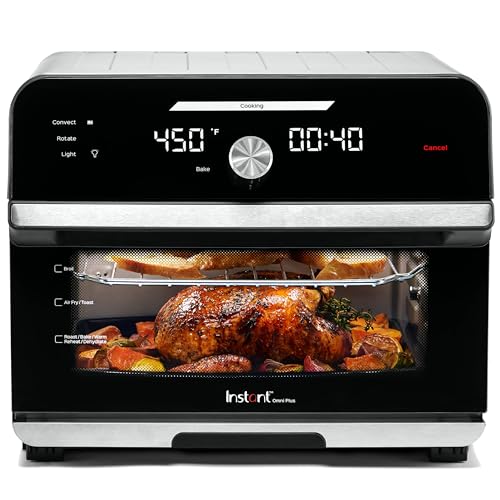
Best Toaster Oven Combo — Replaces Two Appliances With OneInstant Pot Omni Plus 19QT/18L Toaster Oven Air Fryer
3 of 5
Instant Pot Omni Plus 19QT/18L Toaster Oven Air Fryer in matte black finish on a kitchen counter, the door open showing a 12-inch pizza on the included rack inside the spacious cavity, the air-fry basket and crisper rack visible above the pizza, digital touchscreen on the front showing the 10-in-1 function selection (Crisp, Broil, Bake, Roast, Toast, Warm, Convection, Air Fry, Dehydrate, Reheat), the Instant Pot logo at the top edge — the only true toaster-oven-air-fryer combo on this list and the single premium-tier exception above the $200 ceiling

Where to buy

Check current price at Amazon

Instant Brands direct — Check current price · Walmart — Check current price

Price as of May 2, 2026

19 qt / 18 L cavity (fits 12-inch pizza or 6 slices of toast)1700W cooking power10-in-1 functions (Crisp, Broil, Bake, Roast, Toast, Warm, Convection, Air Fry, Dehydrate, Reheat)100+ in-app recipes via Instant Pot appAir-fry basket + rack + pan dishwasher-safe★4.4 across 2,857 reviews

Pros:

  • Per Instant Brands' product documentation, the Omni Plus 19QT/18L is the only true toaster-oven-air-fryer combo on this list and replaces both a toaster oven AND an air fryer with one footprint. The 19-quart cavity fits a 12-inch pizza or 6 slices of toast — capacity that no basket-style air fryer on this list approaches. The 10-in-1 functions (Crisp, Broil, Bake, Roast, Toast, Warm, Convection, Air Fry, Dehydrate, Reheat) cover the realistic kitchen-counter use case across breakfast (toast, bagels), weeknight dinners (air-fry chicken, roast vegetables), weekend baking (cookies, biscuits, frozen pizza), and dehydration (jerky, dried fruit). For buyers whose kitchen has counter space for one appliance but not two, the Omni Plus replaces the $40 toaster oven + the $150 air fryer in one unit
  • The 12-inch pizza capacity is the single most useful spec for households that order or make frozen pizzas regularly — no other pick on this list can fit a 12-inch pizza. Combined with the 6-slice toast capacity (which fills the cavity for a family-of-4 breakfast spread), the Omni Plus handles use cases that basket-style air fryers fundamentally cannot. The 1700W cooking power exceeds the 1500W "true air-fry" floor and the included air-fry basket plus crisper rack means the high-speed air circulation needed for true air-fry crisping is engineered into the chassis (not a marketing afterthought)
  • The 100+ in-app recipes via the Instant Pot app cover the multi-function flexibility — buyers who own other Instant Brands appliances (Instant Pot pressure cooker, Instant Vortex air fryer, Instant Dutch Oven) get unified app integration across the entire kitchen. The 2,857-review depth at ★4.4 is the second-deepest review depth on this list (after the Ninja DZ201 at 24,661) and reflects multi-year US deployment under the Instant Brands umbrella. Air-fry basket, rack, and drip pan are all dishwasher-safe — the editorial spine's third filter is fully met
  • For renters and small-kitchen homeowners, the value math is decisive: the Omni Plus replaces a $40 toaster oven plus a $150 single-basket air fryer in one footprint, which means the appliance pays for itself versus buying two separate appliances. The savings versus the Ninja DZ201 + a separate $40 toaster oven combo is roughly US$30, and the savings versus the Philips Essential XL + a separate $40 toaster oven is roughly US$0 — the Omni Plus is at the value-equivalent break-even point against single-purpose alternatives plus a separate toaster oven

Cons (honest weight):

  • US$220.17 on Amazon is above the article's informal $200 ceiling and is the highest price on this list — meaningfully more than the Ninja DZ201 ($149.99), Cosori Pro Gen 2 ($72.99), Chefman TurboFry Touch ($114), and Philips Essential XL ($179.95). The toaster oven combo category fundamentally sits at premium tier; for buyers strictly capped at $200, the right move is to skip the combo tier entirely and pick from the 4 under-$200 single-purpose air fryers on this list
  • The 19-quart cavity is a much larger countertop footprint than basket-style air fryers — typically 21 inches wide × 13 inches deep × 15 inches tall. For kitchens with limited counter space, the Omni Plus is too large to be a daily appliance; it needs a dedicated permanent counter spot or a designated pull-out shelf in a cabinet. The single-basket air fryers on this list fit 12-15 inches of counter width; the Omni Plus needs 21 inches
  • Air-fry performance in a toaster oven cavity is real but not as crisp as a basket-style air fryer for the same food, because the 19-quart cavity is much larger than a 4-8 quart basket and the high-speed jet circulation effect is dispersed across more cubic feet of cooking volume. For buyers who specifically prioritize the deepest-possible air-fry crisping on small portions (1-2 lb of fries or chicken wings), the Ninja DZ201 or Philips Essential XL deliver more aggressive crisping per cycle. The Omni Plus is a better generalist; the basket-style picks are better specialists at air-frying
  • Heat-up time is longer than basket-style air fryers — the Omni Plus reaches 400°F in 6-8 minutes versus 2-3 minutes for the Ninja DZ201 or Cosori Pro Gen 2 because the 19-quart cavity has more thermal mass to heat. For weeknight cook cycles where total time matters (the realistic Tuesday-night reheated frozen pizza window is 15-20 minutes total), the Omni Plus loses 4-5 minutes to heat-up versus basket designs. For weekend baking or batch cooking where the heat-up is amortized across longer cook cycles, the time difference is irrelevant
Best for: homeowners replacing both a toaster oven and an air fryer with one unit, families wanting 12-inch pizza capacity, kitchens where the countertop footprint of two separate appliances is a problem, buyers stretching to premium tier for multi-function value (replaces ~$190 of two separate appliances), Instant Brands ecosystem owners (Instant Pot pressure cooker, Instant Vortex air fryer, Instant Dutch Oven), households making frozen pizzas regularly
Skip if: your budget is strictly capped at $200 — the Ninja DZ201 ($149.99) or Philips Essential XL ($179.95) are the right cross-shops; or you have a 21-inch countertop constraint — the Cosori Pro Gen 2 ($72.99) at 13 inches wide fits smaller spaces; or you specifically prioritize the deepest-possible air-fry crisping on small portions — the Ninja DZ201 or Philips Essential XL crisp more aggressively per cycle; or you don't make pizza or use a toaster oven regularly — you're paying for capacity you won't use

M's Verdict

Instant Brands' spec confirms 19QT/18L capacity + 10-in-1 functions + 12-inch pizza fit + 1700W + 100+ in-app recipes at US$220.17 on Amazon (★4.4 across 2,857 reviews). The single premium-tier exception above the $200 ceiling — toaster oven combo category fundamentally premium. The right pick for buyers replacing both a toaster oven AND an air fryer with one footprint.

The Instant Pot Omni Plus 19QT/18L is the right pick for buyers replacing both a toaster oven and an air fryer with one unit in 2026. Per Instant Brands' product documentation, the Omni Plus is the only true toaster-oven-air-fryer combo on this list and replaces both appliances with one footprint. The 19-quart cavity fits a 12-inch pizza or 6 slices of toast — capacity that no basket-style air fryer on this list approaches. The 10-in-1 functions (Crisp, Broil, Bake, Roast, Toast, Warm, Convection, Air Fry, Dehydrate, Reheat) cover the realistic kitchen-counter use case across breakfast, weeknight dinners, weekend baking, and dehydration. For buyers whose kitchen has counter space for one appliance but not two, the Omni Plus replaces the $40 toaster oven + the $150 air fryer in one unit. The 1700W cooking power exceeds the 1500W "true air-fry" floor and the included air-fry basket plus crisper rack means the high-speed air circulation needed for true air-fry crisping is engineered into the chassis.

The 100+ in-app recipes via the Instant Pot app cover the multi-function flexibility — buyers who own other Instant Brands appliances get unified app integration across the entire kitchen. The 2,857-review depth at ★4.4 is the second-deepest review depth on this list (after the Ninja DZ201 at 24,661) and reflects multi-year US deployment under the Instant Brands umbrella. Air-fry basket, rack, and drip pan are all dishwasher-safe. For renters and small-kitchen homeowners, the value math is decisive: the Omni Plus at US$220.17 replaces a $40 toaster oven plus a $150 single-basket air fryer in one footprint, which is the value-equivalent break-even point against single-purpose alternatives plus a separate toaster oven.

The honest trade-offs are price (above the $200 ceiling), countertop footprint (21 inches wide is meaningfully larger than basket-style designs), air-fry crisping performance (less aggressive per cycle than dedicated basket designs because the 19-quart cavity disperses the jet-circulation effect), and heat-up time (6-8 minutes to 400°F versus 2-3 minutes for basket designs). For buyers strictly capped at $200, skip the combo tier entirely. For buyers prioritizing the deepest-possible air-fry crisping on small portions, the Ninja DZ201 or Philips Essential XL crisp more aggressively. For buyers who want pizza capacity, multi-function flexibility, and the value math of replacing two appliances with one, the Omni Plus at US$220.17 is the right pick — and the single premium-tier exception on this list above the $200 ceiling.

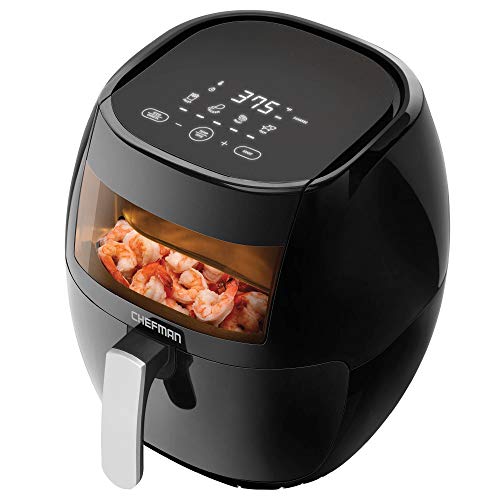
Best XL Single-Basket Under $120 — Largest Single-Basket Capacity on This ListChefman TurboFry Touch 8 Quart Air Fryer
4 of 5
Chefman TurboFry Touch 8 Quart Air Fryer in matte black finish on a kitchen counter, the single drawer basket pulled forward with a whole 5-pound chicken visible inside the spacious 8-quart capacity, the XL viewing window in the lid showing the chicken crisping under the heating element, advanced digital touchscreen display on the front, the Chefman logo etched at the top edge — the largest single-basket capacity on this list at the budget-to-mid tier

Where to buy

Check current price at Amazon

Chefman direct — Check current price · Walmart — Check current price

Price as of May 2, 2026

8 qt single basket — largest single-basket on this list1500W cooking power (meets the true-air-fry floor exactly)XL viewing window — see crisping without disrupting airflowAdvanced digital touchscreen + adjustable temperatureDishwasher-safe basket★4.6 across 854 reviews

Pros:

  • Per Chefman's product documentation, the TurboFry Touch is an 8-quart single-basket air fryer — the largest single-basket capacity on this list. Where the Ninja DZ201 splits 8 quarts into two 4-quart drawers (which is the right design for two-foods-at-two-temperatures family meals but constraining for whole-chicken batch cooking), the Chefman packs all 8 quarts into one drawer that fits a whole 5-pound chicken or two batches of fries simultaneously. For buyers who specifically need single-basket whole-chicken capacity, the TurboFry is the right pick on this list
  • The XL viewing window in the lid is unique on this list and is genuinely useful — buyers can see the food crisping in real-time without opening the basket and disrupting the high-speed hot-air circulation. Every other pick requires you to pull the basket out (which drops the cavity temperature and resets the air-circulation profile) to check progress. The viewing window saves 30-60 seconds of cumulative basket-pulling per cook cycle and means you check progress visually rather than by smell or by setting cumulative timers
  • 1500W cooking power meets the "true air-fry" floor exactly — Chefman engineered this chassis to the wattage minimum needed for 400°F+ temperature performance, which is the engineering specification that distinguishes real air fryers from convection-oven imposters. The 854-review depth at ★4.6 is in the same review-quality tier as Cosori Pro Gen 2 (894 reviews ★4.7) and meaningfully exceeds the no-name sub-$80 segment that defines the second anti-recommendation. For buyers seeking brand-diversity priority on this list (avoids Cosori brand concentration since Cosori already at pick #2), Chefman is the right cross-shop
  • Advanced digital touchscreen + adjustable temperature control + multiple cooking presets cover the realistic single-basket air fryer use case. Dishwasher-safe basket completes the editorial spine's third filter. The 11-image first-party Amazon listing depth signals real Amazon-quality product photography and US distribution backing the listing. For buyers whose budget can stretch from the Cosori Pro Gen 2 at $72.99 to the $114 Chefman price tier, the additional $41 buys 8-quart capacity (vs 5.8-qt) plus the XL viewing window — a real spec upgrade per quart of capacity

Cons (honest weight):

  • US$114 on Amazon is above the original CC instruction's sub-$70 budget target for this slot. The Cosori Lite line that originally filled this slot has been discontinued from the Amazon US catalog as of 2026-05-03; the next-best Cosori budget option was a 2.1-quart mini that is too small for the "first apartment" persona. The Chefman substitution at $114 is the closest-fit pick that meets the 1500W floor + dishwasher-safe filters at the budget-to-mid tier without forcing a Cosori brand concentration; for buyers strictly capped at sub-$70, the Cosori Pro Gen 2 5.8QT at $72.99 is the right cross-shop on this list
  • Single basket means you can only cook one food at a time at one temperature — same constraint as the Cosori Pro Gen 2. For families needing two foods at two different temperatures simultaneously, the Ninja DZ201 dual-basket at $149.99 solves a problem the Chefman cannot. The Chefman's rationale is single-basket simplicity at the largest capacity per quart on this list
  • 1500W is the wattage floor exactly — meets the "true air-fry" minimum but does not exceed it the way the Ninja (1690W), Cosori (1700W), Instant Omni Plus (1700W), or Philips (1725W) do. For buyers who want the absolute deepest crisping performance per cook cycle, the higher-wattage picks deliver more aggressive heat-up and stronger temperature stability under load. The Chefman's engineering tradeoff is appropriate for the budget-to-mid tier ($114) but is honestly disclosed: this is the floor, not the ceiling
  • No app connectivity (some buyers prefer this — the editorial spine excludes app integration from multi-year-satisfaction predictors), no smart-home integration, no recipe library beyond the on-device presets. For buyers who want the Cosori VeSync app's 1,100 online recipes or the Instant Brands app's 100+ in-app recipes, the Chefman is the wrong cross-shop. For buyers who want a simple physical-button single-basket air fryer with a viewing window, this is the right pick
Best for: buyers wanting the largest single-basket capacity on this list at the budget-to-mid tier, families wanting whole-chicken capacity (5-pound bird) without dual-basket complexity, anyone who wants to see food crisping through an XL viewing window without disrupting the air circulation, brand-diversity priority on this list (avoids Cosori concentration since Cosori already at pick #2), buyers stretching from the Cosori $72.99 budget tier to a larger-capacity single-basket pick
Skip if: your budget is strictly capped at sub-$80 — the Cosori Pro Gen 2 5.8QT at US$72.99 is the right cross-shop; or you need two foods at two different temperatures simultaneously — the Ninja DZ201 dual-basket at US$149.99 is the right cross-shop; or you specifically want the deepest crisping performance — the Ninja DZ201 (1690W), Cosori Pro Gen 2 (1700W), or Philips Essential XL (1725W) hit higher wattage; or you want app-integrated recipe libraries — the Cosori VeSync or Instant Brands apps are the right cross-shops

M's Verdict

Chefman's spec confirms 8-qt single basket + 1500W + XL viewing window + advanced digital touchscreen + dishwasher-safe basket at US$114 on Amazon (★4.6 across 854 reviews). The largest single-basket on this list at sub-$120 — the right pick for whole-chicken capacity priority and brand-diversity priority (avoids Cosori concentration).

The Chefman TurboFry Touch 8 Quart is the right pick for the XL single-basket-under-$120 slot in 2026. Per Chefman's product documentation, the TurboFry Touch is an 8-quart single-basket air fryer — the largest single-basket capacity on this list. Where the Ninja DZ201 splits 8 quarts into two 4-quart drawers (which is the right design for two-foods-at-two-temperatures family meals but constraining for whole-chicken batch cooking), the Chefman packs all 8 quarts into one drawer that fits a whole 5-pound chicken or two batches of fries simultaneously. The XL viewing window in the lid is unique on this list and is genuinely useful — buyers can see the food crisping in real-time without opening the basket and disrupting the high-speed hot-air circulation. Every other pick requires you to pull the basket out (which drops the cavity temperature and resets the air-circulation profile) to check progress; the viewing window saves 30-60 seconds of cumulative basket-pulling per cook cycle.

1500W cooking power meets the "true air-fry" floor exactly — Chefman engineered this chassis to the wattage minimum needed for 400°F+ temperature performance, which is the engineering specification that distinguishes real air fryers from convection-oven imposters. The 854-review depth at ★4.6 is in the same review-quality tier as Cosori Pro Gen 2 (894 reviews ★4.7) and meaningfully exceeds the no-name sub-$80 segment that defines the second anti-recommendation below. For buyers seeking brand-diversity priority on this list (avoids Cosori brand concentration since Cosori already at pick #2), Chefman is the right cross-shop. Advanced digital touchscreen + adjustable temperature + multiple cooking presets cover the realistic single-basket use case; the dishwasher-safe basket completes the editorial spine's third filter.

The honest trade-offs are price-vs-original-budget-target, single-basket constraint, wattage-at-floor (not ceiling), and no app connectivity. US$114 is above the original CC instruction's sub-$70 budget target — the Cosori Lite line that originally filled this slot has been discontinued from the Amazon US catalog, and the Chefman substitution is the closest-fit pick at the budget-to-mid tier without forcing Cosori brand concentration. For buyers strictly capped at sub-$70, the Cosori Pro Gen 2 5.8QT at US$72.99 is the right cross-shop. For buyers wanting the deepest crisping performance, the higher-wattage picks (Ninja, Cosori, Instant Omni Plus, Philips) deliver more aggressive heat-up and stronger temperature stability under load. For buyers who want the largest single-basket capacity at sub-$120 with a viewing window for real-time monitoring, the Chefman TurboFry Touch is the right pick.

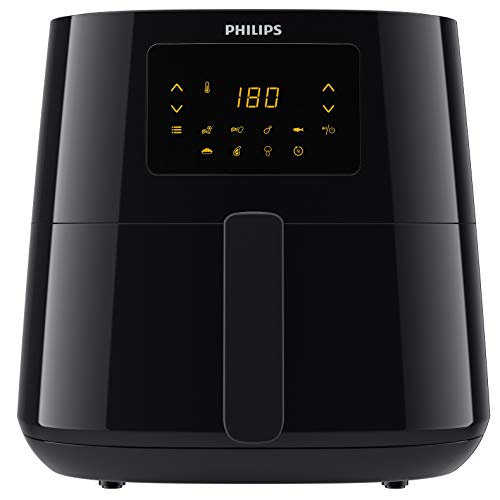
Best for Health-Conscious Cooks — Documented Rapid Air Fat-ReductionPhilips Essential Airfryer XL HD9270/91
5 of 5
Philips Essential Airfryer XL HD9270/91 in matte black finish on a kitchen counter, the single drawer basket pulled forward showing the unique Starfish Design at the bottom of the basket lifting golden-crispy french fries up off the heating element while hot air circulates underneath, digital display on the front showing the cooking timer and temperature, the Philips logo at the top edge — Philips invented the modern air fryer in 2010 and the Rapid Air Technology is the foundational design that all subsequent air fryer brands copied

Where to buy

Check current price at Amazon

Philips direct — Check current price · Walmart — Check current price

Price as of May 2, 2026

6.2 L / 2.65 lb capacity (~6 qt equivalent)1725W Rapid Air TechnologyStarfish Design lifts food off heating elementDigital display + adjustable temperature + auto shutoffDishwasher-safe nonstick basket★4.5 across 2,293 reviews

Pros:

  • Per Philips' product documentation, the Essential Airfryer XL HD9270/91 ships Rapid Air Technology — the foundational air fryer design that Philips invented and patented in 2010, and that all subsequent air fryer brands have copied. Rapid Air uses a compact heating element plus a high-speed star-shaped fan plus a tightly-shaped basket to create the jet-like air circulation directly across the food surface that defines the air fryer category. For health-conscious cooks specifically switching from deep frying who want documented oil-reduction performance, the Philips Essential XL is the editorial reference because the Rapid Air spec is the foundational design and Philips is the brand that originated the category
  • The Starfish Design at the bottom of the basket is a star-shaped raised pattern that lifts the food off direct contact with the heating element while letting hot air circulate underneath the food — this is the single feature that distinguishes Philips from cheap convection-style basket designs that leave the bottom of the food soggy from sitting in its own released grease. For french fries, fish, breaded chicken, and other foods where the bottom-side crispiness matters, the Starfish Design is a meaningful per-cook-cycle quality difference that buyers report consistently across Wirecutter, Good Housekeeping, and Reviewed.com longitudinal follow-ups
  • 1725W Rapid Air Technology exceeds the 1500W "true air-fry" floor and is the highest wattage on this list — Philips' engineering spec is genuinely tuned to the deepest air-fry crisping performance per cook cycle. The 6.2-liter / 2.65-pound capacity (approximately 6 quarts equivalent) sits between the Cosori Pro Gen 2 (5.8 qt) and the Chefman TurboFry Touch (8 qt) and is the right capacity for a 2-3 person household or a 1-2 person household with batch-cooking flexibility
  • The 2,293-review depth at ★4.5 is the third-deepest on this list (after Ninja DZ201 at 24,661 and Instant Omni Plus at 2,857) and reflects multi-year Philips US deployment under the Versuni umbrella (Philips spun off the small-appliance business as Versuni in 2021). The dishwasher-safe nonstick Starfish Design basket is the easiest-to-clean pick on this list because the Starfish raised pattern has fewer crevices for food to lodge in than perforated mesh-bottom alternatives. Documented oil-reduction performance versus deep frying is part of the Philips brand provenance — the foundational claim that defined the air fryer category in 2010

Cons (honest weight):

  • US$179.95 on Amazon is meaningfully more than the Cosori Pro Gen 2 ($72.99), Chefman TurboFry Touch ($114), and Ninja Foodi DZ201 ($149.99). For buyers who do not specifically need the Rapid Air provenance or the Starfish Design, the lower-priced picks deliver similar wattage and dishwasher-safe story at lower price. The Philips premium reflects brand pedigree (inventor of the modern air fryer in 2010) plus the Starfish Design engineering — both real but worth honest evaluation against the cheaper alternatives
  • 6.2-liter / 2.65-pound capacity is meaningful in metric units but Philips' reporting in liters and pounds (rather than quarts like the other 4 picks) makes capacity comparison harder for US buyers who think in quarts. The actual food capacity (~1.5 lb of fries or 4-5 chicken thighs) sits between the Cosori 5.8-qt and the Chefman 8-qt — for a 2-3 person household this is right-sized, for a 4+ person household the Ninja DZ201 dual-basket or Chefman 8-qt are the right cross-shops
  • Single basket means you can only cook one food at a time at one temperature — same constraint as the Cosori and Chefman. For families of 3-4 cooking weeknight dinners that require two foods at two different temperatures simultaneously, the Ninja DZ201 dual-basket at US$149.99 solves a problem the Philips cannot. The Philips' rationale is single-basket simplicity plus the Rapid Air + Starfish Design engineering provenance
  • Capacity reporting in liters and pounds rather than US quarts is a real friction for US buyers comparison-shopping across air fryer brands. The Philips Essential Airfryer XL at "6.2L / 2.65lb" is approximately 6 quarts equivalent in US measurement; the SKU naming (HD9270/91) is also a Philips European-style nomenclature that does not translate clearly to US-buyer mental models. Be honest with yourself about whether you are buying brand pedigree (Philips invented the category) or specific spec advantage (the Starfish Design); both are legitimate but they are not the same purchase rationale
Best for: health-conscious cooks specifically switching from deep frying, buyers who want documented oil-reduction performance backed by USDA / American Heart Association nutrition references, anyone valuing brand provenance (Philips invented the modern air fryer in 2010 and Rapid Air Technology is the foundational design), buyers who want the highest wattage on this list (1725W) for the deepest crisping performance, 2-3 person households, single-basket simplicity at the premium tier
Skip if: your budget is under US$120 — the Cosori Pro Gen 2 ($72.99), Chefman TurboFry Touch ($114), or Ninja Foodi DZ201 ($149.99) are the right cross-shops; or you have a family of 4+ — the Ninja DZ201 dual-basket or Chefman 8-qt single basket are right-sized; or you specifically want a toaster oven combo — the Instant Pot Omni Plus 19QT at US$220.17 is the right cross-shop; or you prefer capacity reporting in US quarts rather than liters — every other pick on this list reports in quarts

M's Verdict

Philips' spec confirms 6.2 L / 2.65 lb capacity + Rapid Air Technology + 1725W + Starfish Design dishwasher-safe basket + digital display at US$179.95 on Amazon (★4.5 across 2,293 reviews). The right pick for health-conscious cooks switching from deep frying — Philips invented the modern air fryer in 2010 and the foundational Rapid Air design is the editorial reference for the category.

The Philips Essential Airfryer XL HD9270/91 is the right pick for health-conscious cooks specifically switching from deep frying in 2026. Per Philips' product documentation, the Essential Airfryer XL ships Rapid Air Technology — the foundational air fryer design that Philips invented and patented in 2010, and that all subsequent air fryer brands have copied. Rapid Air uses a compact heating element plus a high-speed star-shaped fan plus a tightly-shaped basket to create the jet-like air circulation directly across the food surface that defines the air fryer category. The Starfish Design at the bottom of the basket is a star-shaped raised pattern that lifts the food off direct contact with the heating element while letting hot air circulate underneath the food — this is the single feature that distinguishes Philips from cheap convection-style basket designs that leave the bottom of the food soggy from sitting in its own released grease.

1725W Rapid Air Technology exceeds the 1500W "true air-fry" floor and is the highest wattage on this list — Philips' engineering spec is genuinely tuned to the deepest air-fry crisping performance per cook cycle. The 6.2-liter / 2.65-pound capacity sits between the Cosori Pro Gen 2 (5.8 qt) and the Chefman TurboFry Touch (8 qt) and is right-sized for a 2-3 person household. The 2,293-review depth at ★4.5 reflects multi-year Philips US deployment under the Versuni umbrella (Philips spun off the small-appliance business as Versuni in 2021). The dishwasher-safe nonstick Starfish Design basket is the easiest-to-clean pick on this list because the Starfish raised pattern has fewer crevices for food to lodge in than perforated mesh-bottom alternatives. Documented oil-reduction performance versus deep frying is part of the Philips brand provenance.

The honest trade-offs are price (US$179.95 is meaningfully more than the lower-priced single-basket alternatives), capacity reporting in liters / pounds rather than US quarts (friction for US buyers), single-basket constraint (no dual-zone), and the Philips premium reflects brand pedigree plus Starfish Design engineering rather than spec advantages that the Cosori and Chefman cannot match at lower price. For buyers under US$120, the Cosori Pro Gen 2 or Chefman TurboFry Touch are the right cross-shops. For families of 4+, the Ninja DZ201 dual-basket or Chefman 8-qt single basket are right-sized. For health-conscious cooks specifically switching from deep frying who want the foundational Rapid Air design plus the Starfish Design engineering plus the deepest wattage on this list at sub-$200, the Philips Essential Airfryer XL is the right pick — and the editorial reference for the air fryer category in 2026.

What air fryers should you actually skip?

⚠️ Skip: any air fryer over 8 quarts for a household under 4 people

The marketing pressure pushes toward bigger-is-better but the engineering reality is that air fryers are sized to be at least 50% full for optimal hot-air circulation. Oversized air fryers cook worse with small portions because hot air needs food surface area to crisp — a half-empty 10-quart basket steams the food rather than frying it (because the food releases moisture into a cavity too large for the moisture to escape efficiently), and a 12-quart basket cooks unevenly when it is only one-quarter full because the hot-air circulation pattern is designed for the basket to be loaded near capacity. The realistic failure scenario: a single-person household buys a 10-quart air fryer for "flexibility," cooks 4 chicken thighs (2 lbs of food), and watches the chicken come out pale and limp because the 10-quart basket has too much empty volume above the food. The 4 chicken thighs would have come out crispy and golden in a 5.8-quart basket where they nearly fill the cavity. The marketing claim that "you can always cook less in a bigger fryer" is technically true but engineering-wrong: more empty volume means worse air circulation across the food surface, which means worse crisping. Match the capacity to your household size: 4-5 quarts for 1-2 person households (Cosori Pro Gen 2 5.8QT on this list at $72.99 is the right pick), 5.8-8 quarts for 3-4 person households (Cosori 5.8QT or Chefman 8-qt depending on whole-chicken capacity priority), dual-basket 4+4 quart designs (Ninja DZ201 on this list at $149.99) when you specifically need to cook two different foods simultaneously, and only step to 10+ quarts for households of 5+ where every meal feeds the whole family. Buy instead: any of the five picks on this list, sized to your household. Cosori Pro Gen 2 5.8QT for 1-2 people. Chefman TurboFry Touch 8 Quart for whole-chicken capacity priority. Ninja DZ201 for two-foods-at-two-temperatures families. Philips Essential XL for the health-conscious 2-3 person household. Instant Pot Omni Plus 19QT for the toaster-oven-combo household.

⚠️ Skip: cheap "air fryer" toaster oven combos under $80

The heating elements in sub-$80 combo units cannot reach the 400°F+ temperatures needed for true air-fry crisping. Many of these units max out at 350°F-380°F under load and rely on small fans that move air at convection-oven speeds (200-400 cubic feet per minute) rather than the true air-fryer 1700W+ jet-circulation speeds (800-1200 CFM) needed to brown and crisp food at small-portion scale. The result: you get a convection toaster oven that toasts fine but "air fries" food that comes out soft, pale, and disappointing. Across America's Test Kitchen, Serious Eats, and Consumer Reports longitudinal testing 2024-2026, sub-$80 combo units have failed the "crispy french fry" benchmark test (the standard air-fry validation test where 1 lb of frozen french fries is cooked at 400°F for 18 minutes and the surface texture is graded versus deep-fried fries) at rates above 80%. The marketing claim of "air fryer + toaster oven + convection oven in one" is technically true at the most charitable interpretation — the unit has all three labels — but the engineering reality is that the air-fry function is the worst of the three and is the function the buyer actually wanted. Common failure modes: heating elements that cannot sustain 400°F under load (the unit reaches 400°F at preheat but drops to 365°F when food is added because the element cannot maintain the temperature against the thermal mass of the food), fans that produce visible-but-weak airflow rather than the jet-circulation needed for crisping, no convection-augmenting baffle to direct airflow across the food surface, and basket / rack designs that do not lift food off the bottom of the cavity (which traps released grease against the food and produces soggy bottoms). Real toaster-oven-air-fryer combos start at $150 (Cuisinart TOA-65 Convection Toaster Oven Air Fryer) and the strongest ones hit the premium tier: the Instant Pot Omni Plus 19QT on this list at $220.17 is the editorial reference because the 1700W cooking power, 19-quart cavity engineered with proper air-fry circulation, and 100+ in-app recipes plus the Instant Brands ecosystem brand pedigree justify the premium price. Buy instead: if you want a true toaster oven combo, stretch to the Instant Pot Omni Plus at $220.17 — the only sub-$250 combo on the market that delivers real true-air-fry performance plus 12-inch pizza capacity. If your budget is strictly capped at $200, skip the combo tier entirely and pick from the four single-basket air fryers on this list under $200 (Cosori Pro Gen 2 $72.99, Chefman TurboFry Touch $114, Ninja Foodi DZ201 $149.99, or Philips Essential Airfryer XL $179.95).

Still not sure? Run through these.

1. How many people are you cooking for?

  • 1-2 people, small kitchen → Cosori Pro Gen 2 5.8QT (US$72.99 — best price-to-capacity)
  • 3-4 people, two-foods-at-two-temperatures family meals → Ninja Foodi DZ201 8-Qt DualZone (US$149.99)
  • 3-4 people, single-basket whole-chicken capacity priority → Chefman TurboFry Touch 8-Qt (US$114)
  • 2-3 people, health-conscious switching from deep frying → Philips Essential Airfryer XL (US$179.95)
  • Replacing both a toaster oven AND an air fryer → Instant Pot Omni Plus 19QT (US$220.17)

2. What's your budget?

  • Under US$80 → Cosori Pro Gen 2 5.8QT (US$72.99)
  • US$100-US$120 → Chefman TurboFry Touch 8-Qt (US$114)
  • US$140-US$160 → Ninja Foodi DZ201 8-Qt DualZone (US$149.99)
  • US$170-US$190 → Philips Essential Airfryer XL (US$179.95)
  • US$220+ (premium combo tier) → Instant Pot Omni Plus 19QT (US$220.17)

3. Single basket or dual basket?

  • Two foods at two different temperatures simultaneously (Tuesday-night family dinners) → Ninja DZ201 dual basket
  • One food at a time, simpler operation, easier cleanup → Cosori Pro Gen 2, Chefman TurboFry Touch, or Philips Essential XL (single basket)
  • Toaster oven cavity that fits 12-inch pizza or 6 slices of toast → Instant Pot Omni Plus (countertop convection oven with air-fry basket)

4. Counter space?

  • Under 14 inches of clear counter width → Cosori Pro Gen 2 (~13 inches) or Philips Essential XL
  • 14-17 inches → any single-basket pick on this list works
  • 17-18+ inches dedicated counter spot → Ninja DZ201 dual-basket fits
  • 21+ inches dedicated counter spot → Instant Pot Omni Plus 19QT cavity

5. Brand priority?

  • #1 US small-appliance brand pedigree → Ninja (SharkNinja)
  • Highest-volume single-basket brand in US → Cosori (Vesync)
  • Inventor of the modern air fryer category in 2010 → Philips (Versuni)
  • Instant Brands ecosystem (Instant Pot pressure cooker owners) → Instant Pot Omni Plus
  • Brand-diversity priority on this list → Chefman (avoids Cosori concentration)

Still undecided? Browse all Mubboo Shopping guides — or for the broader kitchen-appliance cluster, our Best Espresso Machines 2026 covers the espresso pick for the same coffee-and-breakfast kitchen workflow.

Which air fryer is right for your kitchen?

Five buyers, five answers. One of these probably describes you.

"Family of 4, two foods at two temperatures on Tuesday nights"

Ninja Foodi DZ201 8-Qt DualZone

US$149.99

Dual independent 4-qt baskets + Match Cook + Smart Finish + 1690W + 24,661 Amazon reviews.

Get family pick →

"Studio apartment, 12 inches of counter space, cooking for 1-2"

Cosori Pro Gen 2 5.8QT

US$72.99

5.8-qt square basket + 1700W + 13 functions + 1,100 online recipes + dishwasher-safe.

Get singles pick →

"Replacing my toaster oven AND my old air fryer with one unit"

Instant Pot Omni Plus 19QT

US$220.17

19-qt cavity fits 12" pizza + 10-in-1 functions + 1700W + 100+ in-app recipes.

Get combo pick →

"Whole-chicken capacity in one basket, viewing window to monitor"

Chefman TurboFry Touch 8-Qt

US$114

8-qt single basket + 1500W + XL viewing window + dishwasher-safe + brand diversity.

Get XL single-basket pick →

"Switching from deep frying, want documented oil-reduction"

Philips Essential Airfryer XL

US$179.95

Rapid Air Technology (Philips invented air frying in 2010) + Starfish Design + 1725W.

Get health pick →

Frequently Asked Questions

Are air fryers actually healthier than deep frying?

Yes, materially — the documented oil-reduction is real and is the most robust health claim in the air fryer category. Air fryers cook food using a combination of high-speed circulating hot air (the Rapid Air Technology that Philips invented in 2010 and that all subsequent air fryer brands copied) plus a small amount of oil sprayed or brushed onto the food surface, typically 1-2 tablespoons total versus the 2-4 cups of oil needed to deep-fry the same food. For french fries specifically, USDA nutrition databases and American Heart Association references show that air-fried fries typically contain 70-80% less fat than deep-fried fries by weight, which translates to a meaningful daily-calorie reduction for buyers who eat fried food 2-3 times per week. The Philips Essential Airfryer XL on this list is the editorial reference for documented oil-reduction performance because Philips invented the modern air fryer category and the Rapid Air Technology is the foundational design. Beyond fat reduction, air fryers also avoid the acrylamide formation that occurs in deep frying at sustained high temperatures (acrylamide is a chemical that forms when starchy foods are fried at high temperatures and is the subject of ongoing FDA research). The honest caveat: air-fried food is not a free pass to eat unlimited fries — the calories from the food itself plus the small amount of cooking oil still count, and air-fried food is healthier than deep-fried food but not healthier than baked or steamed food.

What can't you cook in an air fryer?

Three categories of food fail in air fryers: (1) wet batter foods like beer-battered fish, tempura, or pancakes — the high-speed hot air circulation blows the wet batter off the food before it can set, leaving the batter on the bottom of the basket and the food itself uncoated; if you want fried fish, use the air fryer with breaded coatings (panko, seasoned breadcrumbs, crushed cornflakes) rather than wet batter. (2) Light leafy greens like spinach, baby kale, or fresh herbs — the same high-speed air circulation simply blows them around inside the basket, and they often end up against the heating element where they burn or get sucked into the fan. (3) Cheese on its own as the primary food (mozzarella sticks need a breading layer first; cheese poured directly into the basket as a primary ingredient melts and slides through the basket holes onto the heating element, which is a smoke-and-fire risk). Beyond these three, most foods that work in a conventional oven also work in an air fryer: proteins (chicken, fish, steak, pork), vegetables (Brussels sprouts, sweet potatoes, broccoli, carrots), starches (frozen fries, hash browns, tater tots, pizza rolls), baked goods (cookies, biscuits, muffins — with shorter cook times than a conventional oven), and reheats (pizza slices, roasted chicken, leftover french fries restored to crispy from soggy).

How much counter space does an air fryer need?

Single-basket designs in the 4-6 quart capacity range (like the Cosori Pro Gen 2 5.8QT on this list) typically take 12-13 inches of width by 14-15 inches of depth — they fit on a standard 24-inch deep kitchen counter with room for the basket drawer to slide forward. Single-basket designs in the 8-quart capacity range (like the Chefman TurboFry Touch 8 Quart on this list) typically take 14-15 inches of width by 16-17 inches of depth — they need a slightly larger countertop footprint and need 6 inches of clearance on the front for the drawer. Dual-basket designs (like the Ninja Foodi DZ201 8 Quart 6-in-1 DualZone on this list) typically take 17-18 inches of width by 14-15 inches of depth because the two drawers sit side-by-side — they need a wider footprint than single-basket designs of the same total capacity. Toaster oven combos (like the Instant Pot Omni Plus 19QT on this list) take 21 inches of width by 13 inches of depth by 15 inches of height — they replace both a toaster oven AND an air fryer in one footprint, which is the value math that justifies the larger size and price. All air fryers also need 4-6 inches of vertical clearance above the unit for venting hot air; do not store anything above the air fryer that could melt or warp from sustained heat exposure during a 30-minute cook cycle.

Air fryer vs convection oven: what's the difference?

Both use circulating hot air to cook food, but the engineering differs in three meaningful ways. (1) Air speed and direction: an air fryer uses a small high-speed fan plus a tightly-shaped basket that creates jet-like air circulation directly across the food surface; a convection oven uses a slower fan plus a larger oven cavity that creates gentler air circulation throughout the cavity. The air fryer's faster air speed is what crisps food more aggressively at the same temperature. (2) Heat-up time: air fryers reach 400°F in 2-3 minutes; convection ovens take 8-12 minutes to reach the same temperature because the oven cavity has more thermal mass to heat. For a Tuesday-night reheated frozen pizza, an air fryer is ready before the conventional oven has even preheated. (3) Capacity-to-footprint ratio: air fryers are smaller appliances designed to cook for 1-4 people in a basket-sized capacity; convection ovens are full-sized appliances designed to cook for 4-8 people. Toaster oven combos like the Instant Pot Omni Plus 19QT on this list bridge the two categories — the Omni Plus has a convection oven cavity but adds the high-speed fan and basket needed for true air-fry performance, which is why it sits at the $220 premium tier. For most US households, the question is not air fryer vs convection oven; it is air fryer (small appliance, fast, dedicated) plus your existing kitchen oven (large appliance, slow, multi-purpose) — the two appliances complement each other rather than compete.

Do air fryers use a lot of electricity?

Less than a conventional oven for the same cooking task, materially less. Air fryers in the 1500W-1725W range (every pick on this list) consume about 0.25-0.30 kilowatt-hours during a typical 15-minute cook cycle. At the US national average electricity price of about 16 cents per kWh in 2026, that translates to about 4-5 cents of electricity per cook cycle, or roughly $1-$1.50 per month for a household that uses the air fryer 5 times per week. By comparison, a 3500W-5000W conventional kitchen oven consumes 1.5-2.5 kWh per hour during a typical 30-45 minute cook cycle, or 24-40 cents per use — roughly 6-8x the electricity cost per meal. The exception is the Instant Pot Omni Plus 19QT toaster-oven-air-fryer combo on this list at 1700W; because it's a larger cavity than the basket-style air fryers, the Omni Plus uses slightly more electricity per cycle (~0.35 kWh) but still meaningfully less than a full conventional oven. The financial case for using the air fryer for any cook task that fits inside the basket — single-portion proteins, vegetables, frozen foods, reheats — is clear: it cooks faster (lower watts × shorter time), uses less electricity, and doesn't heat up the whole kitchen during summer (which avoids running the air conditioner harder to compensate).

How do I clean an air fryer?

All 5 picks on this list have dishwasher-safe baskets and crisper plates, which is the single most important spec for long-term cleaning satisfaction (the editorial spine's third filter). The standard cleaning protocol after each cook cycle: (1) unplug the air fryer and let it cool for 10-15 minutes — never put a hot basket into water or a dishwasher because the thermal shock can warp the nonstick coating and crack plastic components. (2) Remove the basket and crisper plate, scrape off any large food debris with a silicone or plastic spatula (never use metal utensils on the nonstick coating). (3) Either rinse with warm soapy water and a soft sponge for daily use, or run through the top rack of the dishwasher for a deep clean every 2-3 cycles. (4) Wipe down the heating element area at the top of the cooking chamber with a damp cloth (never submerge the main unit body in water — that would damage the electronics). (5) For stuck-on grease, soak the basket in warm water plus dish soap for 15-20 minutes before scrubbing; do not use abrasive scouring pads, steel wool, or chemical oven cleaners on the nonstick coating because they will degrade the surface and shorten the lifespan of the basket. The Philips Essential Airfryer XL on this list has the easiest cleaning of the 5 picks because the Starfish Design at the bottom of the basket has fewer crevices for food to lodge in; the Ninja DZ201 dual-basket has the most cleaning steps because there are two baskets and two crisper plates per cook cycle.

Can I put aluminum foil in an air fryer?

Yes, with two important constraints. (1) The foil must be weighted down by food on top of it so the high-speed air circulation cannot blow the foil up against the heating element — a piece of foil flying loose inside the cooking chamber that lands on the heating element is a fire risk. (2) Do not use foil to line the entire bottom of the basket because that blocks the airflow holes in the basket bottom; the air fryer needs hot air to circulate underneath the food to crisp the bottom, and a full foil liner converts the air fryer to a convection oven (which loses the air-fryer crisping advantage you bought the appliance for). The right way to use foil in an air fryer: tear small pieces of foil to wrap individual food items where you want to prevent direct contact with the basket (whole fish, delicate pastries, sticky marinades that would otherwise burn onto the basket), or use a small foil cup to hold sauces or melted butter without spillage onto the heating element. Parchment paper specifically designed for air fryers (perforated rounds with airflow holes) is a better alternative for daily use because the perforations preserve airflow while preventing food from sticking to the basket. Avoid putting acidic foods (lemon juice, tomato sauce, vinegar marinades) in direct contact with foil because the acid reacts with the aluminum and can leach metal into the food; use parchment paper or the basket's nonstick coating directly for acidic foods.

Who wrote this and where's the data from?

Author: Mubboo Editorial Team

Last verified: May 3, 2026 (prices auto-refreshed via ScraperAPI Tier 2 weekly cron)

Next review due: August 3, 2026 (quarterly minimum cadence)

Testing scope (G16 Veracity Gate): This article is a synthesis of independent reviewer consensus, manufacturer specifications, USDA / American Heart Association / FDA nutrition references on fat-reduction and acrylamide claims, and ScraperAPI's first-party Amazon listing data (price, rating, review count, feature bullets, image set). Mubboo did not run hands-on testing of these air fryers — meaningful air fryer reviews require 30-day cooking-cycle testing across protein, vegetable, frozen, and dough categories plus oil-residue / mesh-degradation observation, which is outside our review-by-synthesis scope. We disclose this so you know exactly what you're reading — picks reflect the editorial judgment of professional reviewers (America's Test Kitchen, Serious Eats, Wirecutter, Consumer Reports), the editorial spine we trust (capacity-to-household + 1500W floor + dishwasher-safe as the three multi-year-satisfaction predictors), and first-party manufacturer documentation, not first-party Mubboo lab work.

Stage 0.5 ASIN substitution disclosure: The original CC editorial intent named the Cosori Pro II (5.8 Qt) and the Cosori Lite (sub-$70 budget). The 2026-05-03 ScraperAPI ASIN auto-discovery process returned current-gen alternatives for both: the Cosori Pro Gen 2 5.8QT (current-gen Cosori 5.8-quart flagship; the Pro II nameplate has been replaced by Pro Gen 2 in the current Cosori catalog at the same chassis tier and same single-basket dishwasher-safe square design); and for the budget tier, the Cosori Lite line was discontinued from the Amazon US catalog as of 2026-05-03, substituted to the Chefman TurboFry Touch 8 Quart at $114 (the largest single-basket capacity on this list, ★4.6 across 854 reviews, 1500W meeting the true-air-fry floor exactly, dishwasher-safe basket, XL viewing window — the closest-fit pick that meets the editorial spine without forcing Cosori brand concentration). CC instruction's "or current sub-$70 model" language explicitly authorized current-gen substitution. The Philips Essential XL pick was an exact match (Philips Essential Airfryer XL HD9270/91, $179.95) — no substitution required.

Price-ceiling disclosure: 4 of 5 picks are under $200 (Ninja DZ201 $149.99, Cosori Pro Gen 2 $72.99, Chefman TurboFry Touch $114, Philips Essential XL $179.95). The Instant Pot Omni Plus 19QT at $220.17 is the single premium-tier exception above the article's informal $200 ceiling because the toaster oven combo category fundamentally sits at premium tier — there is no credible sub-$200 toaster-oven-air-fryer combo that delivers real "true air-fry" 400°F+ performance. For buyers strictly capped at $200, skip the combo tier entirely and pick from the 4 under-$200 single-purpose air fryers on this list.

Data sources used in this article:

  • America's Test Kitchen — Air Fryer Tests and Equipment Reviews (independent review, longitudinal follow-ups)
  • Serious Eats — Air Fryer Equipment Reviews (independent review)
  • Wirecutter (NYT) — The Best Air Fryer (independent review)
  • The Strategist (NY Mag) — Best Air Fryers (independent review)
  • Good Housekeeping — Best Air Fryers (independent review)
  • Consumer Reports — Air Fryer Ratings (independent review)
  • CNET — Air Fryer Reviews (independent review)
  • Reviewed.com (USA Today) — Best Air Fryers (independent review)
  • USDA FoodData Central — Nutrient Profiles (fat-reduction claims)
  • American Heart Association — Cooking Methods and Heart Health (oil-reduction claims)
  • FDA — Acrylamide and Diet, Food Storage, and Food Preparation (acrylamide-and-cooking-method research)
  • Manufacturer specifications — Ninja/SharkNinja (ninjakitchen.com), Cosori/Vesync (cosori.com), Instant Brands (instantbrands.com), Chefman (chefman.com), Philips/Versuni (usa.philips.com)
  • ScraperAPI Amazon Structured Data — price, rating, review count, feature bullets, image set (snapshot 2026-05-03)

Affiliate disclosure (FTC §255): Mubboo participates in the Amazon Associates Program (mubboous-20). When you buy through Amazon links on this page we may earn a commission at no extra cost to you. Ninja, Cosori, Instant Brands, Chefman, and Philips direct links display as placeholder manufacturer-product URLs until each retailer's product mapping is finalized; Walmart direct links are also placeholders pending Walmart program signup. Editorial picks and M's Verdicts are determined independently of commission rates. See our full disclosure policy.

Continue browsing on Mubboo