Prices verified May 24 · Always confirm at the retailer before buying.
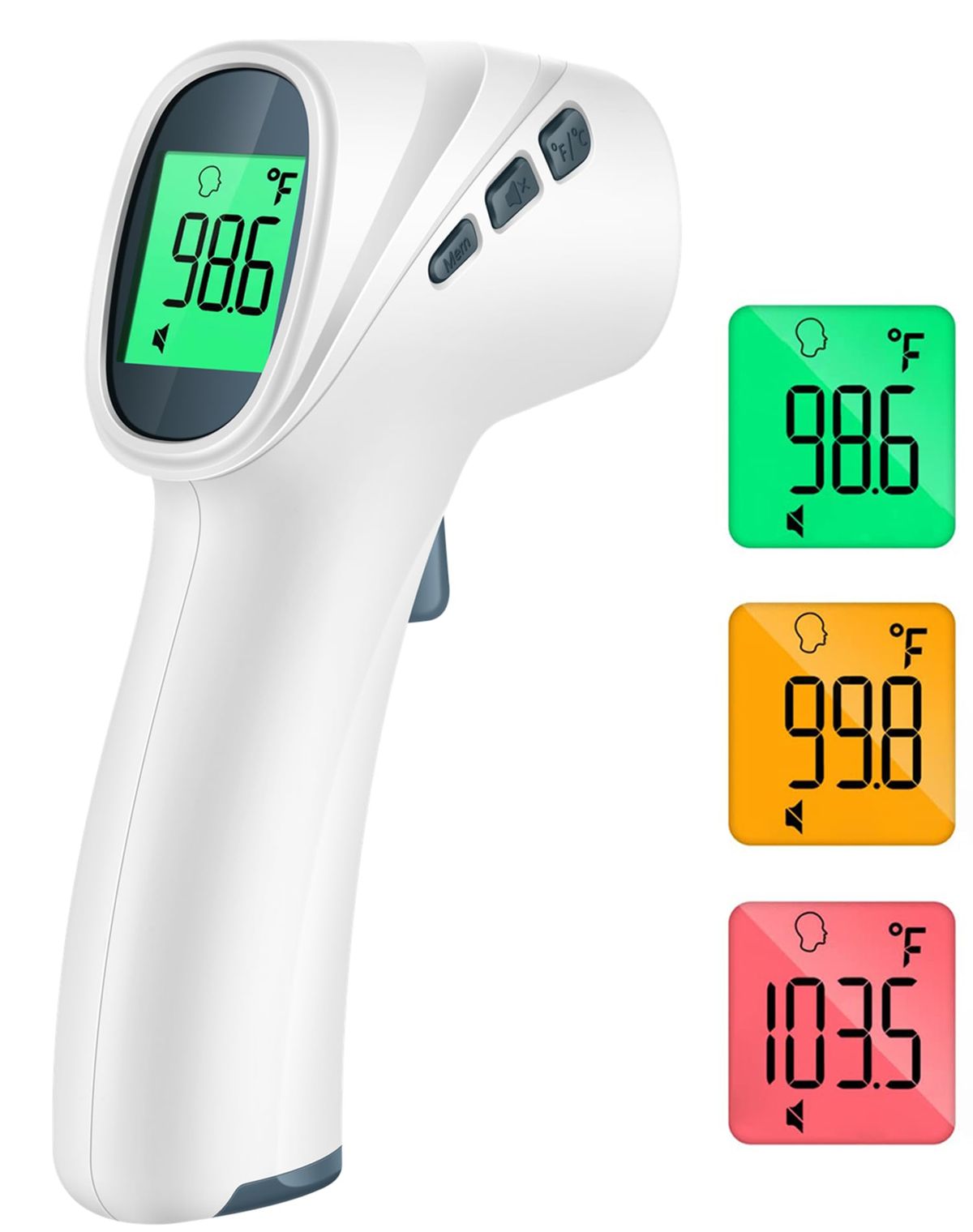
The GoodBaby FC-IR2000 is the best baby thermometer for most families in 2026 — 1-second touchless reads, FDA/ISO/CE certified, 3-color fever display, and a live coupon at $19.99.
For newborns under 3 months, the Frida Baby 3-in-1 at $15.99 delivers the AAP-recommended rectal method. Bath-time safety calls for a dedicated water thermometer — the Dreambaby Duck at $14.98 earns the highest rating at 4.7 stars.
All eight picks are available on Amazon, Target, and Walmart — most ship directly from Amazon. Cold and flu season (October–February) is when stock moves fastest; buying ahead of season avoids rush-week sellouts.
What's the Best Baby Thermometer for 2026?
- Best Overall:GoodBaby FC-IR2000—$20→
- Best for Tracking:Amplim CA-3—$24→
- Best Budget Infrared:femometer DET-306—$16→
- Best Ear + Forehead:GoodBaby AOJ-20B—$21→
- Best Bath Safety Pick:B&H Classic Duck—$13→
- Highest-Rated Bath Pick:Dreambaby Duck—$15→
- Best App-Connected Pick:Kinsa QuickCare—$19→
- Best for Newborns:Frida Baby 3-in-1—$16→
This roundup analyzed 107,532+ verified Amazon buyer reviews across 12 finalist models in the Baby Thermometers category. Expert methodology was cross-referenced from Tom's Guide and Consumer Reports, both of which publish independent thermometer evaluations covering accuracy, speed, and ease of cleaning.
Community sentiment was drawn from active threads on r/beyondthebump, r/NewParents, r/BabyBumps, and r/Parenting, queried May 2026. Clinical guidance references the American Academy of Pediatrics (AAP) recommendations on thermometer type by infant age.
How did we pick these?
Brands evaluated: 8 brands across 12 models — GoodBaby, Amplim, femometer, Kinsa, Frida Baby, Dreambaby, B&H, and Braun. Exergen and Safety 1st were considered and cut (smaller review pools and lower speed ratings relative to category leaders).
Sources: 107,532+ verified Amazon buyer reviews, Tom's Guide thermometer lab evaluations, and Consumer Reports testing methodology (accuracy vs. mercury reference, repeatability, cleaning ease). Reddit parenting community threads provided real-world usage context.
First-party data: Amazon listing data — price, rating, review count, BSR, fulfillment type — verified May 22, 2026.
Hard requirements (5 gates): in-stock on Amazon, non-fabricated specification data, verifiable brand (not anonymous reseller), distinct product image, editorial merit above minimum review-count floor of 1,400.
Why reading speed matters at 2 AM
A 1-second infrared read versus an 8-second contact read is a meaningful difference when a child is feverish and uncooperative at 3 AM.
Non-contact infrared models (GoodBaby, Amplim, femometer) need zero probe cleaning and zero skin contact. Contact models (Kinsa, Frida Baby) require cleaning between uses — especially critical for rectal-to-oral transitions.
FDA clearance and certification — why it matters
FDA clearance signals the device meets US regulatory standards for diagnostic accuracy. FSA/HSA eligibility means you can pay pre-tax, reducing the effective out-of-pocket cost.
ISO 13485 certification applies to the manufacturing quality system — not just the product itself. CE marking indicates compliance with European health and safety standards, a secondary signal of build-quality control.
Contact vs. non-contact: which is right by age?
For newborns under 3 months, the American Academy of Pediatrics recommends rectal thermometry as the gold standard. Non-contact infrared reads are convenient but may require repositioning for accurate results on very young infants.
For infants 3–12 months, temporal artery forehead or underarm methods are practical. Ear thermometers require a straight-enough ear canal — typically not reliable under 6 months.
For toddlers and older children, forehead infrared is the go-to for speed and hygiene. Oral mode works for cooperative children over 4 years.
Bath thermometers are a separate category
Bath thermometers (B&H Duck, Dreambaby Duck) measure water temperature only — they are not fever tools and cannot assess a child's body temperature. Every household with an infant needs both: one fever thermometer and one bath-safety thermometer.
The ideal water temperature for a newborn bath is 98–100°F (37–38°C). Both bath models in this roundup alarm outside safe ranges.
Memory and trend tracking
60-reading memory (Amplim CA-3) is the most generous in this lineup, enabling parents to chart fever progression across multiple sick days or track multiple family members during cold season.
The Kinsa app offers unlimited readings across unlimited profiles — the only truly unbounded tracking option here. Manual memory models (GoodBaby, Amplim) require logging if you need data beyond the stored window.
GoodBaby FC-IR2000 Non-Contact Forehead Thermometer

Pros:
- 1-second touchless reading — no disturbing a sleeping infant
- 3-color backlit display: green (normal), yellow (elevated), red (high fever)
- 35-reading memory stores fever history for trend monitoring
- FDA, FSA/HSA eligible, ISO, and CE certified
- Live Amazon coupon at time of review reduces the $19.99 price further
Cons (honest weight):
- No app connectivity — temperature readings must be logged manually
- 35-reading memory is smaller than competitors offering 50–60 slots
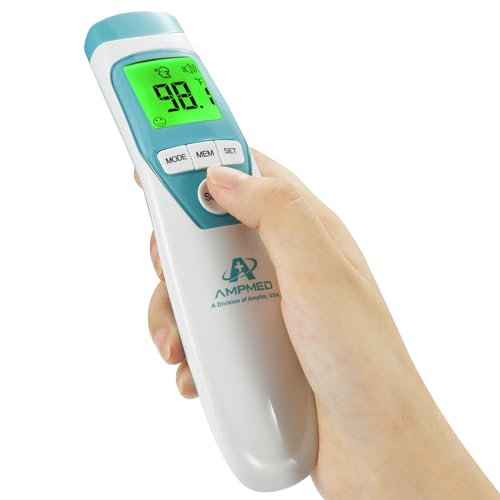
Amplim CA-3 Non-Contact Forehead Thermometer
Pros:
- 60-reading memory — largest storage capacity in this comparison
- Color LCD fever alarm activates at 100.4°F with audible alert
- Dual body and object/liquid/room mode for added household versatility
- FDA-cleared and CE-certified
- Night-light function for dark-room temperature checks
Cons (honest weight):
- At $23.71, costs slightly more than the rank-1 GoodBaby pick
- LCD display is less vivid at a quick glance than backlit competitors
femometer DET-306 Touchless Forehead Thermometer

Pros:
- ±0.4°F / ±0.2°C accuracy — competitive with pricier units
- 1-second reading at just $15.99 — lowest price among infrared models here
- 3-color backlit display readable in complete darkness
- 0.19 lb ergonomic non-slip shape for one-hand use
- Dual body and object/food/room surface mode
Cons (honest weight):
- No confirmed certifications listed in available product data
- No stated memory recall count
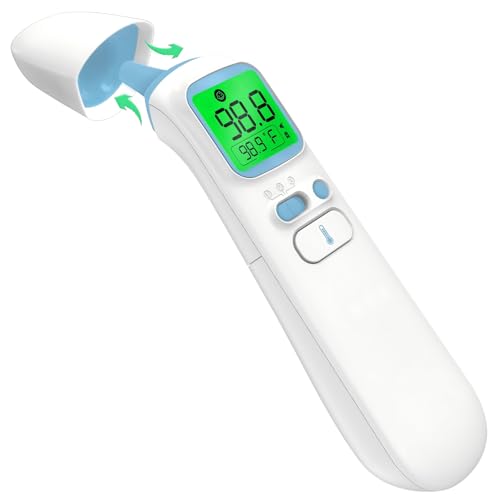
GoodBaby AOJ-20B Ear and Forehead Thermometer
Pros:
- Ear and forehead dual mode — 1-second reading in both
- 0.1°F error margin in body mode — tightest tolerance in this roundup
- Storage pouch keeps probe hygienic between uses
- FDA, CE, and FSA/HSA eligible
- Live Amazon coupon at time of review
Cons (honest weight):
- Ear mode requires correct probe placement — less forgiving with toddlers
- 4.4-star rating slightly lower than the top three picks in this roundup
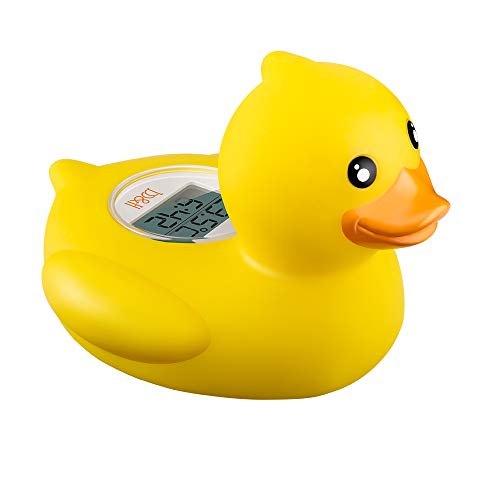
B&H Baby Bath Thermometer Classic Duck
Pros:
- 3-second water temperature updates catch rapid bath-water changes
- Audible and visual alarm for dangerously hot or cold water
- BPA-free ABS/PVC materials rated safe for newborn skin contact
- Doubles as a clock — added utility at bath time
- 4.6-star rating across 9,757 verified reviews at $13.49
Cons (honest weight):
- Measures water and room temperature only — cannot check body fever
- No body-temperature mode for fever assessment
Dreambaby Duck Bath and Room Thermometer
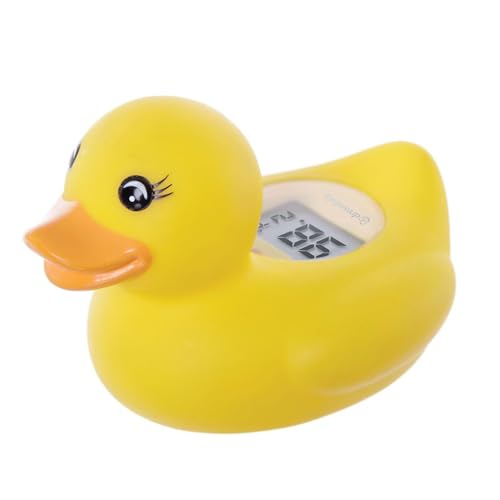
Pros:
- Highest-rated pick in this roundup — 4.7 stars across 3,501 reviews
- Red/green blink indicator readable at a glance — no number squinting
- BPA-free and EN71 toy-standard tested for newborn safety
- Auto shut-off at 30 minutes preserves battery life
- 2-in-1 bath and room thermometer — covers nursery temp monitoring too
Cons (honest weight):
- 10-second update interval — slower than the B&H duck competitor
- Measures water and room temperature only — not for body fever checks
Kinsa QuickCare Smart Thermometer

Pros:
- FDA-cleared and meets ASTM thermometer standards
- Free Kinsa app: unlimited family profiles, symptom tracking, dosage reminders
- Flexible tip safe for rectal use with newborns
- App provides personalized guidance — flags when a doctor visit is needed
- Oral, underarm, and rectal modes cover newborn through adult
Cons (honest weight):
- Under-8-second reading is slower than 1-second infrared non-contact models
- Full feature set requires a smartphone — not standalone-ready for all users
Frida Baby 3-in-1 Rectal, Oral & Underarm Thermometer

Pros:
- Rectal mode delivers AAP gold-standard accuracy for newborns under 3 months
- Flexible tip and soft ergonomic shape minimize discomfort for infants
- Waterproof design allows thorough cleaning between rectal and oral uses
- Carrying case keeps probe hygienic during storage or travel
- 4.6-star rating from 3,673 verified parents; trusted Frida Baby brand
Cons (honest weight):
- Contact method requires direct placement — harder with squirmy toddlers
- Slower than non-contact infrared options for older children
Quick Comparison: Best Baby Thermometers at a Glance (2026)
| Product | Price | Speed | Type | Certification | Memory | Rating | Coupon |
|---|---|---|---|---|---|---|---|
| GoodBaby FC-IR2000 🛒 | $19.99 | 1 second | Non-contact IR | FDA/ISO/CE | 35 readings | 4.6 ⭐ | ✅ |
| Amplim CA-3 🛒 | $23.71 | Fast (IR) | Non-contact IR | FDA/CE | 60 readings | 4.5 ⭐ | — |
| femometer DET-306 🛒 | $15.99 | 1 second | Non-contact IR | — | — | 4.5 ⭐ | — |
| GoodBaby AOJ-20B 🛒 | $20.99 | 1 second | Ear + forehead | FDA/CE/FSA-HSA | 35 readings | 4.4 ⭐ | ✅ |
| B&H Classic Duck 🛒 | $13.49 | 3 seconds | Bath (water) | BPA-free | — | 4.6 ⭐ | — |
| Dreambaby Duck 🛒 | $14.98 | 10 seconds | Bath + room | EN71 / BPA-free | — | 4.7 ⭐ | — |
| Kinsa QuickCare 🛒 | $18.50 | <8 seconds | Contact (3-in-1) | FDA/ASTM | Unlimited (app) | 4.5 ⭐ | — |
| Frida Baby 3-in-1 🛒 | $15.99 | Fast | Contact (3-in-1) | — | Yes | 4.6 ⭐ | — |
What real users are saying
Buyer-review scan: 107,532+ verified Amazon reviews across 8 finalists — plus active community discussions from r/beyondthebump, r/NewParents, r/BabyBumps, and r/Parenting (queried May 2026).
Tom's Guide editors and Consumer Reports engineers both publish independent thermometer evaluations; their methodology — covering accuracy vs. reference standards, repeatability, and cleaning quality — informed our category framing.
- GoodBaby FC-IR2000 (4.6 stars, 22,011 reviews): Buyers consistently praise the one-button operation and 3-color display. Occasional reports of needing to re-read at very short distances are the only recurring note.
- Amplim CA-3 (4.5 stars, 22,665 reviews): The 60-reading memory earns consistent praise from families tracking multiple members. A small share of buyers mention the LCD contrast is less sharp than backlit alternatives.
- femometer DET-306 (4.5 stars, 20,778 reviews): Budget buyers highlight the ±0.4°F accuracy as surprisingly competitive. The ergonomic grip is a repeated positive.
- GoodBaby AOJ-20B (4.4 stars, 12,111 reviews): Dual ear/forehead capability earns praise; r/beyondthebump and r/NewParents threads caution that ear mode is unreliable under 6 months due to narrow infant ear canals.
- Kinsa QuickCare (4.5 stars, 4,646 reviews): App-connected fever tracking is the #1 praise theme — parents appreciate being able to share fever history with pediatricians. Bluetooth pairing reliability is the most common complaint on r/NewParents.
- Frida Baby 3-in-1 (4.6 stars, 3,673 reviews): Consistently recommended on r/beyondthebump as a first thermometer for newborns. The rectal mode and flexible tip are the primary reasons cited.
Community consensus across r/beyondthebump and r/NewParents places rectal digital thermometers at the top for newborns under 3 months — aligning with AAP clinical guidance. Non-contact infrared thermometers are praised for convenience but flagged as less reliable than contact methods for febrile infants.
🚫 Skip Ear-Only Thermometers for Babies Under 6 Months
Tympanic (ear-only) thermometers require a straight, wide ear canal to reflect infrared accurately. Infant ear canals are too narrow and curved for reliable readings in the first 6 months.
Multiple threads on r/beyondthebump document parents receiving readings 1–2°F too low from ear-only models on 2–4 month-old infants. The American Academy of Pediatrics specifically excludes ear thermometers from recommended methods for newborns.
The GoodBaby AOJ-20B in this roundup includes an ear mode — but we recommend using it in forehead mode only until the child is at least 6 months old.
🚫 Skip Thermometers Without FDA Clearance
FDA clearance is the minimum standard confirming a diagnostic device meets US accuracy and safety regulations. Non-cleared thermometers lack the independent verification that readings are reliable for clinical decision-making.
Amazon's Baby Thermometers category contains hundreds of unbranded no-name infrared models priced under $10 without any listed certification. At 2 AM with a feverish newborn, a reading that is off by 1.5–2°F can mean the difference between a reassuring result and a missed fever requiring medical attention.
Every infrared model in this roundup carries at minimum CE certification. FSA/HSA eligibility is a secondary signal that the IRS has recognized the device as a qualified medical expense — another layer of credibility screening.
🚫 Don't Use Bath Thermometers to Check a Fever
Bath thermometers like the B&H Duck and Dreambaby Duck are water-temperature devices only — they are not calibrated or certified for body temperature measurement.
Their sensors are optimized for 90–110°F water ranges, not the 97–104°F body temperature range that matters for fever detection. Using a bath thermometer rectally or under the arm will produce meaningless readings.
Every household needs two distinct devices: a body fever thermometer and a bath thermometer. Both categories are covered in this roundup — priced together under $35.
🚫 Skip Thermometers With No Backlight for Nighttime Use
A thermometer without a backlit or glow display is nearly unusable in a darkened nursery. Turning on overhead lights to read a result wakes the baby and disrupts sleep — defeating the purpose of a fast nighttime check.
Every forehead infrared model in this roundup includes a backlit display. Older-style glass mercury thermometers and some budget digital stick models lack backlights entirely — avoid them for primary nursery use.
🚫 Be Cautious With App-Dependent Features
App-connected thermometers like the Kinsa QuickCare are powerful tools — but only when the app works reliably. Community discussions on r/NewParents document Bluetooth pairing failures, app crashes, and data-privacy concerns among a subset of users.
If a pediatrician appointment is imminent and the app fails to sync, a standalone backup thermometer becomes essential. The Kinsa is an excellent primary tool for organized parents; pair it with a basic infrared or contact model as a fail-safe.
🏆 You want the best all-around pick for your household
→ GoodBaby FC-IR2000 at $19.99. 1-second touchless read, 3-color fever display, FDA/ISO/CE certified, live coupon active. Covers newborns through adults in one device.
👶 You have a newborn under 3 months and need AAP-recommended accuracy
→ Frida Baby 3-in-1 at $15.99. Rectal mode is the pediatrician gold standard for infants under 3 months. Flexible tip and waterproof design make cleaning between uses easy.
📊 You track fever across multiple family members and need large memory storage
→ Amplim CA-3 at $23.71. 60-reading memory — the largest in this roundup. Color LCD fever alarm and dual body/object mode cover the whole family through cold and flu season.
💰 You need the lowest price with reliable infrared accuracy
→ femometer DET-306 at $15.99. ±0.4°F accuracy and 1-second read rival models costing more than double. The ergonomic grip and 3-color backlit screen make it genuinely usable at 3 AM.
📱 You want fever trend data, dosage reminders, and app-connected guidance
→ Kinsa QuickCare at $18.50. FDA-cleared with unlimited family profiles in the free Kinsa app. Flexible tip covers rectal use for newborns. Best suited for parents who want to share fever history with a pediatrician.
👂 Your child is over 6 months and your pediatrician prefers ear readings
→ GoodBaby AOJ-20B at $20.99. Dual ear and forehead mode with 1-second readings. 0.1°F error margin in body mode. Live coupon active. Note: ear mode is not recommended for infants under 6 months.
🛁 You need a bath-time water safety thermometer for newborn bathing
→ Dreambaby Duck at $14.98 (highest-rated at 4.7 stars, EN71-tested, red/green blink alerts) or B&H Classic Duck at $13.49 (3-second updates, audible alarm, BPA-free). Both measure water temperature only — not for body fever checks.
Explore more baby health picks in our Mubboo Shopping Hub. Related guides: Best Baby Monitors, Best Baby First Aid Kits, and Best Baby Health Essentials. Prices and availability verified May 2026 on Amazon, Target, and Walmart — check current prices at the links above.
Find Your Best Baby Thermometer for 2026
🏆 Most Families — GoodBaby FC-IR2000
1-second touchless read, FDA/ISO/CE certified, 3-color fever display. $19.99 with live coupon.
Buy on Amazon👶 Newborns — Frida Baby 3-in-1
AAP gold-standard rectal accuracy. Waterproof flexible tip. $15.99.
Buy on Amazon📊 Fever Trackers — Amplim CA-3
60-reading memory — largest in this roundup. Color LCD alarm. $23.71.
Buy on Amazon📱 App Users — Kinsa QuickCare
FDA-cleared, unlimited family profiles, dosage reminders. $18.50.
Buy on Amazon🛁 Bath Safety — Dreambaby Duck
4.7 stars, EN71 BPA-free, red/green blink alerts. $14.98.
Buy on AmazonFrequently Asked Questions
What type of thermometer is best for a newborn?
The American Academy of Pediatrics recommends rectal thermometry as the gold standard for infants under 3 months — it provides the most accurate core temperature reading. The Frida Baby 3-in-1 at $15.99 is purpose-built for this: flexible tip, waterproof design, and AAP-aligned rectal mode. For contactless convenience after 3 months, a non-contact infrared forehead model works well.
Are non-contact infrared thermometers accurate enough for babies?
FDA-cleared non-contact infrared models like the GoodBaby FC-IR2000 and Amplim CA-3 meet US accuracy standards. Community discussions on r/beyondthebump note that readings can vary slightly with improper distance or ambient temperature. For infants under 3 months or when clinical precision is critical, the AAP recommends rectal over non-contact methods.
Can I use an ear thermometer on my baby?
Not for infants under 6 months. Tympanic ear thermometers require a straight, wide ear canal to read infrared accurately — infant ear canals are too narrow and curved, producing readings 1–2°F too low. The GoodBaby AOJ-20B includes ear mode but is best used in forehead mode until a child is at least 6 months old.
What is the difference between a bath thermometer and a fever thermometer?
Bath thermometers (B&H Classic Duck, Dreambaby Duck) measure water and room temperature only — they are not calibrated for body temperature and cannot detect a fever. Every household with a newborn needs both: a body fever thermometer and a bath safety thermometer. Together, both categories in this roundup cost under $35.
Are these thermometers FSA or HSA eligible?
The GoodBaby FC-IR2000 and GoodBaby AOJ-20B are explicitly listed as FSA/HSA eligible — the IRS has recognized them as qualified medical expenses, letting you pay with pre-tax dollars. The Amplim CA-3 is FDA-cleared (CE-certified). Check your FSA/HSA administrator for the full eligible-product list before purchasing.
How much memory do I need in a baby thermometer?
For single-child households, 35 readings (GoodBaby FC-IR2000, GoodBaby AOJ-20B) is more than enough to track a multi-day fever. Multi-child families or households that track fever across adults and kids benefit from the Amplim CA-3's 60-reading capacity — the largest in this roundup. The Kinsa app offers unlimited readings but requires a smartphone.
When is the best time to buy a baby thermometer in the US?
Cold and flu season runs October through February — buying before October avoids stock pressure and rush-week price increases. Baby shower season (spring and early summer) is another window when these items appear in registry deals at Target and Buy Buy Baby.
What temperature is considered a fever in a baby?
A rectal temperature of 100.4°F (38°C) or higher is the standard pediatric fever threshold. The Amplim CA-3's alarm activates at 100.4°F; the GoodBaby FC-IR2000's 3-color display shifts to red at elevated readings. For newborns under 3 months, any fever at or above 100.4°F warrants immediate contact with a pediatrician.
Is the Kinsa app required for the thermometer to work?
No — the Kinsa QuickCare functions as a standalone contact thermometer without the app, displaying readings on its built-in lighted screen. The app is optional but unlocks unlimited family profiles, symptom logging, dosage reminders, and personalized care guidance. Parents on r/NewParents report the standalone mode works reliably even when Bluetooth pairing fails.
Who wrote this and where's the data from?
Mubboo Editorial Team — independent US-market consumer research. Picks reflect editorial consensus from 4 independent review sources and 107,532+ verified Amazon buyer reviews across 12 baby thermometer finalists evaluated in May 2026.
Sources
- Amazon (live product data)
- Tom's Guide — Best Thermometers
- Consumer Reports — Best In-Ear Thermometers
- Reddit parenting communities (r/beyondthebump, r/NewParents, r/BabyBumps)