Baby Bottles Buying Guide 2026
How to choose the right bottle for your infant's feeding style and your family's routine
By Mubboo Editorial Team · Updated May 19, 2026 · 8 min read

The Short Answer
Choosing the right baby bottle in 2026 comes down to four variables: anti-colic vent design, nipple shape, neck width, and cleaning complexity. For most households — especially those dealing with gas or colic — the Dr. Brown's Natural Flow Options+ Narrow (8 oz, 4-Pack, $22.78) remains the most validated choice with 51,754 Amazon reviews at 4.8 stars. Its internal vent tube actively reduces air ingestion, and its narrow neck fits most standard breast pump adapters. Parents who need a breast-to-bottle bridge should consider the Philips Avent Natural Response (9 oz, 4-Pack, $29.99), whose nipple mimics the breast's latch behavior across 24,564 verified reviews. For anti-colic performance with easier cleaning, the Dr. Brown's Wide-Neck Options+ (9 oz, 4-Pack, $25.98) combines the same vent system with a wider opening — 22,262 reviews at 4.6 stars. Budget-first families stocking up for newborns will find the Lansinoh Anti-Colic (5 oz, 3-Pack, $18.69) at roughly $6.23 per BPA-free bottle. Parents without a standalone sterilizer should look at MAM Easy Start Anti-Colic+ (9 oz, 2-Pack, $13.38), which self-sterilizes in the microwave in 3 minutes. Reflux-prone infants benefit from the Philips Avent AirFree Vent (9 oz, 4-Pack, $23.99), whose horizontal milk-fill cuts air swallowing without multi-piece disassembly. Buy no more than 4 bottles of any single brand until your baby confirms nipple acceptance.
The right baby bottle depends on three things: your infant's feeding behavior, your pumping setup, and how much cleaning complexity you can manage daily. Most parents overbuy — stocking 12 bottles of one brand before knowing whether the baby accepts the nipple.
This guide maps six well-reviewed 2026 picks to specific feeding scenarios — colic, breastfeeding transitions, reflux, budget, and convenience — so you buy correctly on the first order.
Your newborn rejects the bottle at 2 a.m. on your first night back from the hospital — and you have only one brand on hand. That single mismatch costs a same-day Amazon or Target run at the worst possible time.
Nipple shape, flow rate, and vent design all affect acceptance. Buying a small starter pack across two bottle styles before birth is the most cost-effective insurance a new parent can buy.
Anti-Colic Vent System
A colic vent reduces the air an infant swallows during feeding, which directly lowers gas pain and fussiness after meals. Not all vents work the same way — design differences matter significantly.
Internal-tube vents (Dr. Brown's system) route air out through a separate channel so it never mixes with milk. This is the most effective air-reduction approach confirmed across 51,754+ buyer reviews.
AirFree vents (Philips Avent) keep the nipple flooded with milk at near-horizontal angles, reducing air at the nipple opening itself. Fewer parts than the internal-tube approach makes daily cleaning faster.
Vented base designs (MAM) vent air through the bottle base rather than the nipple. Self-sterilization via microwave is a side benefit of the modular base — a meaningful convenience for families without a standalone sterilizer.
Skip any bottle marketed as "anti-colic" that does not specify the vent mechanism — this label is applied loosely and is not regulated by the CPSC or FDA.
Good range
Internal-tube, AirFree, or vented-base mechanisms; verified by 10,000+ Amazon reviews at 4.6 stars or higher
Red flag
"Anti-colic" label with no specified vent mechanism — marketing language without structural backing

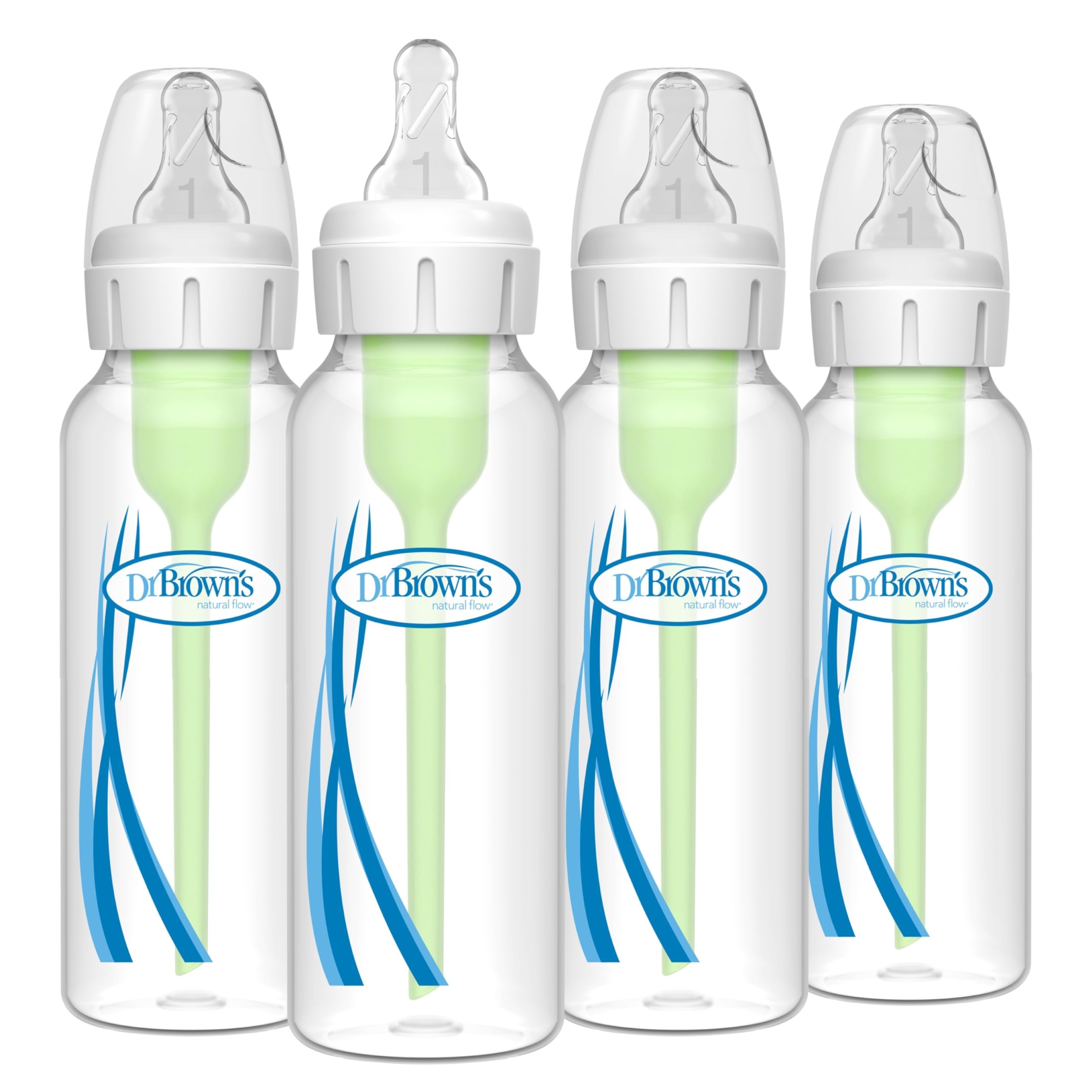
Dr. Brown's Natural Flow Options+ Narrow 8oz 4-Pack
The most-reviewed anti-colic bottle in the category — 51,754 ratings at 4.8 stars with a proven internal-vent tube system.
Nipple Shape and Flow Rate
Nipple shape determines whether a breastfed baby will accept the bottle — and whether a formula-fed baby can feed efficiently without overfeeding. This is the variable most first-time parents underweight.
Demand-activated nipples (Philips Avent Natural Response) require the baby to actively suckle to release milk, mimicking breast behavior. This dramatically improves acceptance rates for combo-feeding and breast-to-bottle transitions.
Standard slow-flow nipples work well for formula-only feeding. Flow rates are typically labeled: Slow (0–3 months), Medium (3–6 months), Fast (6+ months). Using a flow rate too fast causes gulping and excess air ingestion — counteracting any anti-colic vent benefit.
Symmetrical nipples (MAM) are designed to be inserted at any orientation. Many infants who reject asymmetrical nipples accept MAM's design within a few tries.
Before buying 8+ bottles, purchase one or two and observe latch quality and post-feed fussiness over 3–4 feeds. Only then stock up at Target, Amazon, or Buy Buy Baby.
Good range
Demand-activated or slow-flow nipple matched to infant age; symmetric design for rejection-prone babies
Red flag
Fast-flow nipples for newborns under 3 months — causes gulping, gas, and possible aspiration risk

Philips Avent Natural Baby Bottle with Natural Response Nipple 9oz 4-Pack
Demand-activated nipple most closely mimics breastfeeding latch — the top choice for combo-feeding households across 24,564 reviews at 4.8 stars.
Neck Width and Cleaning Ease
Neck width is the most overlooked compatibility variable — it determines pump adapter fit, nipple brand options, and how easily you can clean inside the bottle.
Narrow-neck bottles (Dr. Brown's 8 oz Options+) fit most standard breast pump adapters directly. Trade-off: hand-washing the interior is harder because a standard bottle brush cannot reach the bottom easily.
Wide-neck bottles accept a full-size bottle brush and allow formula scoops to drop cleanly without powder sticking to the sides. Most wide-neck bottles are dishwasher-safe on the top rack — a meaningful time saver for daily use.
Part count per bottle matters more than neck width for cleaning burden. Dr. Brown's internal vent adds 2–3 extra pieces per bottle — at 8 daily feeds, that is 16–24 additional parts to wash vs. a 2-part bottle design.
Families feeding 6+ times per day should seriously weigh the MAM or Philips AirFree designs, which reduce part count significantly without sacrificing anti-colic performance.
Good range
Wide neck with dishwasher-safe rating; 3 parts or fewer per bottle for high-frequency feeders
Red flag
5+ parts per bottle for households feeding more than 6 times daily — cleaning fatigue is a documented parent pain point

Dr. Brown's Natural Flow Options+ Wide-Neck 9oz 4-Pack
Anti-colic vent performance in a wide-neck design that accepts standard bottle brushes and wide-neck nipple accessories — 22,262 reviews at 4.6 stars.
BPA-Free Status and Material Safety
Every baby bottle sold in the US market today must be BPA-free under the FDA's 2012 ban — but not all bottles carry explicit BPA-free certification labeling, and the distinction matters to new parents.
BPA-free certification clearly displayed on packaging is a purchasing signal that reduces parental anxiety and satisfies pediatrician checklists. Lansinoh Anti-Colic leads this group with BPA-free labeling prominently featured across all pack sizes.
Polypropylene (PP) is the most common BPA-free plastic used in baby bottles. It is dishwasher-safe and heat-stable for sterilization up to 250°F — standard for most US dishwashers and steam sterilizers.
Glass bottles are not covered in this guide, but they represent the zero-leaching alternative for households in California, Texas, Florida, or other states with high consumer-safety awareness. Check the sibling best-of list at Best Baby Bottles 2026 for glass options.
CPSC recall history is worth a 30-second Amazon review scan before buying any bottle brand. All six bottles in this guide carry clean records as of May 2026.
Good range
BPA-free polypropylene or borosilicate glass; FDA-compliant; CPSC clean record within 24 months
Red flag
Any bottle without explicit BPA-free labeling for use with infants under 12 months — regardless of country of origin

Lansinoh Anti-Colic Baby Bottle BPA-Free 5oz 3-Pack
Prominent BPA-free certification at the lowest per-bottle price in the group — ~$6.23 per bottle across 21,689 reviews at 4.7 stars.
Sterilization and Setup Convenience
Most US pediatricians recommend sterilizing baby bottles before first use and periodically for infants under 3 months — but the method you choose affects which bottle designs work for your household.
Microwave sterilization (MAM Easy Start) is the fastest method at 3 minutes in a standard microwave. No separate sterilizer purchase required — a $13–$40 savings at Target or Amazon. The trade-off is microwave compatibility: metal-trimmed or oversized bottles cannot use this method.
Electric steam sterilizers (Philips, Dr. Brown's brand accessories) hold 6–8 bottles and sterilize in 8–12 minutes. These work with every bottle type regardless of neck width, material, or vent design.
Boiling is the universal fallback that costs nothing. All six bottles in this guide are rated boiling-safe. Limit boiling to 5 minutes — extended boiling degrades polypropylene nipples faster than steam or microwave methods.
Baby shower season (spring) and Prime Day are the best times to bundle a bottle starter pack with a sterilizer purchase — bundled discounts at Buy Buy Baby and Amazon frequently cut 15–25% off multi-item baby registry orders.
Good range
Microwave-safe for convenience buyers; electric steam sterilizer for full compatibility; boiling-safe as universal backup
Red flag
Bottles labeled 'dishwasher clean only' without sterilization guidance — insufficient for infants under 3 months per CDC guidance

MAM Easy Start Anti-Colic+ Wide Neck Vented 9oz 2-Pack
Self-sterilizes in 3 minutes in any standard microwave — the most convenient setup for parents who skip a separate sterilizer, at $13.38 for two.
Reflux and Posture-Based Feeding
Gastroesophageal reflux (GER) affects an estimated 50% of US infants in the first 3 months — making reflux-aware bottle design a practical concern for the majority of new parents, not just edge cases.
Paced feeding is the standard technique: hold the bottle near-horizontal, pause every 20–30 seconds, and allow the baby to control milk flow. The Philips Avent AirFree vent is purpose-built for this posture — its vent keeps the nipple milk-filled even when the bottle is nearly flat.
Upright-angle feeding (45-degree tilt) works with most standard vent designs and is widely recommended by US lactation consultants. Dr. Brown's internal vent performs reliably at a 45-degree angle without modification.
Slow-flow nipples reduce reflux incidents significantly by limiting the milk volume per suck cycle. Pairing an AirFree vent bottle with the slowest-flow nipple available is the most-recommended starting configuration for diagnosed reflux infants.
If reflux persists beyond 6 months or causes weight loss, a pediatrician visit — not a bottle swap — is the appropriate next step. No bottle eliminates reflux; effective designs reduce symptom severity.
Good range
AirFree or angled vent design; slow-flow nipple; wide neck for easy paced-feeding angle control
Red flag
Fast-flow nipples or straight-tube bottle designs for diagnosed reflux infants — these worsen symptom frequency

Philips Avent Anti-Colic Baby Bottle with AirFree Vent 9oz 4-Pack
AirFree vent keeps the nipple milk-filled at near-horizontal angles — designed for paced feeding and reflux management across 18,744 reviews at 4.7 stars.
Common Mistakes to Avoid
Stocking up on one bottle brand before confirming infant acceptance is the single most common and most expensive baby-bottle mistake. Nipple rejection is among the top reasons baby bottles are returned at Target and Buy Buy Baby.
Mistake 1: Buying 8–12 bottles of one brand before the baby has fed from it. Buy a 2- or 4-pack first, run 3–4 feeds, then stock up. Prime Day and Black Friday both offer multi-pack discounts that reward patients buyers.
Mistake 2: Choosing a flow rate based on price, not infant age. A fast-flow nipple on a 6-week-old causes gulping, excess gas, and more fussiness — nullifying any anti-colic vent benefit the bottle provides.
Mistake 3: Ignoring part count when choosing an anti-colic bottle. Dr. Brown's 5-piece vent system is clinically effective, but at 8 daily feeds that is 40 extra parts to wash. Parents in households with multiples or demanding schedules report cleaning fatigue within the first week.
Mistake 4: Skipping BPA-free verification on discount bottles. Amazon Marketplace third-party listings occasionally surface non-compliant imports. Buy only from sold-by-Amazon or brand-direct listings, and verify the BPA-free callout appears on the main product image, not just in the description text.
Mistake 5: Buying narrow-neck bottles when you plan to pump and pour directly. Most breast pump flanges output into a narrow-neck collection bottle — but if you intend to pour breast milk directly from pump to feeding bottle, a wide-neck opening at both ends of the transfer simplifies the process significantly.
Your Pre-Purchase Checklist
- Confirm anti-colic vent type: internal-tube (Dr. Brown's), AirFree (Philips), or vented-base (MAM) — choose based on part-count tolerance and feeding posture.
- Match nipple flow rate to infant age: Slow-flow for 0–3 months, Medium for 3–6 months, Fast for 6+ months. Confirm the flow stage is labeled on the nipple packaging, not just in the product description.
- Decide neck width based on your pump: Narrow neck if your breast pump outputs to a narrow-neck bottle. Wide neck if you prioritize cleaning ease or plan to use a bottle brush.
- Buy a starter pack of 2–4 bottles only until your infant accepts the nipple across 3–4 consecutive feeds. Only then order the full 8–12 bottle stash.
- Check BPA-free certification appears on the product image (not only in description text) — especially for Amazon third-party listings and discount multipack bundles.
- Verify sterilization compatibility: microwave (MAM), electric steam (most brands), or boiling (all brands). Cross-check against your existing sterilizer before buying.
- Plan for nipple upgrades: You will need medium-flow and fast-flow nipples as your baby grows. Confirm replacement nipples are available on Amazon and in-stock at Target or Walmart for your chosen bottle brand.
- Register for baby shower season (spring) or Prime Day discounts at Buy Buy Baby or Amazon before stocking a full 8–12 bottle supply — registry discounts and bundle deals regularly cut 15–20% off multi-pack orders.
Our Recommended Starting Points
Best Baby Bottles 2026
Ranked list of the top-rated bottles across all categories — anti-colic, breastfeeding, budget, and premium.
Baby Bottle Comparison: Dr. Brown's vs. Philips Avent
Head-to-head breakdown of the two most popular bottle families — narrow vs. wide neck, vent system differences, and price-per-bottle value.
Best Baby Gear for Newborns
Full starter kit guide covering bottles, pacifiers, sterilizers, and feeding accessories for the first 3 months.
Baby Bottle Sterilizers Buying Guide
How to choose between microwave, electric steam, and UV sterilizers — with compatible bottle models for each method.
Frequently Asked Questions
Which baby bottle is best for breastfed babies switching to a bottle?
The Philips Avent Natural Response (9 oz, 4-Pack, $29.99) is the top choice for breast-to-bottle transitions. Its demand-activated nipple requires active suckling to release milk, closely mimicking breast behavior. Across 24,564 Amazon reviews at 4.8 stars, it shows the strongest acceptance rate among combo-feeding households.
Which baby bottle helps the most with colic and gas?
Dr. Brown's Natural Flow Options+ Narrow (8 oz, 4-Pack, $22.78) leads for colic. Its internal vent tube channels air out separately so it never mixes with milk. With 51,754 reviews at 4.8 stars, it is the most-validated anti-colic bottle in the US market. The Wide-Neck version ($25.98) offers the same vent with easier cleaning.
What is the easiest baby bottle to clean?
MAM Easy Start Anti-Colic+ (9 oz, 2-Pack, $13.38) has the fewest steps: it self-sterilizes in a microwave in 3 minutes and has a wide neck for easy brush access. The Philips Avent AirFree Vent (9 oz, 4-Pack, $23.99) is also simpler than Dr. Brown's multi-piece vent — fewer parts per bottle means fewer items to wash per feed.
Which baby bottle is best for newborns under 1 month?
The Lansinoh Anti-Colic (5 oz, 3-Pack, $18.69) is sized specifically for newborns, who typically consume 2–3 oz per feed in the first weeks. Its 5 oz capacity avoids overfeeding risk. Dr. Brown's Narrow 8 oz ($22.78) also works at newborn stage with a slow-flow nipple — and the larger capacity extends useful life as feed volumes grow.
What is the best budget baby bottle that doesn't sacrifice safety?
Lansinoh Anti-Colic (5 oz, 3-Pack, $18.69) delivers ~$6.23 per BPA-free, FDA-compliant bottle — the lowest per-unit price in this group. It carries prominent BPA-free certification labeling and 21,689 reviews at 4.7 stars. MAM Easy Start ($13.38 for 2, ~$6.69 each) is comparable and adds microwave self-sterilization at a similar per-bottle cost.
Which baby bottle works with most breast pumps?
Narrow-neck bottles — specifically Dr. Brown's Options+ Narrow (8 oz, 4-Pack, $22.78) — fit most standard breast pump flanges and adapters without extra hardware. Wide-neck bottles require a separate adapter for most pump brands. If you plan to pump directly into the feeding bottle, verify your pump brand's adapter compatibility before buying wide-neck.
What baby bottle is best for babies with reflux?
The Philips Avent AirFree Vent (9 oz, 4-Pack, $23.99) is purpose-built for paced feeding and reflux management. Its vent keeps the nipple filled with milk even when the bottle is held near-horizontal, cutting air ingestion without a multi-piece vent. Pair it with the slowest-flow nipple available for the best reflux management result.
How many baby bottles do I need before my baby is born?
Buy a starter pack of 2–4 bottles from one or two brands — not a full 12-bottle stock. Nipple rejection is one of the top reasons baby bottles are returned at Target and Buy Buy Baby. Confirm acceptance across 3–4 consecutive feeds, then stock up. Baby shower season (spring) and Prime Day offer multi-pack discounts that reward waiting.
Which baby bottle nipple flow rate is right for my baby's age?
Use slow-flow (labeled Stage 1 or Level 1) for 0–3 months, medium-flow for 3–6 months, and fast-flow for 6+ months. Flow rate too fast causes gulping and excess air ingestion — counteracting any anti-colic vent benefit. Always verify the flow stage is printed on the nipple packaging itself, not only in the online product description.
Which baby bottle is best for formula-fed infants?
Wide-neck bottles simplify formula powder scooping — the Dr. Brown's Wide-Neck Options+ (9 oz, 4-Pack, $25.98) and Philips Avent Natural Response (9 oz, 4-Pack, $29.99) are both strong choices. For pure formula feeding without breastfeeding, nipple-shape compatibility is less critical, so prioritize anti-colic vent effectiveness and cleaning ease.
How we wrote this guide
This guide draws on 158,904 verified Amazon buyer reviews across six finalist bottles, cross-referenced against Amazon listing data verified on 2026-05-19. Each bottle was evaluated against eight decision axes: anti-colic vent mechanism, nipple shape, neck width, part count, BPA-free certification, sterilization compatibility, price-per-bottle, and age-range coverage.
Spec data — capacity, pack count, vent type, and BPA-free status — was pulled directly from Amazon listing data and manufacturer specifications. Price figures reflect Amazon pricing as of May 19, 2026 and may vary at Target, Walmart, and Buy Buy Baby.
No single bottle earned universal praise across all eight axes — every pick in this guide involves a deliberate trade-off. The guide structure maps those trade-offs to specific household scenarios rather than declaring a single winner for every family.
About this guide
Mubboo Editorial Team — independent US-market consumer research. Picks reflect editorial analysis drawn from 158,904 verified Amazon buyer reviews across six finalist bottles, verified against manufacturer specifications and Amazon listing data as of May 2026.
Affiliate disclosure: Mubboo earns commissions from qualifying purchases made through links on this page. This does not influence our rankings or recommendations — full methodology is detailed in the "How We Wrote This" section above.