How to Choose a Car Battery (2026 Guide)
Find the right group size, CCA, and battery type for your vehicle
By Mubboo Editorial Team · Updated Jun 7, 2026 · 8 min read
At a Glance
- Price range
- $160 – $270
- Data
- Analysis of thousands of verified Amazon reviews and expert guides to identify the most reliable car batteries.
- Best for
- Modern cars with start-stop systemsDrivers in cold climatesReplacing OEM AGM batteries
- Skip if
- You only drive a vintage car without modern electronics — a basic flooded battery works fine
Types Explained
AGM Battery
Sealed, maintenance-free batteries with glass mat separators that absorb electrolyte, ideal for modern vehicles.
- Handles start-stop systems
- Vibration resistant
- Up to 2-3x longer lifespan than flooded
- Spill-proof and versatile mounting
- Higher upfront cost
- Heavier than some flooded equivalents
Best for: Cars with start-stop technology, heavy electrical loads, or extreme climates
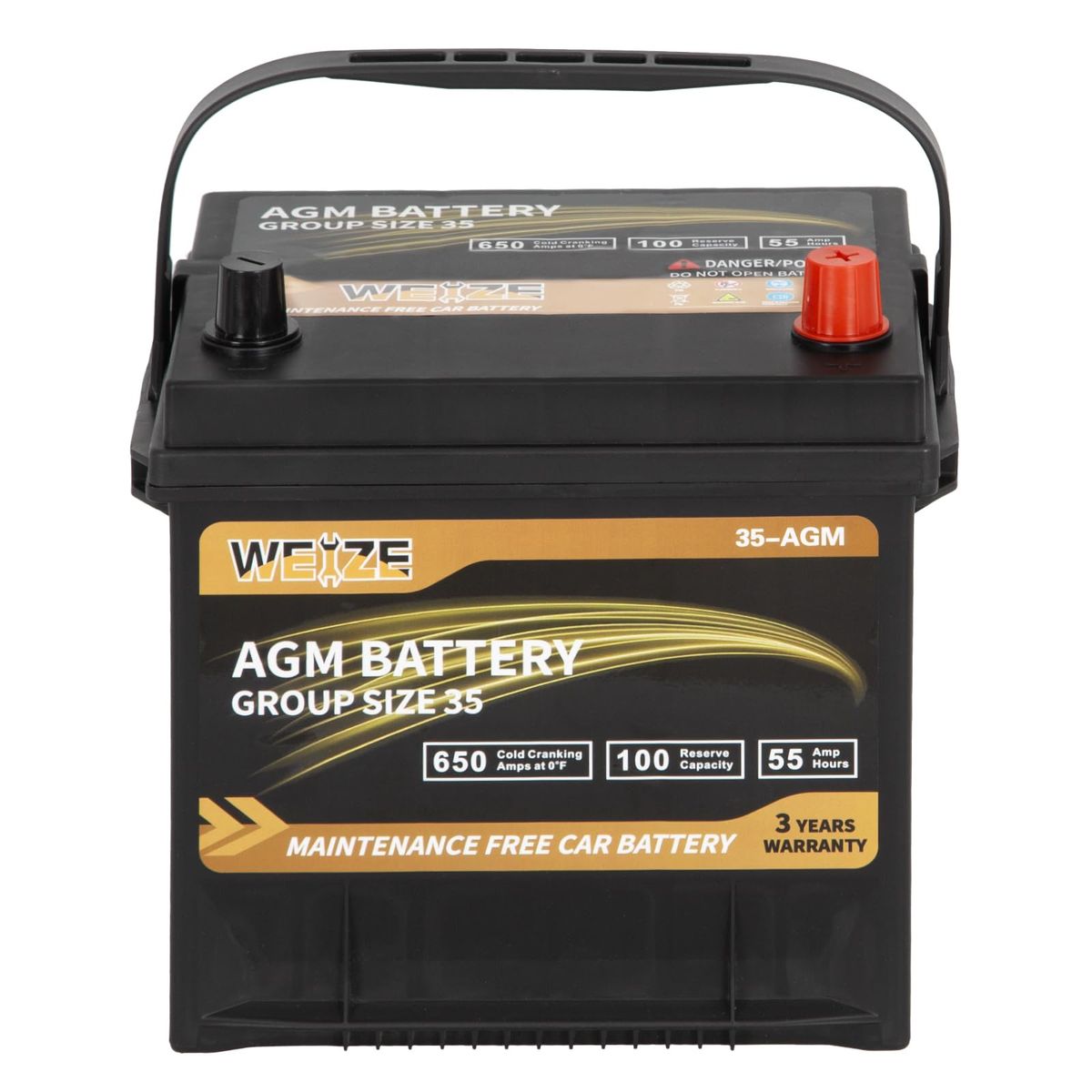
Example: Weize Platinum AGM (Group 35)
Flooded Lead-Acid Battery
Traditional battery with liquid electrolyte, requiring occasional maintenance.
- Lowest upfront cost
- Widely available at any auto parts store
- Shorter lifespan (3-5 years)
- Can spill acid if tipped
- Not suitable for start-stop vehicles
Best for: Older cars, budget-friendly replacements
Example: EverStart Value (typical economy battery)
EFB (Enhanced Flooded Battery)
An improved flooded battery designed to handle mild start-stop systems, but less robust than AGM.
- Better cyclic durability than standard flooded
- Lower cost than AGM
- Maintenance-free in many cases
- Still not as durable as AGM
- Limited group sizes available
Best for: Vehicles with basic start-stop systems where AGM is not mandatory
Example: ACDelco Professional EFB
What Actually Matters
| Factor | Importance | Best brand |
|---|---|---|
Cold Cranking Amps (CCA) At least 500 CCA for small cars; 650+ for larger engines and cold climates. Too little CCA and your car may struggle to start in winter; excessive CCA (>900 for a sedan) is wasted money. | Must-have | Weize (650–900 CCA range) |
Battery Group Size Must match your vehicle's BCI group code (e.g., 35, 24F, H8). An undersized battery may not fit or secure properly, leading to vibrations and short circuits. | Must-have | Weize offers multiple group sizes |
Battery Type (AGM vs Flooded) AGM mandatory for vehicles with start-stop or regenerative braking. Using a flooded battery in a start-stop car can cause rapid failure and may void warranty. | Must-have | Weize, ACDelco (AGM); Optima (SpiralCell AGM) |
Reserve Capacity (RC) 90+ minutes for most cars; 120+ for vehicles with many electronics. Higher reserve capacity gives you more time to run lights or accessories if the alternator fails. | Nice-to-have | Weize H8 (160 min RC) |
Warranty Length Look for at least 36 months free replacement. A longer warranty often signals manufacturer confidence, but ensure the process is hassle-free. | Nice-to-have | Weize, ACDelco (36 months) |
Overkill CCA Ratings Stick to manufacturer's recommended CCA range; extra won't help. Batteries marketed with 800+ CCA for a Honda Civic are overkill. The extra power is never utilized and you pay more for nothing. | Marketing BS | — |
Budget Tiers & Top Picks
What to buy at each price point — and exactly where spending more stops paying off.
Budget-Friendly AGM
$160 – $170Weize Platinum AGM Group 35

Stop paying more: Stop at $160. Spending more gets you minimal improvement in lifespan for the average sedan.
When to upgrade: Need a larger group size or higher CCA? Step up to the Group 24F or H8 models.
Higher Power for Trucks/SUVs
$170 – $190Weize Platinum AGM Group 24F

Stop paying more: Diminishing returns above $180; the 24F provides strong 710 CCA and 120 min reserve at a mid-tier price.
When to upgrade: If you need even more power or a larger group size like H8, consider the Weize H8 with 900 CCA.
Premium Vibration-Resistant
$200 – $270Optima RedTop 35

Stop paying more: At $270, you're paying for SpiralCell technology and 15x vibration resistance; beyond that, any more expensive battery is likely overkill for non-commercial use.
When to upgrade: If you need deep-cycling for accessories, consider the Optima Yellow Top, but it's not a dedicated starting battery.
Common Mistakes to Avoid
Buying the Wrong Group Size
Most cars require a specific BCI group size. A battery that doesn't fit securely can vibrate, short out, or cause terminal damage. Always check your owner's manual or measure your tray before ordering.
Cost of getting it wrong: A wrong-size battery often can't be returned easily, + and leaving you stranded.
Opting for a Flooded Battery in a Start-Stop Car
Vehicles with start-stop technology require an AGM battery. Installing a cheaper flooded battery will cause rapid failure, often within a year, and may void your vehicle warranty.
Cost of getting it wrong: Premature failure leads to another battery purchase within 18 months, wasting + and potential electrical damage.
Focusing Only on Price, Not CCA or Warranty
A battery with low CCA might not crank your engine in winter. Also, cheap batteries often have pro-rated warranties that leave you paying more than half the cost after a year.
Cost of getting it wrong: A failed start in extreme cold could mean a tow bill of +, plus the cost of a new battery.
Find Your Match
What's your primary vehicle type?
Frequently Asked Questions
How do I find the right battery group size for my car?
Check your owner's manual or look for a label on your existing battery. The BCI group number (like 35 or 24F) must match exactly. You can also use a sizing tool at any auto parts store. An incorrect size can cause terminal damage or poor fitment.
What is CCA and how much do I need?
CCA (Cold Cranking Amps) measures a battery's ability to start your engine in cold weather. Most passenger cars need 500-650 CCA. Larger engines and extreme cold require 700+ CCA. Always match or exceed your vehicle's original equipment CCA rating.
Is an AGM battery worth the extra cost?
Yes, if your car has start-stop technology or you live in extreme temperatures. AGM batteries last 2-3x longer, handle vibration better, and are spill-proof. For traditional cars in mild climates, a quality flooded battery may suffice.
Can I install a car battery myself?
Yes, with basic tools and safety precautions. Disconnect the negative terminal first, then positive. Remove the hold-down clamp, swap batteries, and reconnect in reverse. Many auto parts stores will test your old battery and offer free recycling.
How do I know when my battery needs replacing?
Slow engine cranking, dim lights, or a battery warning light are key signs. Most batteries last 3-5 years. Get a free voltage test at any auto store if you're unsure. Proactive replacement can prevent unexpected breakdowns.
What should I avoid when buying a car battery?
Never choose solely on price; cheap flooded batteries may fail early in modern cars. Avoid batteries with less than 36-month warranty if possible. Also, confirm terminal position (positive on left or right) matches your vehicle.
How we wrote this guide
About this guide
Mubboo Editorial Team. We research automotive products based on thousands of verified Amazon reviews and independent testing data to help US drivers make informed purchases.