How to Choose a Car Subwoofer (2026 Guide)
Master RMS vs. peak power, impedance, and enclosures — so your bass hits exactly how you want.
By Mubboo Editorial Team · Updated Jun 7, 2026 · 7 min read
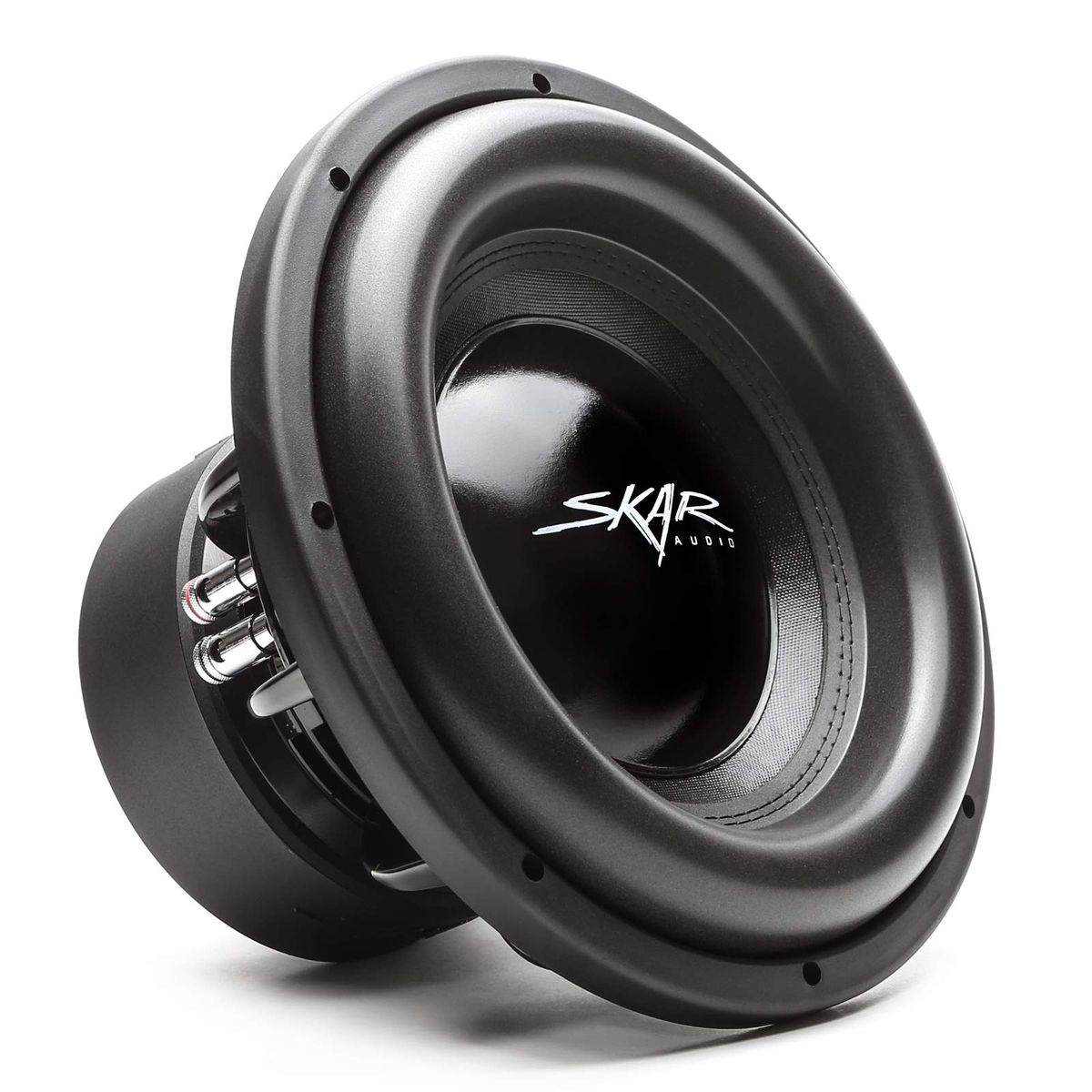
At a Glance
- Price range
- $95 – $220
- Budget pick
- Skar Audio SDR-10 D4 ($95.19 · 4.7★)
- Data
- 14,281 verified reviews analyzed across 6 finalists
- Best for
- Bass enthusiasts upgrading from factory stereoCompetition-level SPL seekersDaily drivers wanting rich, room-filling low end
- Skip if
- You only listen to talk radio or podcasts — a subwoofer won't add much to spoken word.
Types Explained
Component Subwoofers
A standalone driver you mount in a custom or pre-built box, paired with a separate amplifier.
- Maximum tuning flexibility with enclosure size and type
- Often handle higher power for greater output
- Wider selection of sizes and impedances
- Requires separate amp and box fabrication or purchase
- Installation more complex than all-in-one solutions
Best for: Audio enthusiasts who want precise control over bass performance
Example: Skar Audio EVL-12 D2 (component, 2,500W peak)
Loaded Enclosure Subwoofers
A pre-built box with one or more subs already mounted, often including a basic amp or designed for a specific amp.
- Simpler installation — just wire to an amp
- Box is tuned for the drivers, saving guesswork
- Often cost-effective when buying drivers and box separately
- Less flexibility if you want to change subs later
- May take up more trunk space than a custom enclosure
Best for: First-time upgraders or anyone who wants a quick, proven bass package
Example: MTX Dual 12" Terminator loaded enclosure
Shallow-Mount Subwoofers
Compact drivers with a slim profile designed to fit under seats or in tight spaces like single-cab trucks.
- Saves trunk space; fits where standard subs can't
- Can be installed in factory locations on some vehicles
- Generally handle less power than full-size subs
- Low-end extension usually less than 30 Hz
Best for: Vehicles with extremely limited space — small coupes, regular-cab pickups, or hidden installs
Example: None in today's top picks — consider if space is your #1 constraint
What Actually Matters
| Factor | Importance | Best brand |
|---|---|---|
RMS Power Handling ≥600W RMS for clean, impactful bass Ignore peak watt claims; RMS is the continuous power the sub can take without distorting. | Must-have | Skar Audio (EVL series handles 1,250W RMS) |
Impedance (Ohms) Match your amplifier's stable load. Dual voice coils (DVC) offer wiring flexibility. A 2-ohm load draws more power from most amps. If your amp is 2-ohm stable, choose a dual 2-ohm sub wired to 1 ohm for maximum output. | Must-have | Skar Audio (D2 or D4 options across lineup) |
Sensitivity (dB) ≥85 dB for efficient volume with moderate power Higher sensitivity means more volume per watt — crucial if your amp isn't huge. | Must-have | Skar Audio DDX-12 (88 dB) and EVL-12 (85.1 dB) |
Frequency Response Low end ≤28 Hz for true sub-bass; high end up to 250–300 Hz for upper punch If you listen to hip-hop or electronic, look for ≤25 Hz. Rock and metal benefit from a 30–80 Hz sweet spot. | Must-have | Skar Audio (SDR series reaches 22 Hz) |
Enclosure Type Sealed for tight, accurate bass; ported for louder, deeper extension A ported box can add 3–6 dB of output but requires a larger box. Check manufacturer specs for recommended volume. | Must-have | MTX (pre-tuned sealed box for the Terminator) |
Peak Power Ratings A sub claiming '2,500W peak' often handles only 600–1,200W RMS continuously. Peak numbers are for milliseconds; RMS is what matters. | Marketing BS | — |
Budget Tiers & Top Picks
What to buy at each price point — and exactly where spending more stops paying off.
Under $150
$95 – $145Skar Audio SVR-12 D2

Stop paying more: Stop at $150. Spending $200 gets you into the DDX-12’s higher sensitivity and 1,000W RMS, but the SVR-12 delivers 800W RMS with surprisingly clean output.
When to upgrade: Ready to push more power? Step up to the DDX-12 for an additional 200W RMS handling and a big jump in sensitivity.
$150 – $220
$150 – $220Skar Audio DDX-12 D2

Stop paying more: At the top of this bracket you reach the EVL-12 at $220. The DDX-12 is louder per watt, but the EVL digs deeper and handles even more power.
When to upgrade: If you have a 1,000+ watt amp and demand the deepest lows, move to the EVL-12 — its 23.5mm Xmax produces serious sub-25 Hz energy.
$220+
$220+Skar Audio EVL-12 D2

Stop paying more: Diminishing returns kick in beyond this price. The EVL-12’s massive motor structure and 23.5mm Xmax justify the premium, but you’ll need a very stout amp to exploit it fully.
When to upgrade: Want more surface area? Jump to the MTX dual 12" loaded enclosure — two 12s move more air for about the same price, though with less per-sub power handling.
Common Mistakes to Avoid
Buying based solely on peak watt ratings
A sub advertised as '2,500W peak' may only handle 600W RMS continuously. If you feed it a true 1,000W amp, you can easily blow the voice coil.
Cost of getting it wrong: Burned voice coil means + replacement plus labor, and possibly a damaged amplifier.
Ignoring amplifier impedance matching
If your amp is stable at 2 ohms mono, a dual 2-ohm sub wired in parallel presents 1 ohm — which can overheat or shut down the amp.
Cost of getting it wrong: Worst case you fry the amplifier; best case you get weak output. Re-wiring or replacing equipment costs time and money.
Not checking mounting depth
A 12" sub with a 6.5" mounting depth may not fit a shallow enclosure. Always measure the space behind your seat or trunk floor.
Cost of getting it wrong: Returns and restocking fees pile up, and you lose a weekend of installation time.
Using the wrong enclosure type for your music taste
A sealed box gives tight, accurate bass ideal for rock; a ported box boosts low-end output for hip-hop but can sound boomy with metal.
Cost of getting it wrong: Rebuilding or replacing the enclosure can –300 and another afternoon of tuning.
Find Your Match
What kind of bass are you after?
Frequently Asked Questions
How much should I spend on a car subwoofer?
You'll also need a compatible amplifier ($100–$300) and an enclosure ($50–$150). Plan $250–$500 total for a solid first system.
What’s the difference between RMS and peak power?
RMS (Root Mean Square) is the continuous power a sub can handle safely; peak is a short burst rating, often three times higher. Always match your amplifier’s RMS output to the sub’s RMS rating. For example, a sub rated 600W RMS works best with a 500–750W RMS amp.
What impedance should I choose for my car subwoofer?
It depends on your amplifier. Most mono amps are stable at 2 ohms. A dual 2-ohm sub can be wired in parallel for a 1-ohm load, extracting maximum power. If your amp is only 4-ohm stable, choose a dual 4-ohm sub wired to 2 ohms. Always check your amp’s spec sheet.
Do I need a separate amplifier for a subwoofer?
Yes, nearly all component and loaded enclosure subs require an external amplifier. Some compact powered subwoofers have a built-in amp, but they generally lack the output of a dedicated amp-sub combo. Invest in a quality mono amp with a low-pass crossover for clean bass.
Can I install a car subwoofer myself?
If you're comfortable running power wire from the battery, finding a signal from your stereo, and tuning gains, a DIY install is doable. Many shops charge $100–$200 for installation, which ensures proper grounding and no noise. Budget an afternoon and a wiring kit ($30–$60).
What size subwoofer is best for my car?
A 10-inch sub fits under many seats and works in small coupes; it reaches down to about 28 Hz. A 12-inch moves more air and hits harder — ideal for sedan trunks and most hatchbacks. For SUVs with huge cabins, dual 12s or a single high-power 12 fills the space best.
How do I break in a new car subwoofer?
Play bass-heavy music at moderate volume for 10–20 hours. Suspension stiffens at first; breaking it in loosens the spider and surround, improving low-frequency extension. Avoid cranking the gain on day one — you can overheat the voice coil before the suspension settles.
How we wrote this guide
We analyzed 6 car subwoofer finalists across more than 14,000 verified buyer reviews. Our research compared RMS power handling, impedance, sensitivity, frequency response, and real-world fitment to identify the models that deliver the best bass for every budget and vehicle type. Data sourced from Amazon product listings and verified purchaser feedback; no sponsored placements.
About this guide
Mubboo Editorial Team — independent US-market consumer research. Subwoofer picks reflect analysis of verified buyer reviews and manufacturer specifications. Prices update weekly from Amazon.