How to Choose a Compost Bin (2026 Guide)
Find the right bin for your kitchen scraps and garden waste
By Mubboo Editorial Team · Updated Jun 8, 2026 · 7 min read
At a Glance
- Price range
- $25 – $140
- Data
- 104,425 verified reviews across 6 top-selling bins
- Best for
- Most householdsSmall kitchensApartment dwellersBeginner gardeners
- Skip if
- You have a large yard and need high-volume composting — consider a tumbler.
Types Explained
Countertop Stainless Steel Bin
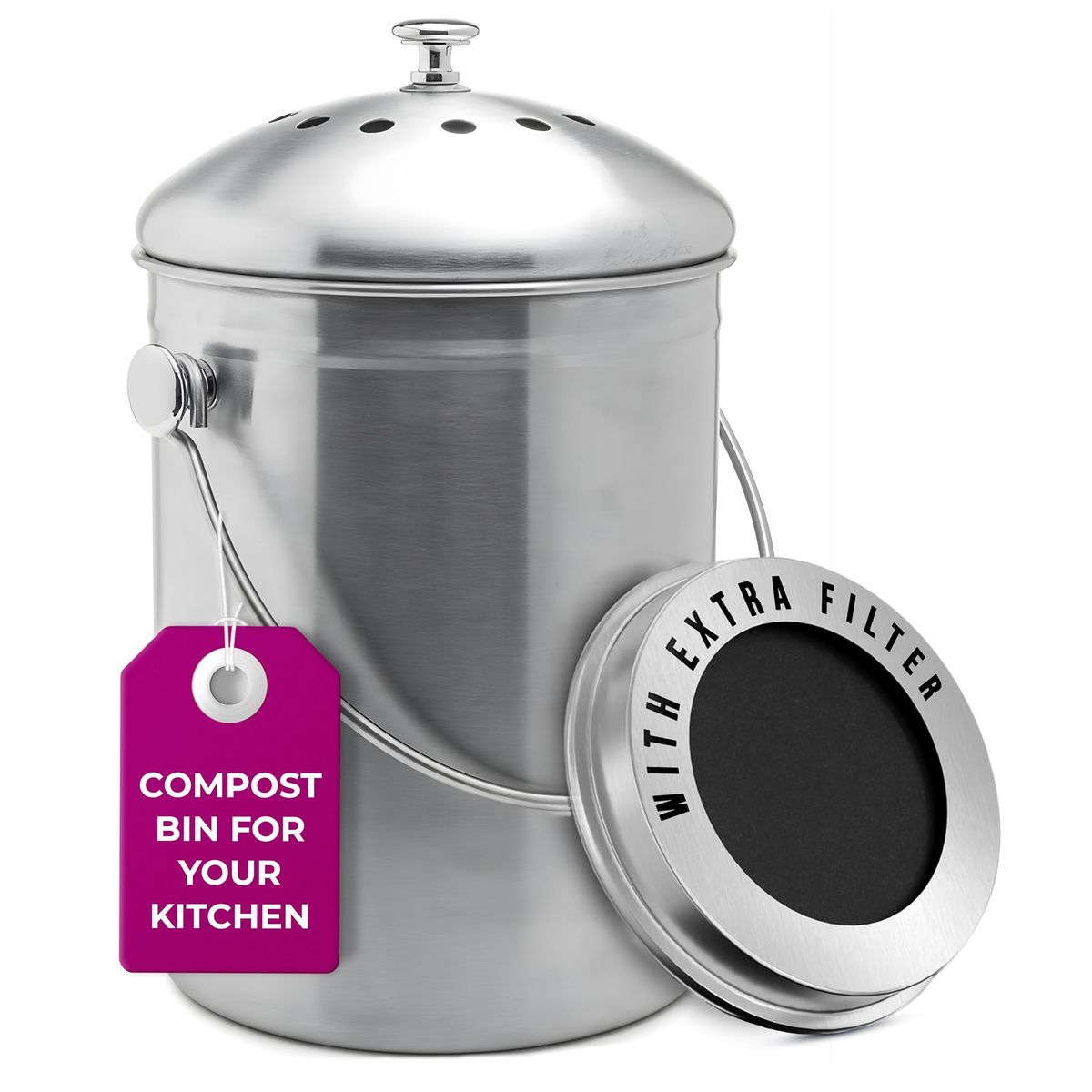
Small indoor bins made from stainless steel, typically 1–1.5 gallons, with a charcoal filter and tight-sealing lid.
- Durable, rust-resistant
- Doesn't absorb odors
- Sleek appearance
- Heavier than plastic
- No window to see fill level
Best for: Most kitchens, daily countertop use
Example: EPICA Countertop Compost Bin
Countertop Plastic Bin
Lightweight plastic bins, often with stay-open lids and smooth interiors for easy cleaning.
- Light and easy to carry
- Often dishwasher-safe
- Lower cost
- Can stain or absorb odors over time
- May crack if dropped
Best for: Busy cooks who want hands-free scraping
Example: OXO Good Grips Easy-Clean Compost Bin
Outdoor Tumbler
Large, rotating drums on a frame, usually dual-chamber, that churn yard and kitchen waste into compost quickly.
- Fast decomposition (as little as 2 weeks)
- Dual chambers allow continuous use
- Keeps pests out
- Requires outdoor space
- Can be heavy to turn when full
Best for: Gardeners and homeowners with yard waste
Example: FCMP Outdoor IM4000 Dual Chamber Tumbling Composter
What Actually Matters
| Factor | Importance | Best brand |
|---|---|---|
Capacity ≥1.3 gallons for a 2-person household A 1.3-gallon bin holds 2–3 days of scraps for a couple. If you cook daily for a family, consider 1.75 gallons or an outdoor tumbler. | Must-have | Utopia for compact size, OXO for larger |
Odor Control Airtight lid or charcoal filter Charcoal filters trap odors but need replacing every 6 months. None eliminate smells completely if scraps sit too long; empty and rinse weekly. | Must-have | EPICA's replaceable filter is highly effective |
Material Stainless steel for durability, plastic for lightness Stainless steel won't scratch or stain; plastic can but is easier to wash. r/composting users favor steel for long-term reliability. | Must-have | EPICA (stainless steel), OXO (plastic) |
Ease of Cleaning Smooth interior, removable lid America's Test Kitchen recommends the OXO bin for its one-wipe clean interior and stay-open lid that makes scraping easy. | Nice-to-have | OXO's smooth interior |
Tumbling Mechanism Rotating drum with aeration fins Tumblers speed up composting by mixing oxygen. Dual chambers let you add new scraps while another batch finishes. | Nice-to-have | FCMP and Miracle-Gro |
Charcoal Filter Filters help but don't replace regular cleaning. Many bins rely on them as a crutch; focus on a tight-sealing lid and proper airflow instead. | Marketing BS | — |
Budget Tiers & Top Picks
What to buy at each price point — and exactly where spending more stops paying off.
Under $30
$25 – $30Utopia Kitchen Compost Bin, 1.3 Gallon

Stop paying more: At this price point, you get a simple steel bin. Spending a few dollars more doesn't add features like stay-open lids or improved filters.
When to upgrade: If you want a bin that's easier to scrape and clean, consider a mid-range model with a smooth interior.
$30 – $80
$30 – $80EPICA Countertop Compost Bin, 1.3 Gallon

Stop paying more: This range hits the sweet spot for countertop bins. The EPICA combines a durable build with effective odor control, and spending much more on a similar bin doesn't improve performance.
When to upgrade: If you're ready to take your composting outdoors, a dual-chamber tumbler starts in the $80–$100 range.
$80 – $140
$80 – $140FCMP Outdoor IM4000 Dual Chamber Tumbling Composter

Stop paying more: For $80-$140, you get a tumbler that can handle yard waste. The FCMP offers the best value; higher-priced models only add capacity, which is overkill for many suburban yards.
When to upgrade: For truly massive volumes, the Miracle-Gro tumbler is the next size up, but most gardeners won't need it.
Common Mistakes to Avoid
Buying a bin that's too small
A 1-gallon bin fills up in a day with family cooking. You'll make extra trips to empty it or let scraps rot.
Cost of getting it wrong: Wasted time and potential odor problems; repurchasing a larger bin costs another $25–$30.
Thinking a charcoal filter eliminates all odor
Filters trap smells but need to be replaced every few months. Scraps sitting too long will still smell, especially in hot weather.
Cost of getting it wrong: Ongoing filter replacements (~each) and potential smelly kitchen.
Choosing a plastic bin without checking the interior
Cheap plastic bins have ridges and crevices where gunk collects. Smooth interiors are easier to clean and don't harbor bacteria.
Cost of getting it wrong: Replacing a stinky bin can cost the same as buying a good one initially — $20–$30.
Ignoring the weight of a full tumbler
A 37-gallon tumbler full of wet scraps and yard waste can weigh over 100 lbs. Turning it becomes a chore.
Cost of getting it wrong: A tumbler you can't turn properly slows composting and may lead to anaerobic mess.
Find Your Match
Where will you use the compost bin?
Frequently Asked Questions
What's the best compost bin for a small kitchen?
A compact stainless steel bin like the EPICA 1.3-gallon (7.16" diameter) fits even narrow counters. If space is really tight, the Joseph Joseph 1-gallon rectangular bin saves room and has a ventilated design to reduce odors.
Do compost bins smell?
All bins can smell if scraps sit too long. A bin with an airtight lid and charcoal filter, like the EPICA, controls odors effectively. Empty it every 2–3 days and wash it weekly to keep smells at bay.
Should I get a countertop bin or a tumbler?
Start with a countertop bin to collect kitchen scraps. If you have a yard and want to create compost for the garden, add a tumbler. Tumblers need outdoor space and regular turning but produce nutrient-rich soil amendment.
How big should my compost bin be?
For a couple, 1.3 gallons (the EPICA size) holds 2–3 days of scraps. A family of four may want 1.75 gallons or larger. Outdoor tumblers range from 37 to 55 gallons for yard waste.
How much should I spend on a compost bin?
You can get a reliable countertop bin for $25–$30. Mid-range bins ($30–$80) offer better filters and easier cleaning. Outdoor tumblers run $88–$140. Don't overspend: a simple bin works if you empty it regularly.
What should I avoid when buying a compost bin?
Avoid bins with no tight-sealing lid, as they let smells out and pests in. Steer clear of ultra-thin plastic that warps. And don't buy a tiny bin if you cook daily — it'll fill up too fast and become a chore.
Can I use a compost bin in an apartment?
Yes! A small countertop bin is perfect for collecting scraps. Many communities have composting drop-off programs. Look for a bin with a charcoal filter to minimize odors, and consider freezing scraps between drop-offs to eliminate smells.
How we wrote this guide
How we researched. We cross-referenced expert analysis from Wirecutter with 104,425 verified Amazon reviews across 6 top-selling compost bins to build this guide. Prices update weekly from Amazon.
About this guide
Mubboo Editorial Team. Picks based on independent research and verified buyer reviews. Prices update weekly from Amazon.