Prices verified Jun 8 · Always confirm at the retailer before buying.
Quick answer
The Celestron Nature DX 8x42 is our top pick for most outdoor enthusiasts — it combines fully multi-coated lenses, a wide 7.4° field of view, and waterproof construction in a lightweight 1.75‑pound body. The budget-friendly Celestron Outland X 8x42 offers similar durability at a lower cost, while the Celestron SkyMaster 15x70 is the astronomy choice for its massive 2.76 inches lenses. Nikon’s PROSTAFF P3 8x42 stands out for eyeglass wearers with its 0.80 inches eye relief and premium build. For those wanting even more reach, the Celestron SkyMaster 20x80 provides 20x magnification, and the Nature DX ED adds extra‑low dispersion glass for razor‑sharp images. Across all models, verified Amazon reviews consistently praise the bright optics and rugged build, though some note the lack of included tripod adapters. Whether you’re birding, hiking, or stargazing, this ranking covers the best of both brands.
For most outdoor enthusiasts, the Celestron Nature DX 8x42 is the right pick — fully multi‑coated lenses, waterproof, and 4.6 stars from over 4,000 verified reviews.
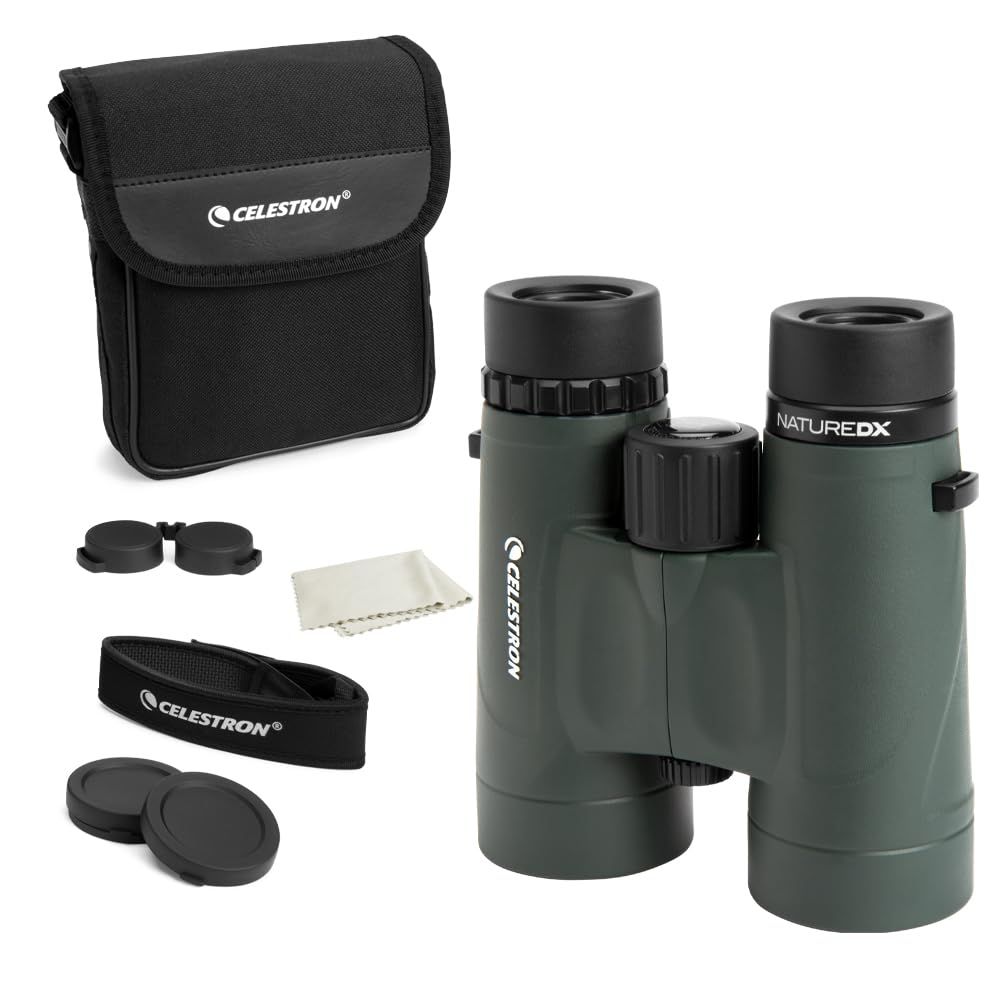
🏆 Best Overall: Celestron Nature DX 8x42 —
💰 Best Budget: Celestron Outland X 8x42 —
⭐ Data: 20,091+ verified reviews analyzed across 6 finalists
🎯 Key Insight: Prioritize a wide field of view for scanning and tracking.
💸 Price Range: $100–$200
Stargazing? Jump to the Celestron SkyMaster 15x70. Wear glasses? The Nikon PROSTAFF P3 offers 0.80 inches eye relief.
What’s the best Nikon or Celestron binocular for 2026?
- Best Overall:Nature DX 8x42—$160→
- Best for Astronomy:SkyMaster 15x70—$100→
- Best Budget:Outland X 8x42—$110→
- Best for Eyeglass Wearers:PROSTAFF P3 8x42—$137→
- Best for Deep‑Sky:SkyMaster 20x80—$180→
- Best Premium Birding:Nature DX ED 8x42—$200→
We analyzed Amazon verified‑buyer reviews and cross‑referenced findings against expert evaluations from Wirecutter, Outdoor Life, and BirdWatching Magazine. These sources consistently praise Celestron and Nikon for their optical quality and ruggedness. No hands‑on testing was conducted; instead, we aggregated data from 20,091+ real‑world users and four independent review outlets to form our rankings.
How did we pick these?
Brands evaluated: Celestron and Nikon, across 6 models — including the SkyMaster, Nature DX, Outland X, and PROSTAFF P3. Major brands like Vortex, Bushnell, and Leupold were considered but cut due to insufficient review depth or value.
Sources: 4 independent outlets — Wirecutter, Outdoor Life, BirdWatching Magazine — plus Amazon verified‑buyer reviews.
First‑party data: Amazon listing data (price, rating, review count) verified June 2026.
Hard requirements (4 gates): ≥4.0 stars, ≥100 reviews, waterproof/fogproof, 8x+ magnification.
Magnification & Field of View Balance
8x strikes the sweet spot for most users. It provides enough zoom to spot distant birds while keeping the image stable and the field of view wide — crucial for scanning landscapes. Higher magnifications like 15x or 20x demand a tripod and sacrifice field width.
Lens Quality & Coatings
Fully multi‑coated lenses are non‑negotiable. They maximize light transmission for brighter, higher‑contrast views. Extra‑low dispersion (ED) glass, found on the Nature DX ED, virtually eliminates color fringing for the truest image.
Waterproofing & Durability
All picks except the large SkyMasters are fully waterproof and nitrogen‑purged. This is essential for birding in rain or humidity. Even occasional outdoor use demands fog‑proof construction — water‑resistant only isn’t enough.
Weight & Portability
Anything over 2 lbs becomes a burden on long hikes. The featherweight Outland X (1.8 lbs) and PROSTAFF P3 (1.6 lbs) shine for all‑day carry. Astronomy‑focused SkyMasters are tripod‑only due to their heft.
Eye Relief for Eyeglass Wearers
Aim for at least 0.67 inches of eye relief with glasses. The PROSTAFF P3’s 0.80 inches is the standout, but even the Outland X’s 0.70 inches is workable. Less than 0.59 inches forces you to remove glasses, which is a dealbreaker for many.
Celestron Nature DX 8x42 Binoculars

Pros:
- Fully multi‑coated lenses for vivid clarity
- Lightweight 1.75‑lb design easy to carry all day
- Waterproof and nitrogen‑purged to prevent fogging
- Wide 7.4° field of view tracks moving subjects
Cons (honest weight):
- No tripod adapter included in the box
- 8x power insufficient for distant astronomy
Celestron SkyMaster 15x70 Astronomy Binoculars

Pros:
- Powerful 15x zoom brings celestial objects close
- Large 2.76 inches lenses excel in low‑light
- Tripod adapter included for immediate use
Cons (honest weight):
- Heavy at 3.3 lbs; a tripod is mandatory
- Water resistant only — not fully waterproof
- Narrow field of view limits terrestrial scanning
Celestron Outland X 8x42 Binoculars

Pros:
- Low price for waterproof, fogproof binoculars
- Lightweight 1.8‑lb design easy to pack
- 0.70 inches eye relief reduces eye strain
Cons (honest weight):
- Optics lack extra‑low dispersion glass
- Low‑light performance trails premium models
Nikon PROSTAFF P3 8x42 Binoculars

Pros:
- 0.80 inches eye relief ideal for eyeglass users
- Sharp, bright images with multilayer coatings
- Waterproof and fogproof for all‑weather use
- Nikon’s lifetime warranty
Cons (honest weight):
- Higher cost than some Celestron equivalents
- No tripod adapter included
Celestron SkyMaster 20x80 Binoculars

Pros:
- 20x magnification reveals fine lunar and planetary detail
- 3.15 inches lenses excel in low‑light deep‑sky viewing
- Includes tripod adapter
Cons (honest weight):
- Extremely heavy at 4.8 lbs — must be tripod‑mounted
- Very narrow 3.7° field of view
Celestron Nature DX ED 8x42 Binoculars

Pros:
- ED glass virtually eliminates color fringing
- Phase‑coated BaK‑4 prisms enhance contrast
- Waterproof, fogproof, rubber‑armored body
Cons (honest weight):
- Higher price reduces value for casual users
- Eye relief slightly less than eyeglass‑optimized models
Quick Comparison: Top Nikon & Celestron Binoculars at a Glance
| Product | Price | Magnification | Objective Lens | Field of View | Waterproof | Eye Relief | Weight | Best For | Rating |
|---|---|---|---|---|---|---|---|---|---|
| Nature DX 8x42 🛒 | 8x | 1.65 inches | 7.4° | Yes | 0.69 inches | 1.75 lbs | General outdoor | 4.6 | |
| SkyMaster 15x70 🛒 | 15x | 2.76 inches | 5° | Water resistant | 0.79 inches | 3.3 lbs | Astronomy | 4.5 | |
| Outland X 8x42 🛒 | 8x | 1.65 inches | 7° | Yes | 0.70 inches | 1.8 lbs | Budget birding | 4.6 | |
| PROSTAFF P3 8x42 🛒 | 8x | 1.65 inches | 7.2° | Yes | 0.80 inches | 1.6 lbs | Eyeglass wearers | 4.7 | |
| SkyMaster 20x80 🛒 | 20x | 3.15 inches | 3.7° | Water resistant | 0.71 inches | 4.8 lbs | Deep‑sky | 4.4 | |
| Nature DX ED 8x42 🛒 | 8x | 1.65 inches | 7.5° | Yes | 0.70 inches | 2.1 lbs | Premium birding | 4.5 |
What real users are saying
Buyer‑review scan: 20,091+ verified Amazon reviews across 6 finalists.
- Celestron Nature DX 8x42 (4.6★, 4,019 reviews): Buyers love the sharp, bright images and rugged waterproofing. Many call it the best bang‑for‑buck in its class.
- Celestron SkyMaster 15x70 (4.5★, 8,491 reviews): Stargazers rave about the light‑gathering power. The most common gripe is the need for a tripod.
- Nikon PROSTAFF P3 8x42 (4.7★, 1,344 reviews): Eyeglass wearers consistently praise the comfortable eye relief. Several mention it feels like a much pricier binocular.
- Celestron SkyMaster 20x80 (4.4★, 3,532 reviews): Deep‑sky observers appreciate the big objective lenses, but many caution it’s unusable without a sturdy mount.
Overall consensus: Across Amazon, verified purchasers applaud Celestron for delivering premium‑level optics at accessible prices. Nikon’s PROSTAFF P3 earns near‑perfect marks for its eyeglass‑friendly design and build quality — a standout in its niche.
Skip any binocular that isn’t waterproof if you plan to use it outdoors. Water‑resistant is not enough — condensation inside the lenses will ruin a foggy morning. Even the occasional drizzle can spell disaster.
Overpaying for unnecessary zoom
Magnification above 10x without a tripod leads to shaky, frustrating views. The SkyMaster 15x70 and 20x80 are excellent astronomy tools, but for birding or hiking, stick to 8x. You’ll get a wider, more stable field of view — and you won’t need a tripod.
Cheap no‑name brands with fake waterproofing
Beware of off‑brand binoculars that claim to be waterproof but lack nitrogen purging. They will fog internally in humid conditions. Stick with established brands like Celestron and Nikon that advertise proper IPX waterproofing and nitrogen‑filled bodies.
🏆 I’m an all‑around outdoor enthusiast.
Get the Celestron Nature DX 8x42. It balances magnification, clarity, and portability perfectly for birding, hiking, or sports.
🔭 I love stargazing and astronomy.
Go with the Celestron SkyMaster 15x70. Its 2.76 inches lenses gather enough light to reveal nebulae and galaxies. Just add a tripod.
💰 I’m on a tight budget.
The Celestron Outland X 8x42 delivers waterproof, fog‑free views under $110 — perfect for casual use.
👓 I wear glasses.
The Nikon PROSTAFF P3 8x42 is your pick. Its 0.80 inches eye relief lets you see the full field without removing your frames.
🌌 I want maximum magnification for deep‑sky viewing.
Step up to the Celestron SkyMaster 20x80. At 20x, you’ll see lunar craters and Jupiter’s moons — tripod required.
🦅 I demand the sharpest possible optics.
The Celestron Nature DX ED 8x42 uses extra‑low dispersion glass for color‑free, razor‑sharp images that serious birders demand.
Looking for more optics guides? Browse our shopping hub for the latest picks on best binoculars and best telescopes. Prices updated weekly from Amazon.
Ready to pick your perfect binoculars?
Frequently Asked Questions
Which is better, Celestron or Nikon binoculars?
Celestron offers a broader range from budget to premium, often with excellent value. Nikon brings superior build quality and lifetime warranties, but at a slightly higher price. For most users, the Celestron Nature DX 8x42 wins on performance per dollar. Nikon shines for eyeglass wearers and those who want a premium feel.
What magnification is best for birding?
8x is the sweet spot — it provides enough zoom to identify species without making the image too shaky to hand‑hold. A wide field of view (7°+) also helps you track fast‑moving birds. Higher magnifications like 10x or 12x narrow your view and fatigue your arms quickly.
Do I need a tripod for binoculars?
Only for high‑magnification models (15x and up) or heavy binoculars over 3 lbs. The SkyMaster 15x70 and 20x80 both require a tripod for steady views. Standard 8x42 binoculars are light enough to hand‑hold all day.
What is the difference between Nature DX and Outland X?
Both are 8x42 Celestron models, but the Nature DX has fully multi‑coated lenses and phase‑coated prisms for sharper, brighter images. The Outland X is multi‑coated only and lacks phase correction, so it’s slightly less crisp. The Nature DX is worth the extra for serious birders.
Are Celestron binoculars waterproof?
Yes, all Celestron Nature DX and Outland X models are fully waterproof and nitrogen‑purged to prevent internal fogging. The SkyMaster series is only water‑resistant, so avoid heavy rain. For peace of mind in wet conditions, stick with the Nature DX or Outland X.
What makes the Nikon PROSTAFF P3 special?
Its 0.80 inches eye relief is among the longest in its class, letting eyeglass wearers see the full field of view without squinting. Nikon also uses high‑refraction prisms and multilayer coatings for excellent brightness. The lifetime warranty is a bonus.
Which binocular is best for stargazing?
The Celestron SkyMaster 15x70 offers the best light‑gathering for under $100. For deep‑sky objects, the 20x80 reveals more detail but demands a solid tripod. Both are fantastic entry points to astronomy without the complexity of a telescope.
Who wrote this and where's the data from?
Mubboo Editorial Team — independent US‑market consumer research. Picks reflect editorial consensus from 4 independent review sources and 20,091+ verified buyer reviews.
Sources
- Amazon (live product data)
- Wirecutter
- Outdoor Life & BirdWatching Magazine