💰 When is the cheapest time to fly from Portland to Osaka?
This month: Obon (mid-August) is Japan's biggest domestic travel surge — fares spike near the April band.
Portland-Osaka connecting fares track Japan's demand calendar, and the swing is wide — the April peak runs roughly 50% over the January floor.
The two demand peaks are cherry blossom (late March–April, ~$1,280) and autumn foliage (late October–November). Golden Week (late April–early May) and Obon (mid-August, ~$1,220) spike on Japanese domestic and diaspora travel.
The annual floor sits in deep winter — January–February at about $820 — with a second value window in the June rainy season (~$880), when demand softens. Booking 8–12 weeks out captures these floors. Ranges are editorial estimates; verify live fares before booking.
Here's a month-by-month look at prices on this route:
✈️ What are the best ways to get from Portland to Osaka?
Because Portland has no Osaka nonstop, the carrier choice is really a hub choice.
Delta runs the Seattle one-stop, Japan Airlines flies the transpacific leg from SFO/LAX behind an Alaska feeder, and ANA routes through Tokyo for the best cabin at the cost of an extra leg.

Delta is the most natural one-stop for a Portland flyer.
Seattle is a 45-minute hop north, and Delta's 2023 SEA consolidation means the most frequency and a single SkyMiles itinerary with through-checked bags to KIX.
One ticket, one alliance, fewest surprises if a leg slips.
Anti-recommendation: avoid Basic Economy on a 16-hour travel day — the no-seat-selection gamble on a transpacific connection is not worth the $60 saved.
Best for: most Portland travelers, SkyMiles members, anyone wanting the simplest single-carrier one-stop via Seattle
Japan Airlines flies the transpacific leg straight into KIX, no Tokyo backtrack.
Because Alaska is Portland's hub carrier and a oneworld member, you book PDX-SFO/LAX-KIX on one ticket and earn Mileage Plan miles end to end.
JAL economy gives two free checked bags and a service polish US carriers can't match.
Anti-recommendation: skip a tight LAX evening connection in winter — transpacific gates are a long sprint from domestic arrivals.
Best for: Alaska Mileage Plan loyalists, travelers wanting a direct West-Coast-to-Osaka leg, two-checked-bag families

ANA is the pick for the best transpacific cabin if you'll accept a Tokyo routing.
United feeds PDX-SFO, ANA flies SFO-Tokyo, then a 70-minute Tokyo-Osaka hop or Shinkansen reaches Kansai. MileagePlus earns the whole way.
ANA economy rates above US carriers for legroom and meals.
Anti-recommendation: this is the longest option on elapsed time — choose Delta via Seattle if you want fewer legs, not the Tokyo detour.
Best for: Star Alliance/MileagePlus members, travelers prioritizing cabin quality, anyone pairing Osaka with a Tokyo stopover

Alaska is Portland's hub carrier — you won't fly it across the Pacific, but it gets you to the gateway.
Since May 2025 Alaska has shifted connecting traffic onto PDX, so a feeder leg to SEA/SFO/LAX is available almost any hour, then JAL takes the transpacific leg.
The value is the single oneworld ticket: through-checked bags and Mileage Plan miles end to end.
Anti-recommendation: never book the Alaska feeder separately — a self-connect means re-checking bags and zero protection if the first leg slips.
Best for: Portland-based Alaska Mileage Plan members wanting the feeder and transpacific leg on one protected ticket
Mubboo verdict: Delta via Seattle is the simplest one-stop. JAL via SFO/LAX on an Alaska ticket adds two free bags. ANA via Tokyo wins the cabin. No nonstop exists.
Prices shown are approximate averages based on recent searches (April 2026). Actual fares vary by date, class, and availability.
🎯 Ready to compare flights?
We compare prices from airlines and travel platforms so you can find the best deal.
Compare all flights →📅 When should you book Portland to Osaka flights?
Book 8–12 weeks out for the best connecting fares, and target a Tuesday or Wednesday ticketing day when sales tend to load.
The January–February floor and the June rainy-season dip are the year's cheapest windows — both roughly 30–35% under the April peak.
Avoid pricing a trip across cherry-blossom April or Obon in mid-August unless those events are the point — both run 40–55% above the floor.
For a connecting itinerary, hold out for a single-ticket fare through one alliance rather than stitching a cheap feeder to a separate transpacific leg.
Obon empties Osaka of locals but fills every transpacific seat with diaspora travel. Hot, humid, and pricey — the worst value week of summer.
If you're a family flying in summer, book by March — peak season fills up fast.
Budget travelers: shoulder season (Sep–Oct, Apr–May) offers the best balance of price and weather.
💡 This Aug: Avoid the Aug 13–16 Obon core; book the shoulders of the month if you must travel.
🏙️ Why visit Osaka?
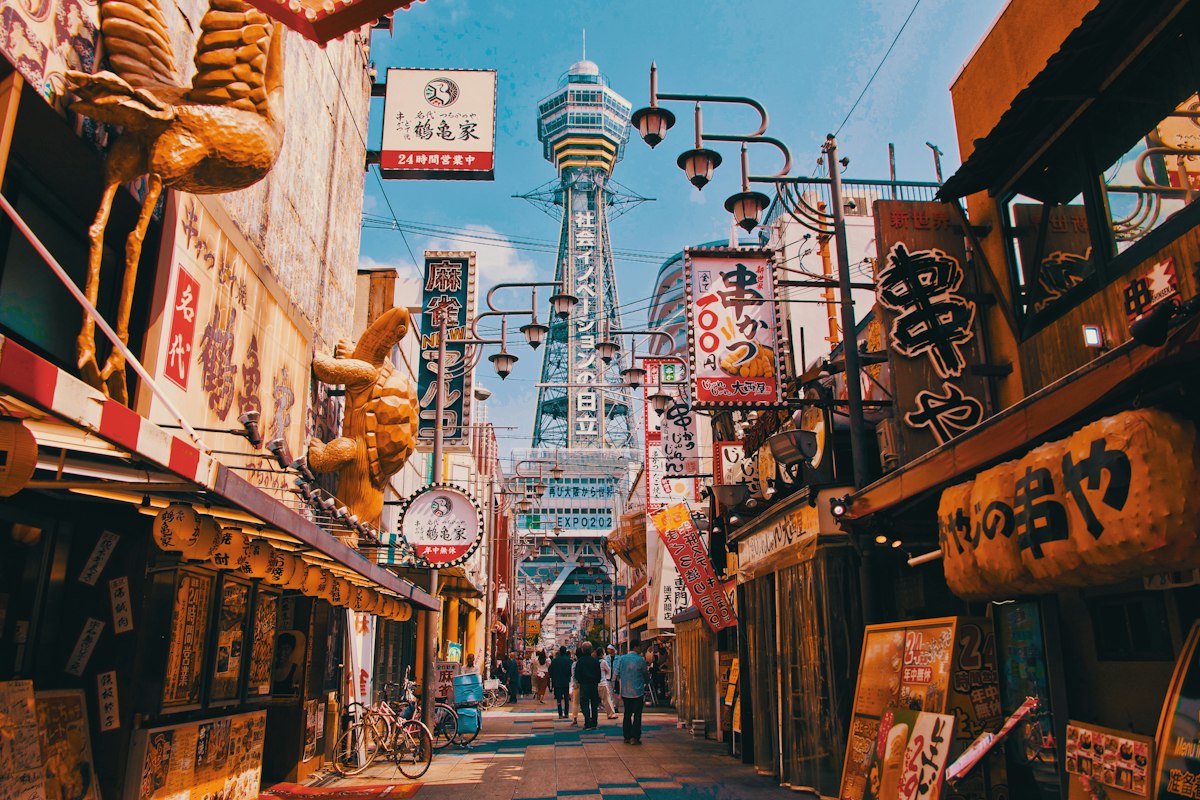
Osaka is Japan's third-largest city and its self-declared kitchen — the loud, food-obsessed counterweight to Tokyo's polish.
The neon canals of Dotonbori, the street-food arcades of Kuromon Market, and a takoyaki-and-okonomiyaki culture that started here anchor the city. For a Portland flyer raised on food-cart pods and a no-fuss eating-out ethos, Osaka reads as a sister food city writ large.
It's also the ideal Kansai base: Kyoto sits about 15 minutes away by limited express and Himeji Castle is 30 minutes by Shinkansen, so a single Osaka hotel covers three headline destinations.
What makes Osaka worth the flight:
Plan by how long you've got — Osaka rewards a tight radius.
8 hours: Dotonbori for the Glico sign and a river cruise, Kuromon Market for lunch, and Osaka Castle for the skyline view (museum ~600 yen, free under 15).
48 hours: add Shinsekai and Tsutenkaku Tower at night, the Abeno Harukas 300 m observatory, and a Kyoto half-day on the Haruka.
A week: fold in Universal Studios Japan (a 15-minute train from Osaka Station), a Himeji day trip, the Nara deer park, and a hands-on takoyaki cooking class.
Best neighborhoods to explore:
Osaka's neon dining-and-nightlife core: covered arcades, the Glico sign, Ebisubashi Bridge, and a 20-minute river cruise. Hotels sit 2–5 minutes from Namba Station — the consensus first-timer base.
The main transport hub and business district around Osaka Station and the Umeda Sky Building. Best connectivity for Kyoto and Himeji day trips when rail convenience drives the plan.
A nostalgic 1912-built district centered on Tsutenkaku Tower — retro neon, kushikatsu, and vintage arcades. Best as an evening stop, not a hotel zone, on a first visit.
The Shinsaibashi shopping arcade meets the calmer Hommachi business pocket, walkable to Dotonbori on the Midosuji Line. Mid-range hotel value for repeat visitors.
Temples, geisha districts, and Fushimi Inari are reachable from your Osaka hotel without changing rooms — the value play for culture-first travelers.
Don't miss:
Osaka Castle
Toyotomi Hideyoshi's reconstructed keep ringed by a double moat; museum inside (~600 yen adults, free under 15) and an observation deck. The surrounding park gives quieter views.
Browse Osaka Castle tours →Dotonbori
The neon canal entertainment street — Glico sign, Ebisubashi Bridge, a 20-minute river cruise, and a covered shopping arcade packed with takoyaki stalls.
Browse Dotonbori tours →Universal Studios Japan
A 15-minute train from Osaka Station: Super Nintendo World, the Wizarding World of Harry Potter, and Minion Park. Buy an Express Pass and visit on a weekday.
Browse Universal Studios Japan tours →Kuromon Ichiba Market
A 600-meter covered arcade with 150+ stalls of sushi, wagyu, and grilled seafood. Open 9 AM–6 PM; go outside the lunch rush for elbow room.
Browse Kuromon Ichiba Market tours →Abeno Harukas
Osaka's tallest building at 300 m / 985 ft, with the Harukas 300 observatory. A free lower garden terrace sits on the 16th floor for a no-cost skyline peek.
Browse Abeno Harukas tours →Shinsekai & Tsutenkaku Tower
The retro 1912 district built with Paris- and New York-inspired layouts: an observation deck, kushikatsu skewers, and neon streets best seen at night.
Browse Shinsekai & Tsutenkaku Tower tours →Himeji Castle (day trip)
The UNESCO white 'White Heron' castle, 30 minutes by Shinkansen from Shin-Osaka, with the nine-garden Koko-en next door.
Browse Himeji Castle (day trip) tours →Mubboo Verdict:
Base in Namba or Dotonbori for a first Osaka trip — you'll walk to the food, the neon, and the Midosuji Line that ties the city together.
Move to Umeda/Kita only if Kyoto and Himeji day trips dominate your plan. Skip basing in Shinsekai on a first visit — it's a great evening stop, not a hotel zone.
🧳 What do you need to know before flying to Osaka?
🛂 Do Americans need a visa for Osaka?
Visa-free, 90 days, US passport.
US passport holders currently do not need a visa for tourism or business in Japan up to 90 days under Japan's visa-exemption arrangement. Confirm at travel.state.gov before booking. [GOV]
Your passport must be valid for the duration of stay — Japan does not require 6 months' validity for US visitors, though your airline may.
Register Visit Japan Web before arrival to pre-clear immigration and customs QR codes — it speeds the fast lane at KIX. [GOV]
Overstays and unauthorized work are not permitted on visa-free entry.
🕐 What's the time difference?
Osaka runs on Japan Standard Time (JST, UTC+9), no daylight saving.
Portland is Pacific Time, so Osaka is 16 hours ahead in summer (PDT) and 17 hours ahead in winter (PST).
Westbound you lose a calendar day; eastbound you arrive the same day you left.
Jet lag is harder westbound (PDX→Osaka). A Portland departure connecting to an evening transpacific leg lands at KIX late afternoon or evening the next day — book the first night near KIX rail and crash early.
🚇 How do you get from the airport to the city?
KIX to central Osaka (Namba): about 50 km south of the city on a man-made island. Two terminals: Terminal 1 (full-service international, transpacific connections) and Terminal 2 (LCC/Peach). Costs are approximate "from" fares as of 2026 — verify on operator sites (nankai.co.jp / westjr.co.jp).
| Option | Time | Cost (JPY + ~USD) | Best for |
|---|---|---|---|
| Nankai rapi:t ✅ | ~38 min to Namba | from ~1,490 yen (~$10) | Fastest to a Namba/Dotonbori base — editor's pick |
| JR Haruka | ~50 min to Tennoji / Shin-Osaka | from ~2,300 yen (~$15) | Kyoto-bound or a Shin-Osaka/Kita base |
| Kansai Airport Rapid (JR) | ~70 min to Osaka Station | from ~1,210 yen (~$8) | Budget travelers, no rush |
| KATE Limousine Bus | ~50–65 min to Namba/Umeda | from ~1,600 yen (~$11) | Heavy luggage, door-to-hub |
Editor's pick: Nankai rapi:t for a first-timer Namba base; JR Haruka if you're heading straight to Kyoto. Grab an ICOCA IC card at KIX on arrival for every onward metro tap.
💷 What about money and tipping?
Japan uses the yen (JPY/¥), and it pays to carry some cash.
The yen has traded in a wide band against the dollar lately — check current rates before you go and don't budget on a fixed ratio.
Japan stays more cash-friendly than the US at small restaurants, temples, and market stalls (Kuromon), though konbini, IC cards, and major retailers take contactless. 7-Eleven ATMs reliably accept US cards.
Carry a no-foreign-fee card — Chase Sapphire Preferred, Capital One Venture, or Amex Platinum all waive the ~3% FX fee.
Tipping is not customary and can confuse staff — don't tip.
Osaka currency snapshot
1 USD = 159 JPY
1 JPY = $0.0063 USD
Japanese Yen
Cash
ATMs offer the best rate. Avoid airport currency desks.
Tipping
Carry cash — many smaller shops are cash-only. ATMs at 7-Eleven and post offices accept foreign cards. No ti…
Cards
Visa and Mastercard widely accepted. Tell your bank before you go.
Source: open.er-api.com · Updated Aug 1, 2026 · Rates fluctuate — check before booking.
📱 Will your phone work?
An eSIM is the move for data in Japan.
US carriers: T-Mobile bundles slow international roaming in many plans (fine for maps); AT&T International Day Pass (~$12/day) and Verizon TravelPass (~$10/day) add up fast over a 1–2 week trip.
For value, a Japan eSIM from Saily, Airalo, or Yesim runs roughly $5–20 depending on data and days — install before you fly, active on landing at KIX.
Japan has dense public Wi-Fi at stations and konbini, but it's patchy for navigation on the move.
☁️ Osaka climate overview
Best: Apr, NovAvoid: JunHistorical highs, lows, and rainfall by month. Plan packing and outdoor time around the extremes.
Jan
49°/35°F
1.1″ rain
Feb
47°/33°F
1.3″ rain
Mar
57°/43°F
3.9″ rain
Apr
68°/50°F
4.2″ rain
May
74°/60°F
8.3″ rain
Jun
83°/70°F
11.4″ rain
Jul
95°/80°F
7.8″ rain
Aug
94°/81°F
4.4″ rain
Sep
88°/75°F
8.3″ rain
Oct
75°/63°F
7.1″ rain
Nov
62°/47°F
2.0″ rain
Dec
55°/39°F
2.3″ rain
Source: Open-Meteo Archive API · 2025 historical data · Updated August 2026
Ready to lock in your fare? Search live prices below:
✈️ Ready to book? Compare Portland to Osaka flights
Search flights →🛫 Flying from Portland — airport tips
PDX Main Terminal — Alaska Airlines feeder gates (Alaska)
- Alaska is the PDX hub — the deepest domestic schedule for SEA/SFO/LAX feeders, almost any hour
- Arrive 90 minutes out for the domestic feeder; use the Alaska Lounge if eligible
- MAX Red Line from downtown runs ~38 minutes to the terminal
PDX Main Terminal — Delta gates (Delta)
- Delta's Seattle feeders position you for the transpacific connection
- Global Entry / TSA PreCheck lanes at PDX cut the security wait
- Confirm bag tags route through to KIX; SkyClub access is at the SEA connection, not PDX
KIX Terminal 1 — international arrival / connection (JAL / ANA / Delta partners)
- Pre-register Visit Japan Web for the fast QR immigration lane
- ICOCA pickup is landside near the rail concourse
- Nankai and JR platforms are both in the connected rail station — no transfer between airport and trains
🚐 Skip the hassle? Book a private airport transfer
Fixed price, meet & greet at arrivals, door-to-door service
💡 Insider tips: Portland to Osaka
Seattle is your shortest Pacific gateway — not California
Fly the Seattle one-stop, not the California backtrack.
PDX-SEA is a 45-minute hop, and Delta consolidated its transpacific flying at Seattle in 2023, so the SEA gateway is the lowest-total-time path to Japan for Portland flyers.
California gateways (SFO/LAX) add backtrack miles south before the aircraft turns west across the Pacific — meaningful extra time on an already-long travel day.
The exception: if you're chasing Alaska Mileage Plan miles on a oneworld ticket, the SFO/LAX-via-JAL routing earns end to end and is worth the detour.
Portland-Osaka fares floor in January–February and JuneMubboo original data
We tracked fares across major booking platforms, and the Portland-Osaka floor sits in deep winter and the June rains.
The January–February trough and the June rainy-season dip sit close to 40% below the April sakura peak near $1,280 — among the widest seasonal swings of any Pacific route.
Booking 8–12 weeks out for these windows captures the floor; waiting until 3 weeks out on a connecting itinerary usually means paying the walk-up premium on the scarce transpacific seats.
The June window buys you low fares and thin crowds at the cost of some rain.
Book the feeder and transpacific leg on ONE ticket
One ticket through one alliance — never two separate tickets.
A self-connected Alaska feeder plus a separate transpacific ticket means re-checking your bags at the gateway and zero protection if the PDX leg slips by 40 minutes.
A single oneworld (Alaska→JAL) or SkyTeam (Delta) itinerary through-checks your bags to KIX and rebooks you for free if the connection breaks.
The $60 you might save stitching tickets evaporates the first time weather delays the feeder and you're buying a new transpacific seat at the counter.
ANA and JAL economy give two free checked bags — US carriers give one
On a souvenir-heavy Japan trip, fly the Japanese carrier's transpacific leg for the second free bag.
ANA and JAL international economy both include two free checked bags at 23 kg each; Delta and United transpacific Main Cabin give one.
That second bag is worth real money on the way home when the Kuromon Market knives, the konbini snacks, and the depachika gifts have filled a case.
If you're routing Delta via Seattle for simplicity, weigh the one-bag limit against the souvenir plan before you book the cheapest fare.
At KIX, ride Nankai rapi:t to Namba and grab an ICOCA on arrivalMubboo original data
Land, tap an ICOCA, and ride the Nankai rapi:t straight to your Dotonbori hotel.
We mapped the KIX rail options against a Namba/Dotonbori first-timer base: the Nankai rapi:t reaches Namba in about 38 minutes and drops you 2–5 minutes from the Dotonbori hotel cluster.
Picking up the ICOCA IC card landside at the airport means you tap straight onto the Midosuji Line later with no ticket-machine fumbling.
If you're Kyoto-bound first, take the JR Haruka from the same connected station instead — it serves Tennoji, Shin-Osaka, and Kyoto.
Forward your bags KIX-to-hotel with takkyubin if you're day-tripping first
Send your suitcase ahead and travel light on arrival day.
Japan's same-day or next-day luggage forwarding (takkyubin) lets you ship your case from a KIX counter to your hotel for a modest fee, then ride to Kyoto or Himeji unburdened on your first afternoon.
It's the quiet hack that turns a jet-lagged arrival into a half-day of sightseeing instead of a hotel-and-luggage shuttle.
Drop your bag at the forwarding desk before you clear the rail concourse, keep a day pack with essentials, and your suitcase is waiting at the hotel that evening or the next morning.
👥 Who flies this route — and what they should know
Family with kids targeting Universal Studios Japan
Featured this monthRecommended: Delta via Seattle, based near the Osaka Loop Line.
The Seattle one-stop is the simplest path with kids, and a Loop Line hotel puts Universal Studios Japan a 15-minute train away.
Buy Express Passes in advance and go on a weekday.
The single SkyTeam ticket keeps the family's bags through-checked to KIX.
Anti-recommendation: avoid a weekend USJ visit — local crowds peak and the queues swallow the day even with Express Passes.
First-time Osaka food tourist
Recommended: Delta economy via Seattle, based in Namba/Dotonbori.
The Seattle one-stop is the simplest first transpacific trip, and a Namba base puts the food at your feet.
Ride the Nankai rapi:t from KIX (~38 min), eat your way through Kuromon Market and Dotonbori, and book a takoyaki class for day two.
Grab an ICOCA card on arrival for the Midosuji Line.
Anti-recommendation: don't base in Shinsekai — it's a great evening stop, not a first-trip hotel zone.
Portland foodie couple using Osaka as a Kansai base
Recommended: JAL economy via SFO on an Alaska ticket, based in Umeda/Kita.
Kita's rail connectivity makes Kyoto (~15 min by limited express) and Himeji (~30 min by Shinkansen) easy day trips from one hotel.
The oneworld ticket earns Mileage Plan miles and gives two free bags for the food hauls.
Use the JR Haruka from KIX straight to Shin-Osaka.
Anti-recommendation: skip Universal Studios if temples are the goal — it eats a full day you'd rather spend in Kyoto.
Alaska Mileage Plan points maximizer
Recommended: single oneworld PDX-SFO/LAX-KIX on JAL metal.
Keep the whole journey on one oneworld ticket so Alaska Mileage Plan earns from PDX to KIX, with two free checked bags on the JAL transpacific leg.
The Alaska feeder protects your connection and through-checks your bags.
Watch the layover: a tight LAX evening connection in winter is a long terminal sprint.
Anti-recommendation: never self-connect the Alaska feeder on a separate ticket — you lose bag protection and rebooking rights.
Tokyo-plus-Osaka two-city combo traveler
Recommended: ANA/United via Tokyo, open-jaw into NRT/HND and out of KIX.
Fly into Tokyo, ride the Shinkansen down to Osaka, and fly home from KIX so you never double back.
ANA's transpacific cabin is the best of the three options, and MileagePlus earns the whole way.
Budget the extra elapsed time for the Tokyo leg and hop.
Anti-recommendation: don't book a round-trip into one city — the open-jaw saves you a wasted Shinkansen backtrack to catch the flight home.
Budget shoulder-season solo traveler
Recommended: the cheapest one-stop in January–February or June, Kansai Airport Rapid from KIX.
The deep-winter and rainy-season windows undercut the April peak by close to 50%.
Take the Kansai Airport Rapid (~$8) into Osaka Station, run on konbini breakfasts, and tap an ICOCA for the metro.
Book 8–12 weeks out to lock the floor.
Anti-recommendation: skip cherry-blossom April unless blossoms are the whole point — you'll pay ~$1,280 for the year's biggest crowds.
⚖️ Flight delayed or canceled?
Portland-Osaka has weaker statutory protection than EU departures — there is no EC 261 payout in either direction.
On the PDX outbound, US DOT rules apply: under the October 2024 Final Rule, airlines must refund a canceled flight in cash, not vouchers, when you choose not to rebook.
For a connecting international itinerary, the Montreal Convention governs baggage and major delays on the transpacific leg, with capped liability rather than fixed compensation.
Japan has no EC 261 equivalent for the return leg, so a single-ticket alliance booking — which obligates the carrier to rebook you end to end — is your strongest practical protection.
Travel insurance covering trip delay and missed connections is worth pricing for a multi-leg trip like this.
📱 Stay Connected — Travel eSIM for Japan
Free option: T-Mobile Magenta bundles slow Japan roaming free (fine for maps, not video) — test it before buying an eSIM
Japan's konbini and station Wi-Fi is dense but patchy on the move, and you'll want live maps the moment you land at KIX.
A pre-installed eSIM gives full speed on arrival: Airalo around $16 for a week, Yesim around $19, Saily around $13 for a smaller bucket.
🛡️ Cover the Connection — Travel Insurance
Free option: Some Chase Sapphire and Amex Platinum cards include trip-delay coverage when you pay the fare with the card — check before buying standalone
A connecting Portland-Osaka itinerary has more failure points than a nonstop — a delayed PDX feeder can cascade into a missed transpacific leg.
Trip-delay and missed-connection coverage repays the hotel and rebooking costs the airline won't. EKTA policies price quickly for multi-leg international trips.
🚕 KIX to Your Hotel — Airport Transfer
Free option: Solo with one bag? The Nankai rapi:t (~38 min, ~$10) beats any car to a Namba base — skip the transfer
After 16+ hours in transit, the Nankai rapi:t to Namba is the value move — but a private transfer earns its keep with kids, heavy bags, or a late KIX arrival.
A pre-booked car meets you landside and drops you at the Dotonbori or Umeda door. Welcome Pickups and Kiwitaxi both serve KIX.
Emergency contacts in Osaka
Frequently asked questions about Portland to Osaka flights
No. There is no nonstop passenger flight between Portland (PDX) and Osaka (KIX), or any Osaka-area airport such as Itami or Kobe.
Portland lost all transpacific passenger service in 2020 when Delta cut its PDX-Tokyo flight, then relinquished its last Tokyo (Haneda) slot in 2023 and consolidated transpacific flying at Seattle.
The only current PDX-Asia link is Cathay Cargo, which carries freight, not passengers.
Every passenger routing connects — via Seattle, San Francisco or Los Angeles, or Tokyo. See the airline comparison above for the best one-stop for your trip.
Researched by Mubboo Editorial Team · Reviewed by Richard Lee, Founder
Prices from Aviasales. Seasonal advice updated: August 2026 · Last editorial review: 2026-06-25 · Government info: travel.state.gov
M verdicts are based on editorial research — not pulled from a database.