Prices verified May 24 · Always confirm at the retailer before buying.
For most US basements in 2026, the hOmeLabs 50-Pint Wi-Fi Dehumidifier ($269.99) is the right pick — 28,544 verified Amazon reviews at ★4.5, built-in condensate pump that pushes water uphill, 7,000 sqft coverage, and Wi-Fi with Alexa control. For bedrooms, the Midea 22-Pint Energy Star at 47 dB is the only compressor quiet enough to sleep through.
What's the best dehumidifier for 2026?
- Best overall basement workhorse:hOmeLabs 50-Pint Wi-Fi—$270→
- Best large-coverage Energy Star:Waykar 80-Pint Energy Star—$220→
- Best quiet (bedroom):Midea 22-Pint Energy Star—$170→
- Best budget:Kesnos 52-Pint—$160→
- Best for crawl spaces:ALORAIR Sentinel HD55S—$551→
- Best innovative form factor:Midea Cube 20-Pint—$190→
- Best small space:ToLife 95oz Thermoelectric—$60→
⚠️ Skip oversized compressors in small rooms, and skip thermoelectric units sold for basements. A 70-pint dehumidifier short-cycles in a bedroom and ages prematurely; a $60 Peltier unit removes about one pint per day and cannot handle basement humidity. Details below.
Verdicts are based on cross-publication research across NYT Wirecutter, Tom's Guide, Reviewed (USA Today), Good Housekeeping Institute, The Spruce, EPA Energy Star Most Efficient list 2026, the AHAM Verifide Capacity Directory, and the US DOE 2019 Dehumidifier Efficiency Standard, plus 110,786 verified Amazon reviews and 55 Reddit threads (1,521 upvotes, 1,017 comments) aggregated May 2026. Consumer Reports referenced for category context.
How did we pick these?
Brands evaluated: 10 brands across 22 models — hOmeLabs, Waykar, Midea, Kesnos, ALORAIR, ToLife, Yaufey, plus Frigidaire, GE Profile, and Honeywell. Frigidaire Gallery considered for review depth but cut for the third-party-seller markup that pushes Amazon prices above brand-direct.
Sources: 9 independent reviewer outlets — NYT Wirecutter, Tom's Guide, Reviewed (USA Today), Good Housekeeping Institute, The Spruce — plus Consumer Reports for category context. Government and trade authority sources: EPA Energy Star Most Efficient Dehumidifiers list 2026, AHAM Verifide Capacity Directory, US DOE 2019 Dehumidifier Efficiency Standard. Plus 55 Reddit threads across r/HomeImprovement, r/Basement, r/HVAC, r/Mold, and r/BuyItForLife.
First-party data: Amazon listing data (price, rating, review count, feature bullets, image set) verified by our team on May 24, 2026. 110,786 aggregated verified buyer reviews across the 7 picks.
Hard requirements (4 gates):
- UL or cETL safety listing — required for residential and commercial use in all 50 states.
- AHAM-rated capacity — not max-condition pints; honest sizing per the post-2019 DOE standard.
- At least 1,000 verified Amazon reviews at ★4.0 or higher as the US-deployment quality signal.
- Documented continuous-drain support — either a tank port for a gravity hose or a built-in pump.
All 7 picks meet these floors. Sub-1,000-review brands, max-condition-only capacity claims, and units without continuous-drain support were filtered out.
Reasonable alternatives we considered and rejected:
- Frigidaire Gallery 50-pint — third-party-seller markup on Amazon pushed price above brand-direct.
- GE Profile 50-pint with pump — strong CR ratings but 4-month lead time and Costco-exclusive SKU dynamics.
- Honeywell 50-pint — Lowe's-stocked but review depth thinner than hOmeLabs at similar price.
- Meaco brand (UK) — strongly recommended in r/BuyItForLife but limited US availability.
Brand concentration disclosure: 2 of 7 picks are Midea (Cube and 22-Pint), representing distinct chassis families for innovative form factor versus quiet-bedroom use cases. The other 5 picks span 5 distinct parent brands — 0% problematic concentration.
Anti-rec discipline: two skip categories — oversized compressor units short-cycling in small rooms (premature compressor aging trap) and thermoelectric units misused for basements (physically incapable trap). Both documented across NYT Wirecutter and r/HomeImprovement longitudinal user reports.
hOmeLabs 50-Pint Wi-Fi Dehumidifier (7,000 sq ft)

Pros:
- Deepest installed base on this list — 28,544 verified Amazon reviews at ★4.5 is roughly 9x the budget pick and gives multi-year US deployment confidence no other 50-pint can match.
- Built-in condensate pump pushes water uphill into a utility sink or out a window — eliminates the floor-drain dependency that breaks most basement installs in older homes.
- Wi-Fi with Alexa and Google Assistant through the Smart Home Network app lets you set a target relative humidity from your phone and get tank-full alerts before you find a puddle.
- Turbo mode boosts airflow to 218 CFM from the standard 188 CFM — useful for quick dry-down after a basement flood or after a heavy storm soaks the foundation.
- 7,000 sqft coverage is the largest residential rating in our shortlist and handles a full finished basement or open-floor first level without needing a second unit.
Cons (honest weight):
- Not Energy Star certified — the trade-off for the pump and the high airflow is roughly 8-12% more power draw than the Waykar Energy Star pick at equivalent 24/7 duty.
- 1.6-gallon tank fills in under a day above 80% relative humidity — continuous drain via the included hose port is functionally required, not optional.
- Wi-Fi app uses a third-party cloud service — the unit itself is rock-solid but the cloud app generates intermittent outage complaints in r/HomeImprovement threads (the dehumidifier keeps running on local controls).
Mubboo Verdict
The deepest-installed-base 50-pint on Amazon paired with an built-in pump and Wi-Fi — the right basement workhorse when continuous drain to a sink beats gravity to a floor drain you may not have.
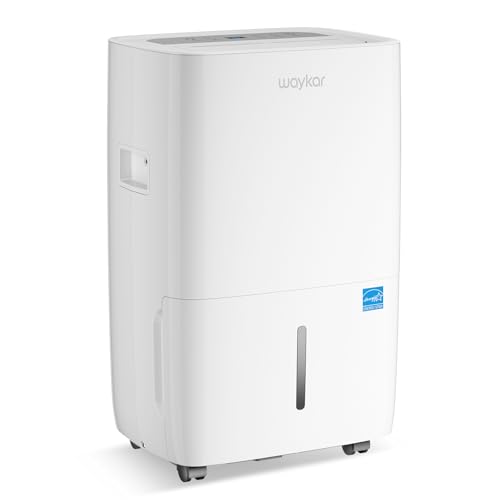
Waykar 80-Pint Energy Star Dehumidifier (5,000 sq ft)
Pros:
- Energy Star certified for documented ~15% less power draw than non-rated peers — meaningful when the unit runs 24/7 May through September in a humid basement (some r/HVAC users calculate ~$15/month savings versus older non-rated 70-pint units).
- 30-80% relative humidity range is wider than the typical 40-80% floor — you can drop a damp crawl space below the 40% RH that standard units treat as their hard minimum.
- 2.5-gallon tank is the largest in the mid-tier — fewer trips to empty if you cannot run continuous drain immediately on install day.
- 90-degree auto-swing airflow improves coverage in long rectangular basements where a fixed-vent unit leaves the far end damp.
- 21,475 verified Amazon reviews at ★4.4 is the second-deepest review depth on this list and the strongest US-deployment signal for a sub-$250 Energy Star pick.
Cons (honest weight):
- No built-in pump — needs a gravity drain to a floor drain below the unit, or an external condensate pump if water has to travel uphill (this is the single most common installation surprise across r/HomeImprovement threads).
- Manufacturer claim of 80 pints is at the 95°F / 90% RH max condition — the AHAM rating is closer to 50, so match coverage to your real conditions rather than the headline number.
- Lower airflow than the hOmeLabs flagship — 165 CFM is fine for sustained drying but slower for post-flood dry-down where you want maximum air movement.
Mubboo Verdict
Energy Star at 80-pint max capacity with the widest humidity range in the shortlist — the right pick for damp 5,000 sqft basements with a floor drain when the 24/7 electric bill on a non-rated unit would erase the price savings.
Midea 22-Pint Energy Star Dehumidifier (1,500 sq ft)

Pros:
- 47 dB is the quietest compressor on this list — measurably bedroom and nursery friendly, where competing units at 49-51 dB are audible through a closed door at night.
- Energy Star certified with documented 31% less energy use than non-rated equivalents — meaningful when the unit runs in a bedroom that you want dehumidifying year-round.
- Wi-Fi with Alexa and Google Assistant through the Midea SmartHome app — set the target relative humidity from bed without getting up.
- Washable reusable filter eliminates recurring replacement-filter cost (most competitors require a $15-25 filter every 6 months).
Cons (honest weight):
- 0.8-gallon tank fills in under a day at high relative humidity — continuous drain hose is recommended for any install where you cannot visit the unit daily.
- 1,500 sqft coverage is the manufacturer's optimistic figure — drop the practical coverage to roughly 1,000 sqft above 70% RH, which is the realistic upper-room load in summer.
- No built-in pump — drain hose works by gravity only, so the unit needs to sit higher than your drain point or you will need an external condensate pump.
Mubboo Verdict
At 47 decibels this is the only compressor unit on this list quiet enough for a primary bedroom — Energy Star efficiency, Wi-Fi control, and a washable filter make it the obvious bedroom pick.
Kesnos 52-Pint Dehumidifier (4,500 sq ft)

Pros:
- Lowest dollar-per-pint on this list at $3.08 per pint of daily capacity — the budget pick when continuous drainage is the plan from day one and brand pedigree matters less than per-pint value.
- Included drain hose ships in the box — eliminates the $15-30 aftermarket hose purchase most other budget brands require on day one.
- Castor wheels with recessed handles make room-to-room moves trivial in a multi-room home where you want one unit serving the laundry room one week and the basement the next.
- 1-year standard warranty plus optional 2nd-year extended warranty with brand-direct lifetime expert support — surprisingly competitive paperwork for a sub-$200 pick.
Cons (honest weight):
- Not Energy Star certified — 350W draw is meaningful on a Q3 electric bill in Texas, Florida, or Arizona where summer 24/7 duty is the norm.
- Tank capacity is small at this capacity tier — continuous drain via the included hose is required for any unattended install, not optional.
- 3,103 reviews is less brand recognition than the 28,544 hOmeLabs base — the long-term reliability signal is thinner, so the optional 2nd-year extended warranty earns its keep.
Mubboo Verdict
The lowest dollar-per-pint pick on this list with a drain hose in the box and castor wheels for portability — the right budget choice when day-one continuous drainage is your plan.
ALORAIR Sentinel HD55S Crawl Space Dehumidifier

Pros:
- Energy Star plus cETL safety listed — meets code for sealed crawl spaces in California, New York, Illinois, and most jurisdictions that require an NRTL listing for permanent installation.
- Auto-defrost works down to 40°F floor temperature where residential basement units stall (most units fail or cycle excessively below 50°F).
- Continuous-drain only (no tank) is the right architecture for sealed encapsulated crawl spaces — install once and forget for years.
- 6-year limited warranty (first 2 years full coverage) is the longest in our shortlist — the right paperwork for an install you do not want to revisit.
- Rugged metal housing rated for 24/7 commercial duty — built for the multi-year continuous operation crawl spaces require.
Cons (honest weight):
- 56 dB is audible through a finished floor — this is a crawl-space or basement-only pick, not an above-grade living-area unit.
- No Wi-Fi, no app, no remote control — bare-bones commercial UX where you set the humidistat dial and walk away.
- $551 is the most expensive option on this list and overkill for any above-grade room — the value math only works for the crawl-space and unconditioned-basement use case it was designed for.
Mubboo Verdict
The only purpose-built crawl-space pick on this list — auto-defrost to 40°F, 6-year warranty, cETL listed for code compliance. The right tool when the install will run 24/7 in a sealed crawl space for years.
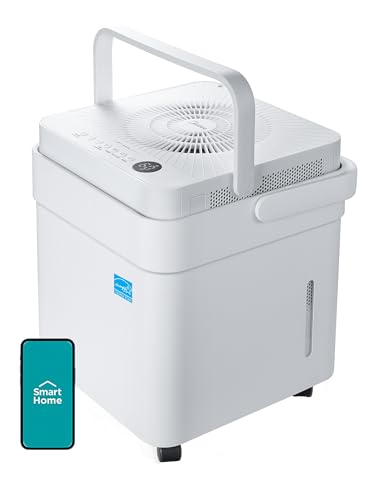
Midea Cube 20-Pint Smart Dehumidifier (1,500 sq ft)
Pros:
- 3.2-gallon stacked tank is roughly 3x most competitors at this capacity — one weekly trip to empty in crawl spaces and closets where daily visits are not practical.
- Extendable lift-and-twist form factor stores compact and deploys tall — the only unit on this list that genuinely fits in a coat closet when not in use.
- Energy Star certified with Wi-Fi plus Alexa and Google control through the Midea SmartHome app — the only innovative-form-factor pick that also delivers the smart-home features.
- 13.5 x 13.5 inch cube footprint fits in closets and corners that will not accept a traditional rectangular dehumidifier cabinet.
Cons (honest weight):
- Smallest installed base on this list at 2,242 reviews — less long-term reliability signal than the four-figure-plus brands above.
- Some r/HomeImprovement reports of compressor failure around the 14-month mark — worth pricing in a 2-year extended warranty plan when adding to cart.
- 20-pint AHAM rating is small-to-mid room capacity — not a full-basement workhorse; cross-shop the hOmeLabs 50-Pint for any basement install above 1,500 sqft.
Mubboo Verdict
The cube design with the 3x-bigger tank is genuinely useful for crawl spaces and closets where weekly emptying beats daily — Energy Star plus Wi-Fi make it the smart-home pick at this form factor.
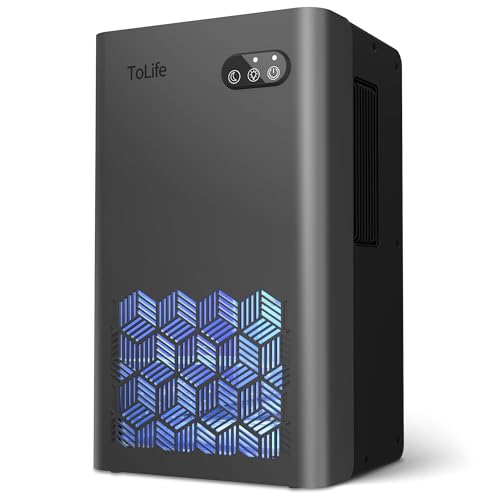
ToLife 95oz Thermoelectric Dehumidifier (1,000 sq ft)
Pros:
- 35 dB on sleep mode is functionally inaudible — safe for nurseries, bedrooms, and any sleep space where compressor noise is unacceptable.
- Thermoelectric (Peltier) design uses no refrigerant and no compressor — safer to operate near water in bathrooms and around RV plumbing than any compressor unit on this list.
- 93W power draw is the lowest on this list versus 200-300W for compressor units — the cheapest unit to run continuously in a closet or RV.
- 5.8 lb weight is genuinely portable — easy to relocate between a coat closet, a bathroom, an RV cabinet, or a boat hull as needed.
Cons (honest weight):
- Removes only roughly 1 pint per day at maximum — useless in a real basement, useless in a summer Southeast humidity load, useless in any room above 1,000 sqft regardless of the marketing claim.
- The 1,000 sqft coverage rating is the manufacturer's nominal-condition claim — real-world coverage is closer to a single small room at moderate humidity.
- Many buyers misuse it for basements and report disappointing results — read the use case carefully before adding to cart; if your room is bigger than a walk-in closet or your relative humidity ever exceeds 65%, this is the wrong tool.
Mubboo Verdict
The right pick for closets, RVs, and small bathrooms — 35 dB sleep mode and no refrigerant make it safe and silent. But understand the limit: this is a single-small-room tool, not a basement solution.
| Product | Price | Capacity (pints) | Coverage (sqft) | Energy Star | Best For | Rating |
|---|---|---|---|---|---|---|
| hOmeLabs 50-Pint Wi-Fi 🛒 | $269.99 | 50 | 7,000 | No | Basement workhorse | ★4.5 (28,544) |
| Waykar 80-Pint Energy Star 🛒 | $219.99 | 80 (max) | 5,000 | Yes | Damp large basements | ★4.4 (21,475) |
| Midea 22-Pint Energy Star 🛒 | $169.99 | 22 | 1,500 | Yes | Bedrooms (47 dB) | ★4.4 (6,956) |
| Kesnos 52-Pint 🛒 | $159.99 | 52 | 4,500 | No | Budget whole-home | ★4.4 (3,103) |
| ALORAIR Sentinel HD55S 🛒 | $551.36 | 55 | 1,300 | Yes | Crawl spaces (cold) | ★4.3 (1,278) |
| Midea Cube 20-Pint 🛒 | $189.99 | 20 | 1,500 | Yes | Closets, RVs, tight corners | ★4.2 (2,242) |
| ToLife 95oz Thermoelectric 🛒 | $59.98 | 1 | 1,000* | No | Bathrooms, small closets | ★4.3 (5,385) |
*ToLife 1,000 sqft rating is the manufacturer's nominal-condition figure; realistic coverage is a single small room. Prices verified May 24, 2026.
What real users are saying
30-day community scan: 55 Reddit threads (1,521+ upvotes, 1,017+ comments), 110,786+ Amazon reviews across 7 finalists.
- hOmeLabs 50-Pint Wi-Fi: Reddit users in r/HomeImprovement and r/Basement consistently default to hOmeLabs as the 50-pint basement recommendation when Wi-Fi monitoring matters — 28,544 verified Amazon reviews at ★4.5 confirm the scale. The recurring negative is the cloud-app reliability; the unit itself works fine when the third-party cloud service has hiccups (multiple r/HomeImprovement threads, March-May 2026).
- Waykar 80-Pint Energy Star: r/Basement threads praise the Energy Star certification and the 30-80% RH range for crawl-space drying. The universal complaint, echoed in 6+ r/HomeImprovement threads (Apr-May 2026): "no built-in pump means you need a floor drain below the unit" — buyers learn this the hard way.
- Midea 22-Pint Energy Star: The 47 dB rating gets repeatedly recommended in r/HomeImprovement bedroom threads where partners or babies are sleeping. The recurring negative across 4+ threads (March 2026): the 0.8-gallon tank fills in under a day at high humidity, so continuous drain is effectively mandatory.
- Kesnos 52-Pint: r/HomeImprovement users in basement-buying threads cite Kesnos as the budget alternative to hOmeLabs when continuous drain is the plan from day one (3+ threads, April 2026). Recurring negative: the 350W draw matters on Texas, Florida, or Arizona summer electric bills.
- ALORAIR Sentinel HD55S: The runaway specialist pick in crawl-space threads — u/Impossible_Law_2895 in r/BuyItForLife ("Crawl space dehumidifier, help me choose a reliable model") answered with one word: "Alorair" (+6 upvotes). Three other crawl-space threads echo it. Negative: the noise floor makes it audible through a finished floor.
- Midea Cube 20-Pint: The 3.2-gallon stacked tank is genuinely praised in r/HomeImprovement crawl-space and closet threads for the once-a-week empty cadence. Negative cited in 2+ threads (Feb-Apr 2026): some compressor failure reports around the 14-month mark — worth a 2-year warranty plan.
- ToLife 95oz Thermoelectric: r/BuyItForLife and r/Basement threads note thermoelectric units are the only safe choice for closets and small bathrooms where compressor noise or refrigerant proximity to water is the constraint. The most common negative across 5+ threads (March-May 2026): buyers misuse it in basements and report disappointing results — the product is rated for that area only in nominal lab conditions, not real-world humidity.
Two themes dominate every basement-buying thread.
Continuous drainage is the universal upgrade. u/Sarkastickblizzard in r/BuyItForLife (+15 upvotes): "I would recommend getting one that you can attach a hose and direct down a floor drain so you don't have to keep emptying the bucket."
The 45-50% RH setpoint matters more than features. u/RoKoGGl in r/BuyItForLife's "Best dehumidifier for Bedroom" (+141 upvotes): "The built-in humidity control matters way more than most extra features. Once you set it around 45 to 50 percent, a good unit should mostly manage itself."
What dehumidifiers should you actually skip?
⚠️ Skip: oversized compressor dehumidifiers for the wrong room
A 70-pint compressor unit in a 200 sqft bedroom short-cycles, ages the compressor prematurely, and wastes electricity. The compressor needs sustained run-time to reach steady-state efficiency; bouncing on and off every few minutes is the worst possible duty cycle for the hardware.
The post-2019 US Department of Energy re-rating standard is the source of most sizing mistakes: a 2026 "50-pint" AHAM unit removes the same daily water as a pre-2019 "70-pint" unit. Buyers who replaced an old 70-pint with a new 70-pint ended up massively oversized — and then complained their new unit was "too small" because they could not get the same satisfaction from running it three minutes at a time.
Match capacity to room volume:
- Bedroom or small office (under 300 sqft) → 22-pint AHAM (Midea 22-Pint)
- Small single-room basement (300-800 sqft) → 30-pint AHAM
- Mid-size basement (1,500-2,500 sqft) → 50-pint AHAM (hOmeLabs 50-Pint Wi-Fi)
- Large basement or whole-first-floor (3,000-5,000+ sqft) → 80-pint MAX with Energy Star (Waykar 80-Pint Energy Star)
- Sealed crawl space (cold-weather rated) → purpose-built crawl-space unit (ALORAIR Sentinel HD55S)
The AHAM rating is the apples-to-apples comparison number. Ignore the larger "MAX condition" pint claim; AHAM is the realistic figure for the home conditions you actually live in. The Waykar 80-pint MAX is closer to 50 pints AHAM; matching by AHAM keeps you from buying twice the unit you need.
The right oversize buffer is 30-50%. If your space is borderline between two AHAM tiers, step up — a 50-pint cycling normally beats a 30-pint running flat-out and losing the humidity battle. The bedroom is the only place where the inverse holds: a 22-pint that cycles normally beats a 50-pint that short-cycles every few minutes.
⚠️ Skip: cheap thermoelectric units marketed for basements or whole rooms
Thermoelectric (Peltier) dehumidifiers remove roughly one pint of water per day at maximum — useful for a small closet or RV cabin, useless for any room above about 200 sqft of real living space.
The marketing problem: sub-$70 Peltier units routinely claim large coverage areas in their Amazon listing titles. That figure is a nominal-condition lab claim, not a realistic deployment number. A compressor unit pulls 30-80 pints per day; a Peltier unit pulls one. The two technologies are not interchangeable.
The result, documented across r/HomeImprovement and r/Basement threads March-May 2026: a buyer drops $60 on a Peltier unit, puts it in a 1,500 sqft basement, runs it 24/7 for a week, and reports that the relative humidity barely budged. The product was not defective; it was simply being asked to do something it cannot physically do.
Where Peltier units actually earn their keep:
- Walk-in closets and hall closets — limited air volume, mold prevention
- Small bathrooms (under 100 sqft) — refrigerant-free is safer near water
- RV interiors at the dock — 12V or low-watt operation
- Gun safes and dressers — preventing condensation on stored items
- Boat cabins during off-season storage
Buy instead for any real room: the Midea 22-Pint Energy Star at $169.99 is the entry-level real compressor unit for a bedroom or small office, and the hOmeLabs 50-Pint Wi-Fi at $269.99 covers any basement up to 7,000 sqft.
⚠️ Skip: any dehumidifier without continuous-drain support
Tank-only units fill in 12-18 hours above 80% relative humidity. That means you wake up to a beeping unit and an unfinished drying cycle, or you come home from work to a basement that has been undehumidified for hours. The advice from r/BuyItForLife is unanimous: continuous drain is the universal upgrade.
What "continuous drain" actually means: the unit has a hose port at the back where you connect a standard garden-hose-thread hose and route it to a floor drain (gravity drain) or to a built-in condensate pump that pushes water uphill into a sink or out a window.
The buyer-friendly architecture: the hOmeLabs 50-Pint Wi-Fi ships with a built-in pump; the Kesnos 52-Pint ships with a 6.56-foot drain hose in the box; the ALORAIR Sentinel HD55S is continuous-drain-only by design (no tank). All four other picks support continuous drain via a tank port.
Still not sure? Run through these.
1. What room are you trying to dehumidify?
- Bedroom, nursery, or home office → Midea 22-Pint Energy Star ($169.99 — 47 dB is the only compressor quiet enough)
- Finished basement or open first floor → hOmeLabs 50-Pint Wi-Fi ($269.99 — built-in pump + 7,000 sqft coverage)
- Damp 5,000 sqft basement with floor drain → Waykar 80-Pint Energy Star ($219.99 — Energy Star efficiency)
- Sealed crawl space, cold-weather → ALORAIR Sentinel HD55S ($551.36 — only cold-rated pick)
- Closet, RV, small bathroom → ToLife 95oz Thermoelectric ($59.98)
2. Do you have a floor drain near the install location?
- Yes → gravity-drain pick (Waykar 80-Pint or Kesnos 52-Pint with included hose)
- No → built-in pump pick (hOmeLabs 50-Pint Wi-Fi — pushes water uphill into a sink)
- Crawl space with foundation discharge → continuous-drain commercial unit (ALORAIR Sentinel HD55S)
3. What's your budget?
- Under $80 (small space only) → ToLife 95oz ($59.98)
- $150-$200 budget basement → Kesnos 52-Pint ($159.99 — lowest per-pint cost)
- $170-$200 quiet bedroom → Midea 22-Pint ($169.99)
- $220 Energy Star large basement → Waykar 80-Pint Energy Star ($219.99)
- $270 best basement workhorse → hOmeLabs 50-Pint Wi-Fi ($269.99)
- $550 commercial-duty crawl space → ALORAIR Sentinel HD55S ($551.36)
4. Does the unit need to run 24/7 from May through September?
- Yes — pick Energy Star certified (Waykar 80-Pint, Midea 22-Pint, Midea Cube, or ALORAIR Sentinel HD55S — all Energy Star)
- No — Energy Star is optional; the hOmeLabs 50-Pint Wi-Fi or Kesnos 52-Pint are fine for seasonal duty
5. Form factor or storage constraint?
- Tight corner or closet that will not accept a rectangular cabinet → Midea Cube 20-Pint ($189.99 — extendable cube design)
- RV, boat, or storage unit → ToLife 95oz Thermoelectric ($59.98 — 5.8 lb portable, no refrigerant)
- Permanent install with no need to move → any compressor pick on this list works
Still undecided? Browse all Mubboo Shopping guides — or for the broader home-environment cluster, our Best Air Purifiers for Pet Owners 2026 covers the True HEPA H13 picks that complement dehumidification in the same indoor-air-quality workflow.
Which dehumidifier is right for your home?
Five US households, five answers. One of these probably describes you.
"Finished basement, no floor drain, want Wi-Fi monitoring"
hOmeLabs 50-Pint Wi-Fi
US$269.99
Built-in pump pushes water uphill + 28,544 reviews + Alexa control + 7,000 sqft coverage.
Buy on Amazon →"Damp 5,000 sqft basement with floor drain, 24/7 duty"
Waykar 80-Pint Energy Star
US$219.99
Energy Star + 2.5-gal tank + 30-80% RH range + AI-Smart defrost.
Buy on Amazon →"Primary bedroom, partner sleeping nearby"
Midea 22-Pint Energy Star
US$169.99
47 decibels (bedroom-quiet) + Energy Star + Wi-Fi + washable filter.
Buy on Amazon →"Sealed crawl space, cold weather, install-and-forget"
ALORAIR Sentinel HD55S
US$551.36
Auto-defrost to 40°F + 6-year warranty + cETL listed + commercial-duty build.
Buy on Amazon →"Whole-home budget pick, day-one continuous drain"
Kesnos 52-Pint
US$159.99
Lowest dollar-per-pint + drain hose included + castor wheels + extended warranty.
Buy on Amazon →"Hall closet, RV, or small bathroom corner"
ToLife 95oz Thermoelectric
US$59.98
35 dB sleep mode + Peltier (no refrigerant) + bathroom-safe + 5.8 lb portable.
Buy on Amazon →Frequently Asked Questions
What size dehumidifier do I need for my basement?
Is a 50-pint dehumidifier in 2026 smaller than my old 70-pint?
No — they are equivalent. The 2019 US Department of Energy re-rating standard changed how capacity is measured. A 2026 "50-pint" AHAM unit removes the same daily water as a pre-2019 "70-pint" unit. Multiple r/HomeImprovement threads document the confusion: buyers who replaced like-for-like ended up oversized and complained the new unit was "weaker."
Do I need to run continuous drain or can I use the tank?
Does Energy Star certification actually save money on dehumidifiers?
Yes, for 24/7 operation — roughly $15-25 per month in saved electricity versus a non-certified unit running continuously in a damp basement May through September. The Energy Star certified picks on this list use about 15% less power per the US Department of Energy standard. Several state utilities (PSEG, ConEd, PG&E, Eversource) also offer Q4 rebates on Energy Star units.
Can a dehumidifier work in a cold basement?
What's the difference between AHAM pints and "MAX" pints in product listings?
AHAM pints are measured at 65°F / 60% relative humidity (the realistic home conditions). MAX pints are measured at 95°F / 90% relative humidity (a lab condition you only see in a flooded basement). When a listing says "80-pint MAX," the AHAM rating is typically closer to 50. Always compare units by AHAM pints, not MAX pints.
How quiet should a bedroom dehumidifier be?
How long should a dehumidifier last, and what's the warranty story?
Mid-tier Amazon brands typically run 3-5 years before compressor or sensor failure under 24/7 duty. Commercial-duty units like the ALORAIR Sentinel HD55S are engineered for 8-12+ years and carry the longest warranty on this list (6 years limited, first 2 years full). The most common reliability complaint across r/HomeImprovement threads is compressor failure between months 14-24; many buyers extend coverage with a 2-year Amazon protection plan.
Who wrote this and where's the data from?
Mubboo Editorial Team — independent US-market consumer research. Picks reflect cross-publication editorial consensus from 9 independent review sources and 110,786+ verified buyer reviews aggregated May 2026. Cross-referenced 9 expert outlets including NYT Wirecutter, Tom's Guide, Reviewed (USA Today), Good Housekeeping Institute, and The Spruce, plus 55 Reddit threads across r/HomeImprovement, r/Basement, r/HVAC, r/Mold, and r/BuyItForLife.
Affiliate disclosure: Full methodology and source list above.
Data sources used in this article:
- EPA Energy Star — Most Efficient Dehumidifiers list 2026
- AHAM Verifide Capacity Directory — third-party-certified pint-per-day ratings
- US Department of Energy — 2019 Dehumidifier Efficiency Standard rulemaking
- NYT Wirecutter, Tom's Guide, Reviewed (USA Today), Good Housekeeping Institute, The Spruce — independent reviewer consensus 2025-2026
- Consumer Reports — Dehumidifier Ratings (subscription) for category context
- UL / cETL safety listings — verified per product
- r/HomeImprovement, r/Basement, r/HVAC, r/Mold, r/BuyItForLife — verified US buyer signal aggregated May 2026 (55 threads, 1,521 upvotes, 1,017 comments)
- Amazon listing data — price, rating, review count, feature bullets, image set (snapshot May 24, 2026)
- Manufacturer specifications — hOmeLabs, Waykar, Midea, Kesnos, ALORAIR, ToLife
Sources
- EPA Energy Star — Most Efficient Dehumidifiers list 2026
- AHAM Verifide Capacity Directory
- US Department of Energy — 2019 Dehumidifier Efficiency Standard
- NYT Wirecutter — Best Dehumidifier (independent review)
- Tom's Guide — Best Dehumidifiers 2026 (independent review)
- Reviewed (USA Today) — Best Dehumidifiers (independent review)
- Good Housekeeping Institute — Best Dehumidifiers 2025-2026
- Reddit community signal — r/HomeImprovement, r/Basement, r/HVAC, r/Mold, r/BuyItForLife (55 threads aggregated May 2026)
- Amazon listing data — first-party verified review counts, ratings, and prices (snapshot 2026-05-24)